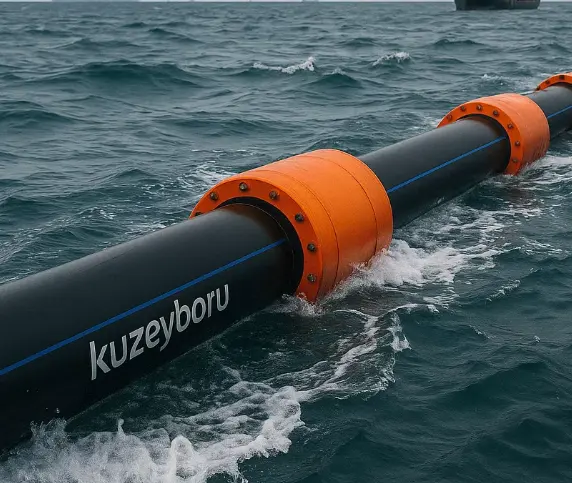
Marine outfall and underwater pipeline projects are demanding applications where high hydrodynamic forces and aggressive chemical conditions coexist. High-Density Polyethylene (HDPE) has become the fundamental engineering material delivering optimum performance in marine ecosystems, thanks to its thermoplastic properties and superior mechanical strength.
Corrosive Effects of Saline Water on Industrial Pipes
Seawater is a highly corrosive electrolyte due to its high concentration of sodium chloride (NaCl), sulfates, and other dissolved salts. When traditional metallic piping systems (such as steel or ductile iron) come into contact with seawater, they undergo electrochemical corrosion. Chloride ions penetrate the passive protective layer on the metal surface, causing localized pitting corrosion and galvanic degradation. These electrochemical reactions cause localized reductions in wall thickness, dramatically lowering the pipe's structural yield strength against environmental stresses.
Polymeric Structure and Corrosion Resistance of HDPE Pipes
The primary reason HDPE is preferred in marine outfall projects is its stability at the molecular level. Polyethylene, a semi-crystalline thermoplastic, consists of carbon-carbon (C-C) and carbon-hydrogen (C-H) covalent bonds. This non-polar structure prevents the material from reacting with water and ionic solutions.
Because HDPE is an electrical insulator, there is no free electron flow within the system, making galvanic cell formation impossible. This gives HDPE a decisive advantage over metals regarding corrosion resistance. Furthermore, the high molecular weight of the polymer chains maximizes environmental stress cracking resistance (ESCR), providing long-term structural protection against seabed pressure and ground movements.
Sinking and Installation Engineering of HDPE Pipes
Since the density of HDPE pipes (approx. 0.94–0.96 g/cm³) is lower than that of seawater (approx. 1.025 g/cm³), the pipes have natural buoyancy. The sinking operation is carried out through controlled water intake into the pipe and the placement of concrete ballast weights (sinkers) along the outer surface. The net sinking force acting on the pipeline is calculated according to Archimedes' principle. During installation, the permissible elastic bending radius of the pipe depends on the material's modulus of elasticity and yield strength. By utilizing Finite Element Analysis (FEA) modeling, engineers ensure that maximum bending moments generated during sinking do not exceed critical limits. The flexible nature of HDPE prevents permanent deformation throughout these operations.
Kuzeyboru Marine Outfall Reference Projects
Kuzeyboru reflects its R&D-driven manufacturing approach in the field through flagship reference projects in marine outfall lines and underwater transmission systems. Engineered in light of structural simulations against dynamic external factors—such as high wave loads, ocean currents, and soil liquefaction—HDPE pipes deliver long-lasting and reliable solutions backed by Kuzeyboru's deep engineering expertise.
Biodiversity for a Sustainable Marine Ecosystem
When integrating engineering projects into oceanographic environments, environmental impact assessment is just as vital as mechanical performance. HDPE is chemically inert; it does not react with or dissolve in seawater, nor does it leach heavy metals or toxic monomers into the marine ecosystem.
With high resistance to biofouling and a fully recyclable structure, HDPE pipes preserve water quality in marine outfall systems and aquaculture fish farms, directly contributing to marine biodiversity and ecosystem sustainability.