

Blog
What is HDPE 100 Pipe? Most Frequently Asked Questions and Answers
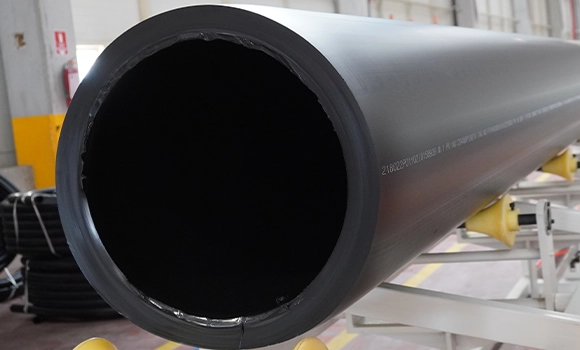
What is HDPE 100 Pipe? Most Frequently Asked Questions and Answers
In modern infrastructure projects requiring pressurized fluid transfer, the pinnacle of engineering achieved by thermoplastic materials is represented by Polyethylene 100 (PE 100) class pipes. The leak-proof conveyance of water, gas, or industrial chemicals under high pressure in underground networks for decades is directly related to the molecular resistance of the material. The frequently encountered industry question regarding what PE100 pipe is does not merely define a raw material nomenclature; it also refers to the bimodal macromolecular structure architecture achieved through thermoplastic extrusion.
1. High-Density Polyethylene (HDPE) Material Technology
HDPE (High-Density Polyethylene) is a thermoplastic with a very low branching ratio and a high degree of crystallinity, obtained through the polymerization of ethylene monomers in the presence of catalysts. The close and orderly packing of polymer chains increases the density of the material (typically ≥0.94 g/cm³) while maximizing intermolecular attractive forces (Van der Waals forces).
Particularly, original PE 100 grade raw materials are produced via a high-technology bimodal (dual molecular weight distribution) polymerization process. While short polymer chains in this structure facilitate processability (melt flow) in the extrusion machine, very long polymer chains elevate the mechanical strength, long-term hydrostatic durability, and Slow Crack Growth (SCG) resistance of the pipe to extraordinary levels.
2. Pressure and Strength Differences Between HDPE 100 and HDPE 80
The numbers 80 and 100 in the PE classification represent the Minimum Required Strength (MRS) value of the material. This value expresses the minimum hoop stress that the pipe can withstand at a temperature of 20°C and at the end of a 50-year continuous operating life.
The hydrostatic internal pressure (P) inside a pipe creates a stress (σ) in the pipe wall. This stress is calculated using the Barlow Formula:
σ = [P × (D – t)] / (2 × t)
Here, D indicates the outer diameter, and t indicates the wall thickness.
- HDPE 80 (PE80): The MRS value is 8.0 MPa.
- HDPE 100 (PE100): The MRS value is 10.0 MPa.
A 25% increase in molecular strength creates a massive advantage in engineering economics: For the same operating pressure (e.g., PN10) and the same outer diameter, HDPE 100 pipes can be manufactured with a much thinner wall thickness. A thinner wall thickness widens the internal hydraulic cross-sectional area of the pipe, increases fluid flow rate, and minimizes logistics costs (OPEX) by reducing the unit meter weight of the pipe.
3. HDPE 100 Utilization Standards in Drinking Water Networks
The transport of potable water in municipal networks requires material chemistry that is flawless from toxicological and organoleptic (taste/odor) perspectives. HDPE 100 pipes possess a completely apolar and chemically inert structure that does not react with disinfectants such as chlorine (Cl).
The fact that internal wall smoothness is very close to an absolute value (hydraulic roughness k ≈ 0.007 mm) hydrodynamically makes it impossible for microorganisms to adhere and form a biofilm layer inside the pipe. Complying with food-grade standards and international hygiene certifications, HDPE 100 systems transport water purity from the source to the point of consumption without corrosion or heavy metal ion release. Kuzeyboru PE Pipe Systems are manufactured from polyethylene raw material in compliance with TS EN 12201-1 and TS EN 12201-2 standards.
Frequently Asked Questions (FAQ)
- What is the maximum operating pressure of HDPE 100 pipes?
Depending on the pipe outer diameter and designed wall thickness (SDR) ratio, they are manufactured in the range of PN4 (4 bar) to PN25 (25 bar) in standard production, and can reach up to PN32 levels in special cases. - What advantages does the elasticity coefficient of HDPE 100 pipes provide to projects?
The viscoelastic flexibility capability resulting from the low modulus of elasticity enables the pipe to absorb seismic tremors, ground settlements, and water hammer (hydraulic shock) impacts caused by pumps without breaking. - Do HDPE 100 pipes have an odorless property in drinking water?
Since it is a completely apolar polymer closed to chemical reactions (inert), it definitely does not impart microplastics, taste, or odor to water, making it 100% toxicologically safe. - Which welding methods are used in HDPE 100 pipe installation?
Depending on the diameter, wall thickness, and site conditions of the installation, Butt Fusion or Electrofusion (EF) methods are used, which enable polymer chains to bond at the molecular level. Additionally, assembly operations can be performed on-site using coupling adapter joining, flanged joining, dredging flanged joining methods, and with the help of some special fittings (such as Fabricated Fittings). - In which colors and stripes are Kuzeyboru HDPE 100 pipes produced?
In order to identify the fluid dispatched at Kuzeyboru facilities according to international standards; drinking water lines are extruded with blue stripes on black (or entirely blue), while gas lines are extruded with yellow stripes on black. Custom stripe colors can also be applied upon customer request.
Related News

Deputy Director General of DSI Mehmet Ekinci and Accompanying Delegation Inspected Our Facility
DSI Deputy Director General Mr. Mehmet Ekinci, Head of Irrigation Department Mr.
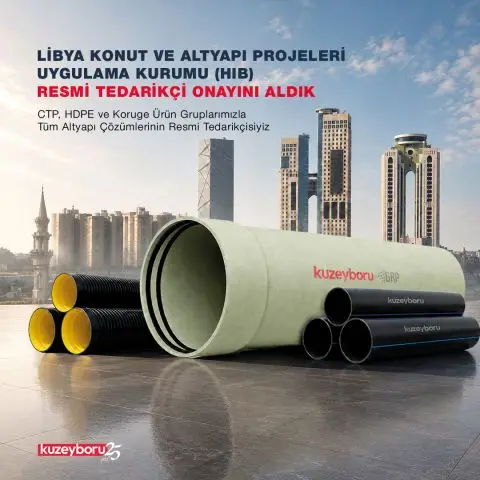
Official Approval from Libya for Kuzeyboru’s High Engineering Quality
Kuzeyboru Received Official Supplier Approval from the Housing and Infrastructure Board (HIB) of

We Won the Kralkızı-Dicle GRP Tender
Giant Contribution to Agricultural Development from Kuzeyboru: 205 Million TL Kralkızı-Dicle Tender
Related Articles

2020 Goal Meeting Held in Kyiv
Kuzeyboru held its first camp of the year in Ukraine between January 28 – February 2. During the…

Completion of Our 2025-2028 Strategic Planning Workshop
We have completed a two-day strategic planning workshop with the participation of our board members and internal stakeholders.…

Kuzeyboru Came Together with the Engineers of the Future at Balıkesir University
Kuzeyboru Came Together with the Engineers of the Future at Balıkesir University