What Is an HDPE 100 Pipe? Frequently Asked Questions and Answers
In modern infrastructure projects that require the transfer of pressurized fluids, Polyethylene 100 (PE100) pipes represent one of the most advanced engineering solutions developed using thermoplastic materials. The leak-tight transportation of water, gas, and industrial chemicals through underground networks under high pressure for decades is directly related to the molecular strength of the material. The frequently asked question, "What is a PE100 pipe?" refers not only to a specific raw material classification but also to the bimodal macromolecular structure achieved through advanced thermoplastic polymerization and extrusion technology.
1. High-Density Polyethylene (HDPE) Material Technology
HDPE (High-Density Polyethylene) is a thermoplastic material produced through the polymerization of ethylene monomers in the presence of catalysts. It is characterized by a very low degree of molecular branching and a high level of crystallinity. The close and orderly arrangement of polymer chains increases the material's density, generally to ≥ 0.94 g/cm3, while maximizing intermolecular attractive forces, also known as Van der Waals forces.
In particular, virgin PE100 raw materials are manufactured using advanced bimodal polymerization technology, which produces a dual molecular weight distribution. Within this structure, shorter polymer chains improve the material's processability and melt flow characteristics during extrusion, while exceptionally long polymer chains significantly enhance the pipe's mechanical strength, long-term hydrostatic resistance, and resistance to Slow Crack Growth (SCG).
2. Pressure and Strength Differences Between HDPE 100 and HDPE 80
The numbers 80 and 100 in polyethylene classifications represent the material's Minimum Required Strength (MRS). This value indicates the minimum hoop stress that the material is expected to withstand at a temperature of 20°C over a continuous service life of 50 years.
The internal hydrostatic pressure (P) inside a pipe generates stress (σ) within the pipe wall. This stress is calculated using Barlow's equation:
σ = P × (D - t) / (2 × t)
In this equation, P represents the internal pressure, D represents the outside diameter of the pipe, and t represents the pipe wall thickness.
- HDPE 80 (PE80): Minimum Required Strength (MRS) of 8.0 MPa.
- HDPE 100 (PE100): Minimum Required Strength (MRS) of 10.0 MPa.
This 25% increase in molecular strength provides a significant advantage in engineering economics. For the same operating pressure, such as PN10, and the same outside diameter, HDPE 100 pipes can be manufactured with considerably thinner walls than HDPE 80 pipes. Reduced wall thickness increases the internal hydraulic cross-sectional area of the pipe, allowing a higher fluid flow rate. It also reduces the weight per meter of pipe, helping minimize transportation and logistics costs (OPEX).
3. Standards for Using HDPE 100 Pipes in Drinking Water Networks
Transporting drinking water through municipal distribution networks requires materials that meet strict toxicological and organoleptic requirements, including those relating to taste and odor. HDPE 100 pipes have a nonpolar and chemically inert polymer structure, which provides resistance to chemical reactions with disinfectants such as chlorine (Cl).
The exceptionally smooth inner surface of HDPE 100 pipes, with a hydraulic roughness value of approximately k ≈ 0.007 mm, minimizes flow resistance and is described as preventing microorganisms from adhering to the pipe wall and forming biofilm layers. HDPE 100 piping systems that meet food-contact requirements and hold relevant international hygiene certifications are designed to transport water from its source to the point of consumption without corrosion or the release of heavy metal ions.
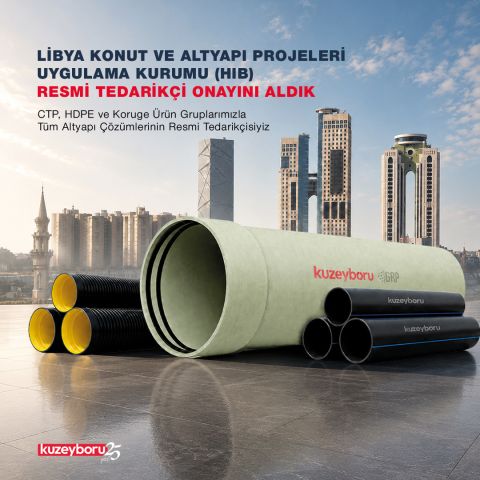
Kuzeyboru PE Pipe Systems are manufactured from polyethylene raw materials in accordance with TS EN 12201-1 and TS EN 12201-2 standards.
Frequently Asked Questions (FAQ)
What Is the Maximum Operating Pressure of HDPE 100 Pipes?
Depending on the outside diameter of the pipe and the specified Standard Dimension Ratio (SDR), which determines the relationship between the outside diameter and wall thickness, HDPE 100 pipes are manufactured in standard pressure classes ranging from PN4 (4 bar) to PN25 (25 bar). For special applications, pressure classes of up to PN32 can also be achieved.
What Advantages Does the Flexibility of HDPE 100 Pipes Provide for Infrastructure Projects?
The viscoelastic flexibility of HDPE 100 pipes, resulting from their relatively low modulus of elasticity, enables them to absorb seismic vibrations, ground settlement, and pressure surges caused by pumping operations, commonly known as water hammer or hydraulic shock. This flexibility allows the pipes to accommodate these dynamic forces without brittle fracture, providing important engineering advantages for infrastructure projects.
Do HDPE 100 Pipes Prevent Taste and Odor Changes in Drinking Water?
HDPE 100 is a nonpolar and chemically inert polymer material. According to the material characteristics described, HDPE 100 pipes do not release microplastics or impart taste or odor to drinking water and are considered completely safe from a toxicological perspective.
Which Welding and Joining Methods Are Used During HDPE 100 Pipe Installation?
Depending on the pipeline diameter, wall thickness, and construction site conditions, HDPE 100 pipes are commonly joined using Butt Fusion Welding or Electrofusion (EF) Welding. These methods allow polymer chains to bond at the molecular level, creating integrated pipe connections.
In addition to welding, HDPE 100 pipes can be installed using coupling adapters, flanged connections, and dredging flange connections. Specialized fittings, including fabricated fittings, can also be used to meet specific installation requirements in the field.
In Which Colors and Stripe Configurations Are Kuzeyboru HDPE 100 Pipes Manufactured?
At Kuzeyboru's manufacturing facilities, HDPE 100 pipes are produced in different colors and stripe configurations to identify the transported fluid in accordance with international industry practices. Pipes intended for drinking water applications are manufactured in black with blue stripes or entirely in blue, while pipes designed for gas distribution networks are produced in black with yellow stripes.
Customized stripe colors can also be applied according to specific customer requirements.