Fundamental Differences Between Steel-Reinforced Corrugated Pipes and Standard Corrugated Pipes
Differences Between Steel-Reinforced and Standard Corrugated Pipes
The fundamental difference between the two pipe types lies in which material provides the moment of inertia (I) and the modulus of elasticity (E) that ensure the system's Ring Stiffness (SN). In standard corrugated pipes, the load-bearing capacity relies entirely on the rib geometry of the High-Density Polyethylene's (HDPE) outer wall and the polymer's wall thickness. Steel-reinforced corrugated systems, however, transcend the physical limits of the polymer through the integration of steel, establishing a flawless thermomechanical balance between material consumption and mechanical strength.
What is Steel-Reinforced Corrugated Pipe?
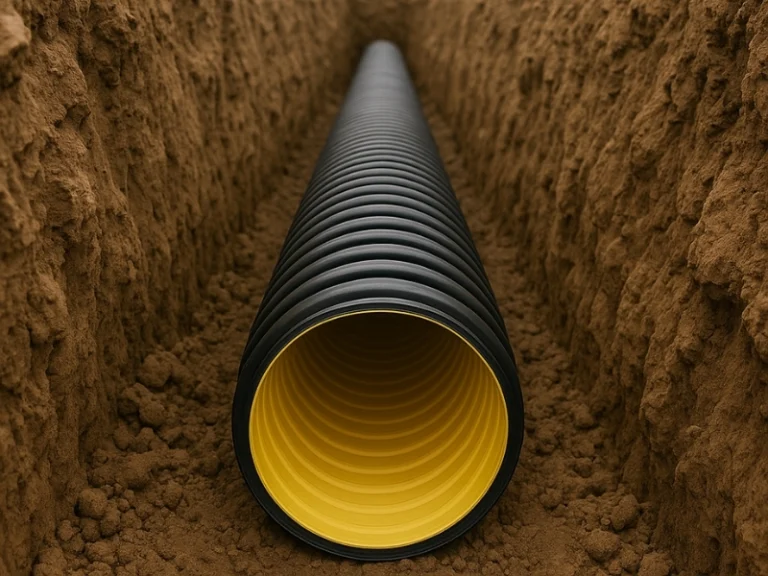
Steel-Reinforced Corrugated Pipe (SRCP) is an advanced composite structure where the superior chemical resistance of polyethylene and the immense mechanical strength of steel are combined in a single body. During the production extrusion process, high-strength and specially formed bent steel profiles (ribs) are completely encapsulated within the polyethylene matrix.
The modulus of elasticity of steel (≈200 GPa) is approximately 200 times higher than that of HDPE. The Ring Stiffness (SN) formula, which determines the pipe's resistance to radial loads without compromising its flexibility, is as follows:
Here, represents the equivalent modulus of elasticity of the composite structure, represents the unit moment of inertia of the pipe wall, and represents the mean diameter. The steel profile integrated into the system dramatically increases the product (Bending Stiffness), enabling the pipe to achieve immense structural stiffness without increasing the total polymer weight. Since the steel profile is completely isolated by the polymer and never comes into contact with groundwater or corrosive fluids, the corrosion risk is zero.
Applications of Standard Corrugated Pipes
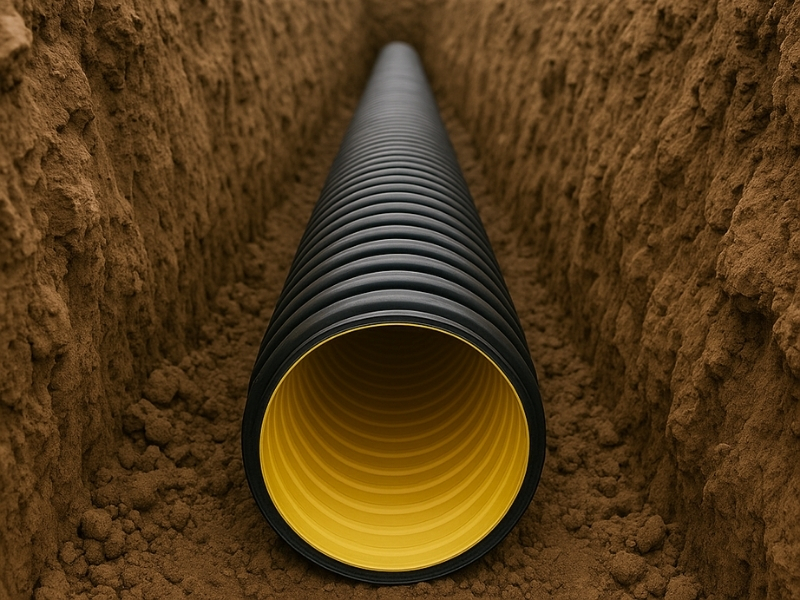
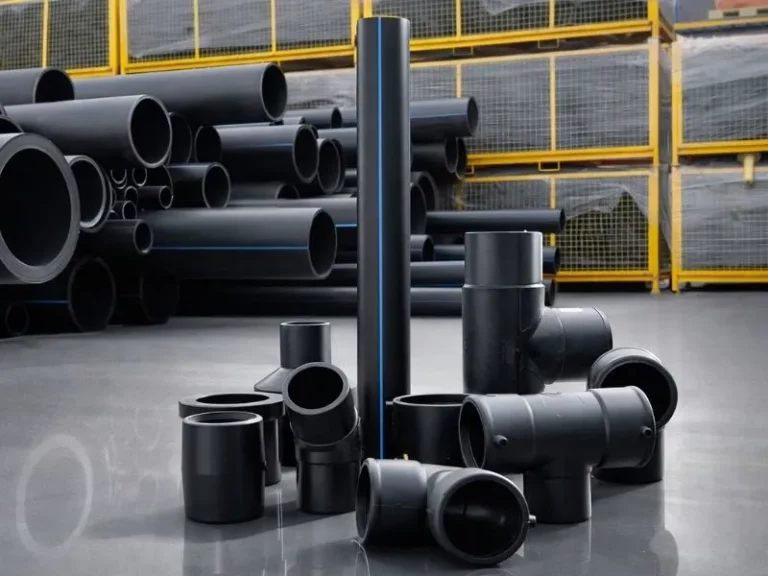
Standard (fully HDPE) double-wall corrugated pipes are indisputably the most rational and economical solution for urban infrastructure networks ranging from DN 100 mm to DN 1000 mm. Thanks to their low weight, absolute inertness against chemical corrosion, and the practical installation advantages of socketed and gasketed joints, they are indispensable in municipal sewage and stormwater lines.
Within these diameter ranges, the SN4 or SN8 stiffness classes typically required by the system can easily be achieved solely through the profile geometry of the HDPE itself. Due to their flexible structure, standard corrugated pipes can absorb soil settlements and seismic vibrations without cracking. However, they reach their structural limits in deep trench projects where higher flow rates, and consequently larger diameters, are required.
Comparison of Soil Load-Bearing Capacities
The engineering criterion in flexible pipe design is the amount of vertical deflection the material will exhibit under the overlying soil and traffic loads. The deflection of a pipe in a buried state (ΔY) is calculated using the Modified Spangler (Iowa) equation:
: Amount of vertical deflection : Total load acting on the pipe (Dead soil load + Dynamic traffic load) : Structural stiffness resistance of the pipe : Modulus of soil reaction (Compaction resistance of the trench backfill)
Standard corrugated pipes are strongly dependent on the right side of the denominator in the equation (—soil reaction); meaning they require a well-compacted trench backfill. In steel-reinforced corrugated pipes, however, the (pipe stiffness) multiplier on the left side is so high that the pipe gains a structural independence capable of compensating even for potential weaknesses in soil compaction quality. This characteristic eliminates the risk of buckling for steel-reinforced corrugated pipes under heavy static loads, such as under-highway crossings and excessively deep trenches.
Solutions in the 800 mm - 2400 mm Diameter Range
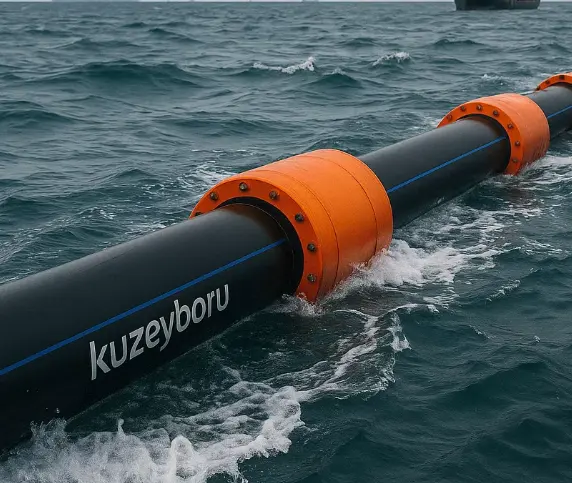
Large-scale hydroelectric power plants, deep marine outfall systems, and main wastewater collector lines of metropolitan cities host massive volumetric flow rates (Q). According to the continuity equation (Q), in order to maintain the water velocity within specific limits, the flow cross-sectional area ( ) and, consequently, the pipe diameter must be very large.
In the diameter scale ranging from 800 mm to 2400 mm, the mechanical limits of standard thermoplastic extrusion end, and composite engineering begins. Because at these massive diameters, due to the limited modulus of elasticity of HDPE (≈ 1 GPa), rib thicknesses must be exponentially increased to achieve the targeted high ring stiffnesses. This situation not only negatively affects the cooling times in the production process but also drives costs to unoptimizable proportions. This is exactly where steel-reinforced corrugated systems come into play, establishing a sustainable balance between material consumption and strength. Thanks to the high modulus support of steel, SN8, SN10, SN16, and even higher stiffness classes for custom projects can easily be achieved, even at massive diameters (2400 mm).
Strength Verification in Accredited Laboratories
It is inconceivable for theoretical calculations and solutions to be deployed to the field without being simulated under accredited laboratory conditions. The developed steel-reinforced corrugated pipes are tested according to EN ISO standards (e.g., EN ISO 9969 Ring Stiffness).
In our laboratories, the pipes are subjected to radial pressure under hydraulic presses. The phenomenon of delamination (the separation of steel and polymer), which constitutes the greatest risk in composite structures, has been completely eliminated thanks to the advanced adhesion technologies applied. These meticulously conducted tests serve as the ultimate and scientific proof that throughout the design life of massive infrastructure networks exceeding 50 years, steel and polyethylene will operate as a single monolithic body, demonstrating unyielding resistance to the destructive stresses of the underground.