In modern communication systems, the structural integrity of fiber optic networks, which are the fundamental data transmission elements, is one of the most critical engineering stages in infrastructure projects. Ensuring that these lines operate stably for many years by isolating them from external environmental conditions is possible through a telecommunication pipe trench design suitable for the physical conditions of the site. When determining excavation depth, instead of proceeding via standard templates, local soil mechanics, static and dynamic load transfers on the surface, and the environmental dynamics of the region should be examined with a technical approach. Burial operations performed at an insufficient depth cause a accumulation of stress beyond tolerable limits on the pipe wall. These mechanical loadings lead to permanent deformations in the polymer structure and damage to the internal fiber cables, creating costly data interruptions in the system.
The Role of Infrastructure Pipes in Fiber Optic Lines
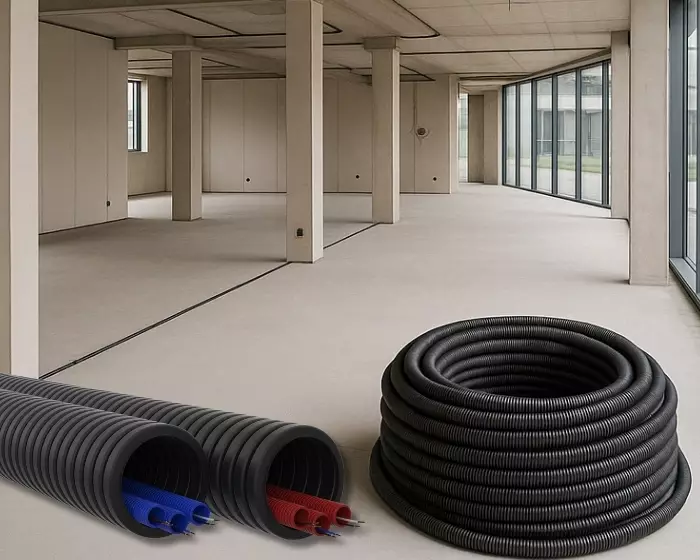
Offering a much higher bandwidth compared to traditional copper cables, silica-based fiber optic cables have a microstructure that is quite sensitive to tensile, bending, and crushing forces. Telecom infrastructure pipes manufactured from High-Density Polyethylene (HDPE) and similar polymers serve as the primary mechanical shield for these sensitive lines. An effective fiber optic protection strategy requires the collaborative functioning of the pipe's ring stiffness and the surrounding soil prism. Flexible structured pipe networks dampen stresses caused by ground movements, eliminating the risks of signal attenuation in data transmission.
Mechanical and External Threats Awaiting Cables
Underground cable routes are under the continuous influence of static and dynamic loads throughout their life cycles. Traffic loads coming from the superstructure (dynamic stresses), static lateral and vertical pressures resulting from the soil's own weight, changes in the groundwater level (hydrostatic), and freeze-thaw cycles are the most fundamental mechanical threats. In addition, rodent attacks, corrosion caused by soil chemistry, and impacts resulting from unplanned infrastructure excavations can lead to deformations on the pipe wall. Preventing these vectorial threats from reaching the cable core is possible with a depth profile that maximizes soil damping capacity.
Ideal Depth Calculation According to Traffic and Soil Type
Trench depth must be calculated using subsoil stress distribution models such as Boussinesq's theory. The intensity of the dynamic traffic load on the surface transmitted to the underground pipe decreases inversely with the square of the depth.
Areas with Heavy Traffic Load (Highways): In standard highway axle load scenarios such as H20 or HL93, the minimum trench depth is projected to be between 80 cm and 120 cm (according to local standards) so that the pipe can tolerate the crown stress to which it will be exposed.
Light Traffic and Walkways: In landscaping, sidewalk, or pedestrian areas where dynamic load is low, a burial depth of 60 cm to 80 cm generally provides optimum mechanical protection.
Soil bearing capacity (SBC), local frost line, and relevant standards (e.g., TS EN 12201, DIN 4124) are decisive engineering parameters in the final depth calculation.
In-Trench Bedding and Backfill Techniques
Merely determining the correct excavation depth is not enough; to ensure that the soil-structure interaction is at an ideal level, bedding and backfill operations must be performed in compliance with international technical specifications. To ensure that there are no sharp-edged rocks at the trench bottom and to prevent point-loading on the pipe, a 10-15 cm thick sand bedding with a homogeneous granulometry must be established. The backfill material, on the other hand, should be laid at the Optimum Moisture Content (OMC) level, typically in 20-30 cm layers, and compacted using vibratory rollers or compactors to achieve a minimum compaction rate of 95% according to the standard Proctor test.
Securing Communication Lines Across 5 Continents
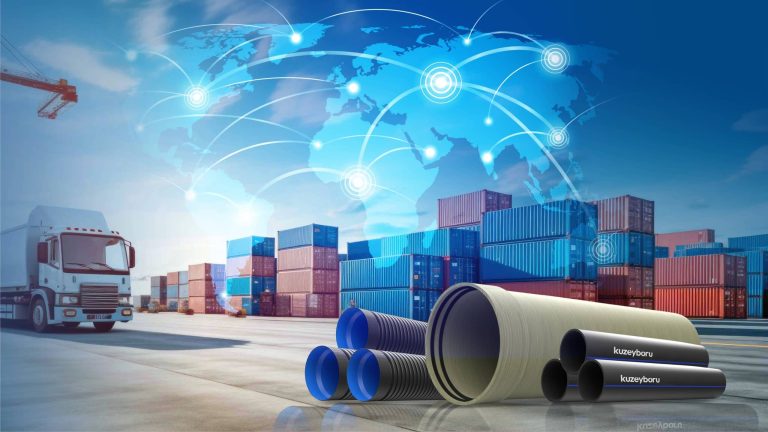
As Kuzey Boru, we produce engineering solutions that overcome all challenges posed by different geological and climatic conditions in global telecommunication projects. Ranging from the extreme thermal expansion dynamics of desert climates to the permafrost (deep freezing) lines of the Northern Hemisphere, we guarantee the mechanical security and data integrity of fiber optic infrastructures across 5 continents with our pipes produced in accordance with international quality standards (ISO, EN, ASTM).
Uninterrupted Production and Sustainability
The smart cities and 5G/6G infrastructures of the future require an uninterrupted and long-lasting physical network operating on a zero-tolerance principle. Kuzey Boru operates with Industry 4.0-based production lines that maximize energy efficiency in polymer extrusion processes, while offering sustainable infrastructure elements with a low carbon footprint in compliance with Life Cycle Assessment (LCA) criteria. The fact that our manufactured pipes maintain their form and function throughout a hydrostatic design life of over 50 years is not only an economic efficiency, but also the cornerstone of our global ecological sustainability vision.