Which Insulation Methods Are Used to Prevent Water Noise and Vibration in Indoor Installations of PPR and PVC-U Pipes in Building Projects?
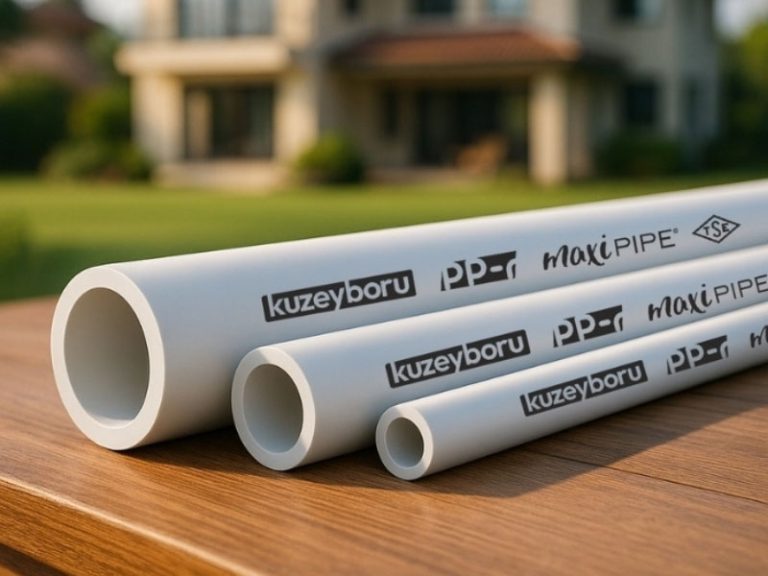
In modern building engineering, the acoustic comfort of living spaces is a design parameter as critical as structural reliability. The hydrodynamic energy generated during fluid transfer within indoor plumbing and wastewater networks causes vibrations in pipe walls and consequently leads to acoustic pollution. Although Polypropylene Random Copolymer (PPR) and Unplasticized Polyvinyl Chloride (PVC-U) pipes offer a higher viscoelastic damping capacity compared to traditional metal systems, improper installation practices and insufficient insulation can trigger structure-borne sound transmission.
Sound and Vibration Insulation in PVC-U and PPR Installations
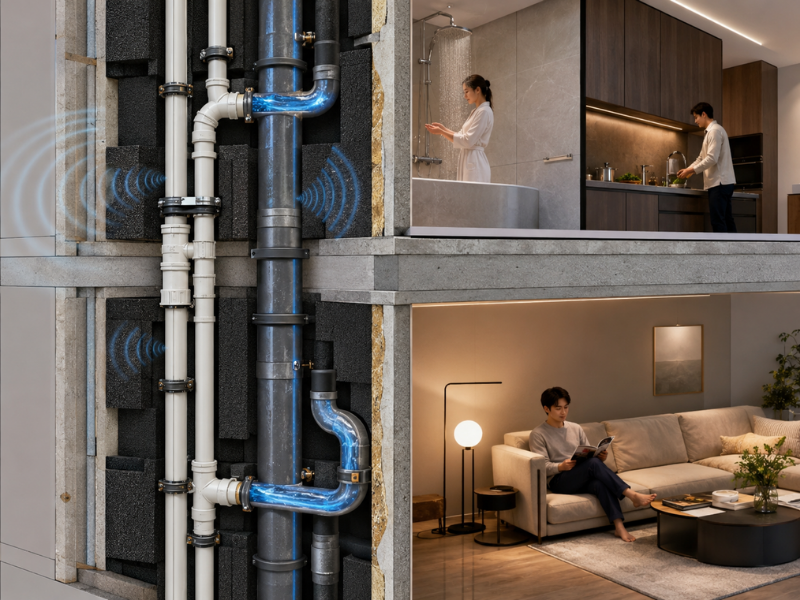
Acoustic insulation in piping systems primarily aims to control two different types of wave propagation: air-borne sounds and structure-borne sounds. Air-borne noise generated by the fluid flowing through polymer pipes can be partially isolated by the density of the pipe wall (Mass Law). However, the real engineering challenge lies in damping structure-borne sounds that occur when vibrating pipes make rigid contact with structural elements such as walls, columns, and floors. At this point, the principles of acoustic decoupling come into play.
What Causes Sound and Vibration in Indoor Plumbing Systems?
The primary source of noise in a pipeline is the conversion of the fluid’s kinetic energy into turbulent flow due to irregularities and changes in direction within the system (elbows, tees, valves, etc.). The nature of a flow is defined by the Reynolds Number (Re):
R_e=(ρ.υ.D_i)/μ
Here, ρ represents the fluid density, υ the average flow velocity, D_i the internal pipe diameter, and μ the dynamic viscosity. When the Reynolds number exceeds the critical threshold (≈ 4000), the flow becomes turbulent, creating hydrodynamic fluctuations that generate variable pressure profiles along the inner pipe wall. These pressure fluctuations are converted into mechanical vibrations through the polymer matrix and transmitted to structural elements.
Use of Rubber in Clamps and Installation Components
Clamps used to secure pipelines to structures act as acoustic bridges in vibration transmission. Direct contact between a metal clamp and a pipe means that vibrations are transferred to reinforced concrete structures with virtually no loss. To interrupt this transmission, Vibration Isolation Theory is applied, and elastomeric gaskets (typically EPDM rubber) are placed between the pipe and the clamp.
The mechanical damping capacity of the system is optimized using the natural frequency (fn) equation:
f_n= 1/2π √(k/m)
The spring constant k of the elastomeric gasket and the mass m of the piping system must be selected to generate a natural frequency sufficiently lower than the excitation (forcing) frequency of the vibration source. Viscoelastic EPDM rubber absorbs mechanical energy from the pipe by converting it into heat energy through its polymer chains (dissipation), dramatically reducing the vibration amplitude transmitted to the structure (typically by 10–15 dB).
Insulation Sleeves for Wall and Floor Penetrations
One of the most common insulation mistakes in building projects is allowing pipes to come into direct (rigid) contact with concrete or screed at floor penetrations. When the space around a pipe is filled with plaster in installation shafts or horizontal wall penetrations, the pipe’s axial thermal expansion is restricted, leading to significant friction noise and potential cracking risks.
To prevent this, polyethylene (PE) foam sleeves, rubber insulation tapes, or larger-diameter PVC-U/corrugated sleeve pipes are used at penetration points. These sleeves create a low-density acoustic barrier with air gaps between the pipe and the structure, physically interrupting the transmission of vibration waves into the reinforced concrete structure while also providing the free space required for the pipe’s thermal movements.
Reducing the Water Hammer Effect
Suddenly closing valves, fixtures, or activated pumps can instantly convert the kinetic energy of water into potential energy, generating a massive shock wave. This phenomenon is known as water hammer and is the source of the most severe impact noises and vibrations within a system. The resulting pressure increase can be calculated using the Joukowsky Equation:
∆P=ρ.α.∆υ
Here, ∆P represents the sudden pressure increase, ρ the fluid density, α the shock wave propagation velocity within the system, and ∆υ the sudden change in fluid velocity.
One of the greatest engineering advantages of PVC-U and PPR pipes in this regard is their low modulus of elasticity. While the wave propagation velocity (α) in metal pipes is approximately 1200 m/s, it decreases to around 300–400 m/s in plastic pipes. The ductility of the material allows it to absorb and dissipate the shock wave through elastic deformation within its structure. Optimizing pipe diameters to keep flow velocity (υ) below standard limits (maximum 1.5 m/s for potable water systems) and integrating water hammer arrestors can effectively eliminate this destructive vibration at its source.
Our Comprehensive Solutions for Building Systems
At Kuzeyboru, we evaluate indoor plumbing systems not merely as fluid-conveying pipes, but as integrated engineering modules that operate in harmony with the structural, hydraulic, and acoustic ecosystem of a building. The PPR and PVC-U formulations developed in our R&D Center laboratories are designed to maximize the viscoelastic damping capacity of the material at the molecular level. In addition, we provide our project partners with advanced engineering consultancy services on clamp spacing (span length) optimization, proper insulation sleeve selection, and hydraulic calculations, helping to eliminate acoustic insulation errors during the design phase before they occur on site.
An Innovative Approach Since 2001
Founded in 2001, Kuzeyboru has been shaping polymer technologies with nearly a quarter-century of industrial and R&D experience. Going far beyond the production of simple plumbing materials, we deliver intelligent piping solutions engineered at the molecular level to withstand the damaging effects of noise, pressure, and time. With our high-capacity production capabilities that respond to market demands, we contribute to the silent, safe, and uninterrupted infrastructure of modern buildings while carrying Kuzeyboru’s innovative vision and uncompromising engineering approach into the future.