What are the benefits of using PPR pipes to prevent cracking and leaks in plumbing systems?
Ensuring hydraulic integrity in building internal plumbing and heating networks constitutes the fundamental engineering goal of fluid transfer. However, thermal fluctuations, mechanical shocks, and material fatigue to which the system is exposed can lead to micro-cracks and leaks in pipelines over time.
Polypropylene Random Copolymer (PPR) pipes are a polymer technology that eliminates these structural weaknesses at the molecular level, thanks to their specific macromolecular form.
Why Does Cracking Occur in Plumbing Systems?
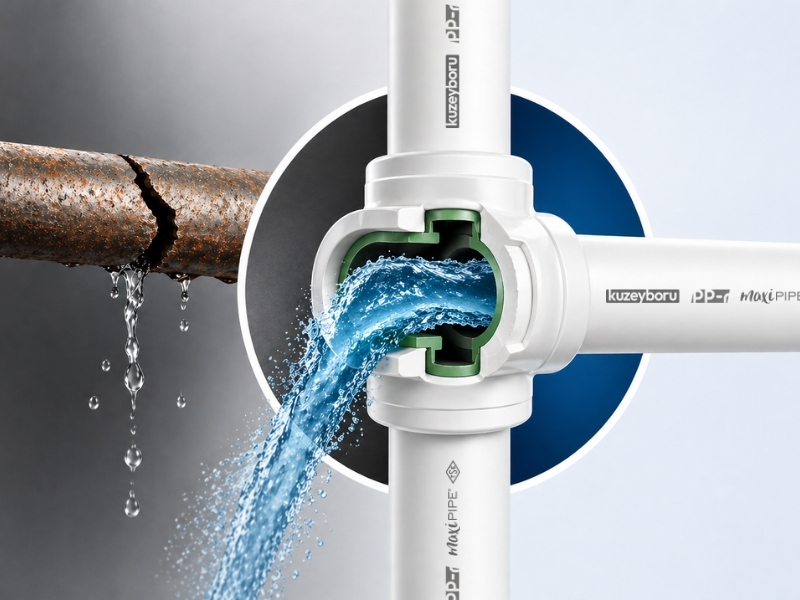
Cracking and bursting mechanisms in pipelines result from environmental and axial stresses that exceed the material’s yield strength.
Traditional metal pipes or low-quality rigid plastics cannot absorb this stress during sudden pressure spikes (water hammer effect) or thermal expansion/contraction cycles. Furthermore, if the water inside the plumbing freezes during winter months, its volume increases by approximately 9% due to phase change. This volumetric expansion creates a massive radial internal pressure on the rigid pipe wall, causing brittle failure of the material and extensive cracking along the longitudinal axis.
High Pressure and Impact Resistance of PPR Pipes
The main engineering advantage of PPR (Polypropylene Random Copolymer) material is hidden within the ethylene molecules randomly distributed between the polypropylene chains. This copolymerization process breaks the material’s crystallinity to a certain degree, granting it outstanding viscoelastic toughness.
This property allows the pipe to absorb impact energy during sudden pressure fluctuations, such as water hammer, and temporarily flex within the limits of its elastic region. At the same time, since it possesses a modulus of elasticity capable of tolerating volumetric expansion in case water freezes, it completely eliminates the risks of frost-induced bursting seen in metal pipes. PPR pipes exhibit long-term hydrostatic strength by maintaining high nominal pressure (PN) values even at elevated temperatures (e.g., hot water lines at 70°C and above).
The Importance of Leak-Proof Fitting Technology
The weakest links in a plumbing system are always the connection points (fitting interfaces). Gasketed (mechanical) or threaded metallic connections begin to drip over time as sealing elements lose their viscoelastic properties (stress relaxation) due to corrosion, vibration, and thermal cycles.
In PPR systems, this mechanical vulnerability is eliminated through polyfusion (socket welding) technology. The pipe and fitting are joined by bringing them to the molecular melting temperature (260°C). Following the cooling phase, the polymer chains completely diffuse into one another (interdiffusion).
Thanks to this fundamental fusion process, the joint transforms into a single homogeneous mass (monolithic structure) with a higher cross-sectional area and mechanical strength than the pipe’s own body. Since there is no sealing gasket in the system to fatigue, decay, or loosen over time, the risk of leakage at connection points is reduced to zero.
Uninterrupted Performance Throughout the Building Lifespan
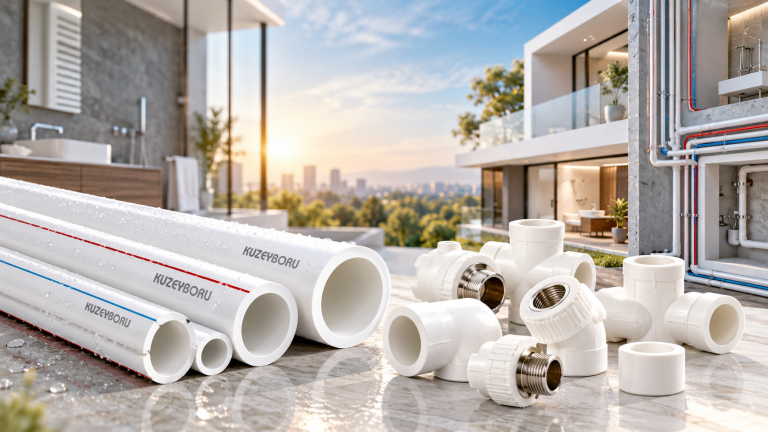
PPR pipes offer complete chemical inertness by not reacting with free oxygen, chlorine ions, or acidic/basic chemicals in the water. This molecular stability prevents galvanic corrosion and internal wall calcification (tuberculation), which are inevitable in metal plumbing systems.
Because the internal diameter does not narrow and the hydraulic smoothness remains as it was on day one, the pipeline delivers uninterrupted performance throughout the building’s lifespan (minimum 50 years) without creating extra hydraulic head loss in pumps or boilers. Its high resistance to environmental stress cracking (ESCR) prevents massive structural damage and high repair costs caused by hidden leaks within building structures.