

Blog
Why are HDPE pipes preferred in marine discharge projects?
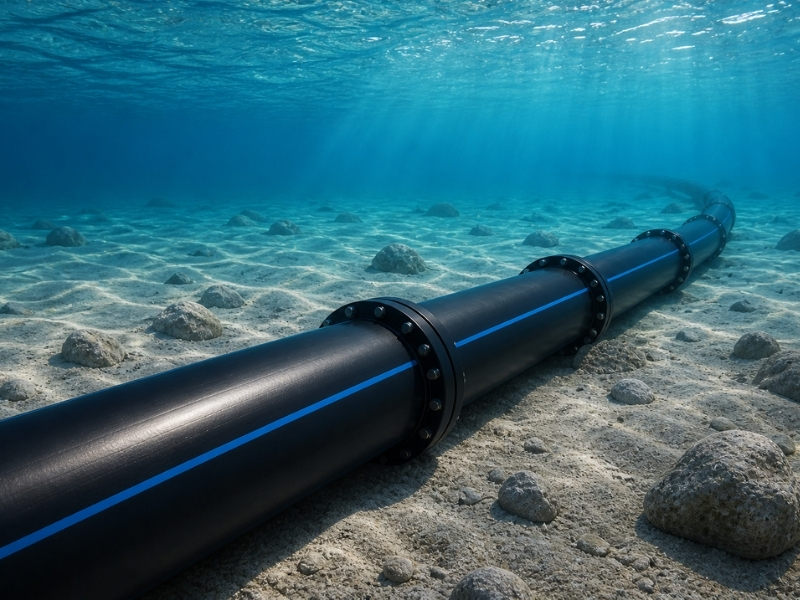
Marine outfall systems and coastal engineering projects are challenging operational areas where hydrodynamic forces and aggressive environmental conditions coexist. The safe conveyance of wastewater, cooling water, or seawater circulation lines is of critical importance for both the structural integrity of the project and environmental sustainability. The inadequacy of traditional pipe materials in these aggressive environments, in light of developments in material science and polymer technology, has made the use of High-Density Polyethylene (HDPE) pipes an engineering standard.
The Corrosive Effect of Seawater and Pipe Corrosion
Seawater is a highly aggressive electrolyte with high electrical conductivity, containing an average of 3.5% dissolved salt (approximately 35,000 ppm). Its high concentration of chloride (Cl⁻), sulfate (SO₄²⁻) ions, and dissolved oxygen (O₂) causes severe electrochemical corrosion in metallic pipe systems.
In traditional steel pipes, the corrosion process occurs through anodic and cathodic reactions as follows:
- Anodic Reaction (Dissolution of iron): Fe → Fe²⁺ + 2e⁻
- Cathodic Reaction (Reduction of oxygen): ½O₂ + H₂O + 2e⁻ → 2OH⁻
- General Corrosion Product (Rust formation):


This electrochemical degradation leads to a decrease in wall thickness over time in metal pipes, resulting in leaks and eventually system failure. In reinforced concrete pipes, the diffusion of chloride ions triggers reinforcement corrosion, causing structural cracks. Therefore, the use of materials that do not engage in electrochemical reactions is essential for infrastructure in contact with seawater.
Resistance of High-Density Polyethylene to Saltwater
HDPE pipes are semi-crystalline, non-polar thermoplastics produced by the polymerization of ethylene (C₂H₄) monomers with Ziegler-Natta or Phillips catalysts. The molecular chain structure of HDPE consists only of carbon (C) and hydrogen (H) atoms and contains no free electrons or polarity. Thanks to this chemical structure, HDPE pipes do not participate in ionic reactions in seawater and possess total galvanic corrosion resistance. The high crystallinity rate of the polymer chains (usually >60%) prevents the diffusion of seawater and other aggressive chemicals into the polymer matrix. This ensures that the material’s physical and mechanical properties are preserved for many years.
Safe Hydraulic Performance in Fish Farms
Energy efficiency in circulation systems for fish farms and marine outfall projects is directly dependent on the hydraulic smoothness of the pipe’s internal surface. In fluid mechanics, internal pressure losses (h𝒇) are commonly calculated using the Darcy-Weisbach equation:

Here; 𝒇 represents the friction factor, L the pipe length, D the internal diameter, v the fluid velocity, and g the gravitational acceleration. The absolute roughness value (ε) of HDPE pipes is approximately between 0.0015 and 0.007 mm.
According to the Colebrook-White equation, the friction factor (𝒇) is directly related to surface smoothness. This ultra-low roughness value of HDPE creates lower pressure losses compared to concrete or steel pipes. Consequently, pump energy consumption is minimized in high-flow water circulations in fish farms, while the risk of biological fouling (biofouling) adhesion is also mitigated.
UV Resistance and Long-Term Service Life
Pipes positioned on or near the surface in open seas are exposed to high levels of solar radiation (UV-A and UV-B). If polymers are not protected against UV rays, the photo-oxidation mechanism is activated, and free radicals cause chain scission in polymer chains, leading to material embrittlement. To withstand this degradation mechanism, an optimum amount of Carbon Black (usually 2-2.5%) is integrated into the HDPE pipe production recipe. Carbon black acts as an excellent UV absorber, converting photon energy into heat and dissipating it from the polymer matrix. This preserves the viscoelastic properties of the material and provides a service life of over 50 years in offshore applications.
Kuzeyboru: Durability Tests in Kuzeyboru Laboratories
The foundation of project reliability lies in the strict quality control and laboratory processes implemented during the production stage. In Kuzeyboru laboratories, a series of thermomechanical tests are performed in accordance with international standards for HDPE pipes to be used in critical applications such as marine outfalls:
Hydrostatic Pressure Test (ISO 1167): To examine the time-dependent creep behavior of the polymer, circumferential stress (σ) is applied to pipe samples at specific temperatures (20°C and 80°C). The long-term operating pressure capacity of the system is verified based on the Barlow formula P = (2 × σ × e) / (D − e).
Oxidation Induction Time (OIT-ISO 11357-6): To determine the thermal stability of the pipe and the lifespan of the antioxidant package, the time it takes for the material to begin oxidizing is measured at high temperatures using a Differential Scanning Calorimetry (DSC) device.
Tensile and Elongation Tests (ISO 6259): The yield strength and elongation at break values of the pipes coming off the extrusion line are analyzed to guarantee the material’s flexibility and toughness parameters.
Large Diameter HDPE Production Capacity
Marine outfall lines require the transfer of large mass flow rates. The relationship between fluid flow (Q) and pipe diameter (D) is expressed by the equation Q = (π × D² / 4) × v. To carry the required high flow (Q) at the desired limit velocities (v), it is necessary to increase the cross-sectional area (A), and therefore the pipe diameter. The production of large-diameter HDPE pipes is a demanding process requiring advanced extrusion technology, mold design, and precise cooling (vacuum tank) processes. As wall thickness increases, minimizing residual stresses that may occur during the cooling of the polymer melt is a critical engineering problem. Kuzeyboru’s high-technology machinery and process control expertise allow these large-diameter HDPE pipes to be produced with homogeneous wall thickness and superior mechanical properties, fully meeting the hydraulic needs of the projects.
Related Articles

PPRC Pipes and Fittings: Zero Errors in Hot and Cold Water Installations
PPRC pipes and fittings, which set the standards especially in hot and cold water lines, stand out

WHAT IS GRP (GLASS REINFORCED POLYESTER) PIPE? AN INDISPENSABLE CANDLE FOR LARGE-SCALE PROJECTS.
GRP (Glass Reinforced Polyester or Glass Fiber Reinforced Plastic) is a composite material that

The Key to Comfort in Underfloor Heating Systems: PE-RT and PE-XB Pipes
The Key to Comfort in Underfloor Heating Systems: PE-RT and PE-XB Pipes In modern building
Related Articles
What is Kuzeyboru Polestra™ Technology?
Technical guide on Polestra™ hybrid filler technology for polymer composites.
What are the advantages of the flexible structure and ease of installation of PE-XB pipes?
A technical guide to the installation benefits and structural performance of flexible PE-XB pipes in modern underfloor heating…

What is a wastewater pipe? What are the different types of wastewater pipes?
Compare premium wastewater pipe types for advanced infrastructural projects.