

Blog
What are the advantages of the flexible structure and ease of installation of PE-XB pipes?
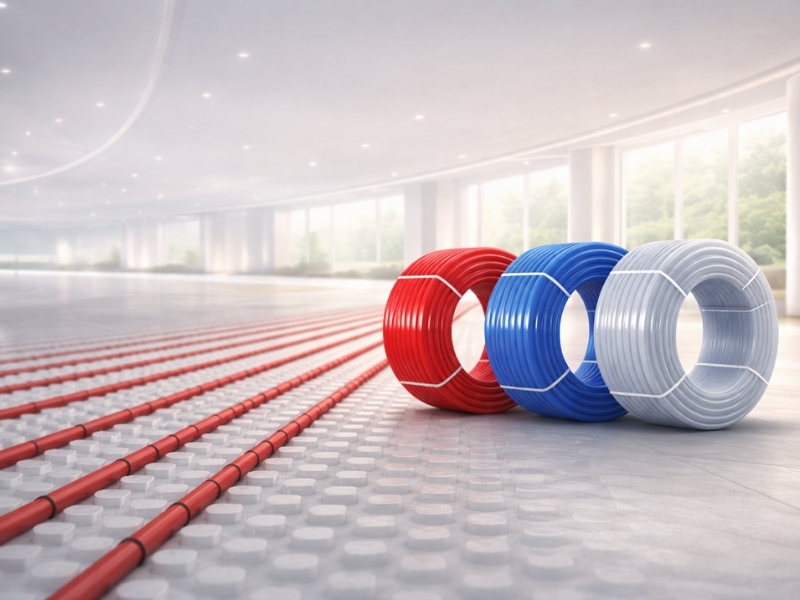
The ease of installation and comfortable heating advantages of flexible PE-XB pipes designed for underfloor heating systems represent one of the primary focal points of modern HVAC engineering and piping technologies. Within Kuzey Boru’s polymer pipe systems portfolio, the PE-XB flexible product line holds a critical importance, particularly for underfloor heating (sub-surface heating), mobile radiator connections, potable water, and natural gas installations.
What is a Cross-Linked Polyethylene (PE-XB) Pipe?
The process of connecting polyethylene (PE) chains to each other through chemical or physical methods to form a three-dimensional network structure is called cross-linking.
In polymer literature and industry standards, PEX (Cross-Linked Polyethylene) pipes are lettered according to the covalent bond formation mechanism applied during their production:- PE-XA: Peroxide method
- PE-XB: Silane method
- PE-XC: Electron beam (Radiation) method
The pipes emerging from Kuzey Boru’s production line and designated as PE-XB are cross-linked via the silane copolymerization and moisture curing method, which is the specific technical equivalent of the “B” designation in its name. This cross-linking reaction highly enhances the thermomechanical properties of the material.
Thermodynamically, this modification prevents the viscoelastic flow of the polymer at temperatures above its crystalline melting point ($T_m$). According to TS EN ISO 15875 standards, the gel fraction (degree of cross-linking) in PE-XB pipes must be at least 65%. This molecular architecture maximizes the material’s creep resistance under high temperature and pressure.
Benefits Provided by the Flexible Structure to Installation Processes
The flexibility of PE-XB pipes is directly related to the molecular architecture of the polymer matrix and its relatively low modulus of elasticity (Young’s Modulus, $E$). The polyethylene raw material used by Kuzey Boru and the applied B-method (silane) cross-linking process grant the pipe a structure that is far more flexible than rigid plastics (such as PVC or standard PP pipes). Thanks to this, the pipes can be wound into coils without breaking and can be easily uncoiled and laid onto modulation panels on the construction site.
At room temperature (20°C), PE-XB pipes possess the capability to absorb the bending and routing forces (external forces) applied to them, thanks to the viscoelastic behavior of the material. The applied force is balanced once the pipe is seated into the floor clips, and no permanent damage (plastic deformation) occurs in the molecular structure of the material.
The heating and cooling of water in underfloor heating systems (thermal cycles) create a tendency for expansion and contraction in the pipes. Kuzey Boru PE-XB pipes absorb these expansion forces (thermal expansion issues) within their own structure, thanks to their cross-linked molecular network. Consequently, dangerous internal stresses that could crack the screed concrete or shorten the system’s lifespan do not accumulate in the pipe wall.
Kink and Bend Resistance in Sharp-Angle Turns
In underfloor heating circulation lines, pipes must be bent at tight intervals to adapt to modulation panels. For a safe bending operation in PE-XB pipes, the minimum bending radius ($R_{min}$) is generally formulated as a specific multiple of the outer pipe diameter ($d$). (Typically $R_{min} \ge 5d$ in cold forming).
The maximum bending stress acting on the pipe wall during bending can be expressed by the following equation:
Savings Secured in Time and Labor Costs
Thanks to the continuous coiled structure and flexibility, the need to use elbows, couplings, and similar fittings is completely eliminated. This situation not only optimizes material and labor times but also boosts the hydrodynamic efficiency of the system. The elimination of fittings reduces localized pressure drops ($\Delta P_{local}$) within the system. According to the localized loss formulation integrated into the Darcy-Weisbach equation ($\Delta P_{local} = K \times (\rho v^2 / 2)$), the sum of localized loss coefficients ($K$) decreases as the number of fittings drops. This allows circulation pumps to operate with lower head requirements, offering high long-term energy savings and facilitating hydraulic balancing.Temperature Tests in an Accredited Laboratory
The life expectancy of polymeric components used in heating systems depends on the resistance the material shows against thermal oxidative degradation. The thermal stability of the pipes is continuously monitored through long-term hydrostatic internal pressure tests and OIT (Oxidation Induction Time) analyses carried out in Kuzey Boru’s accredited laboratories in accordance with international standards.
The 50-year design life expectancy of polymeric pipes is mathematically predicted using accelerated aging tests performed at high temperatures and the Arrhenius equation.Production Capacity Exceeding 100 Thousand Tons
Meeting the thermoplastic pipe demands of large-scale infrastructure and superstructure projects requires robust process engineering and high-capacity production lines. Kuzey Boru’s production capacity exceeding 100 thousand tons is backed by state-of-the-art extrusion lines, gravimetric dosing units, and in-line ultrasonic thickness measurement devices.
The high-capacity and continuous production model guarantees the homogeneity of the polymer matrix by eliminating batch-to-batch variations. This state ensures that each PE-XB coil shipped to the construction site possesses the same superior mechanical and thermal stability.Related Articles

PPRC Pipes and Fittings: Zero Errors in Hot and Cold Water Installations
PPRC pipes and fittings, which set the standards especially in hot and cold water lines, stand out

WHAT IS GRP (GLASS REINFORCED POLYESTER) PIPE? AN INDISPENSABLE CANDLE FOR LARGE-SCALE PROJECTS.
GRP (Glass Reinforced Polyester or Glass Fiber Reinforced Plastic) is a composite material that

The Key to Comfort in Underfloor Heating Systems: PE-RT and PE-XB Pipes
The Key to Comfort in Underfloor Heating Systems: PE-RT and PE-XB Pipes In modern building
Related Articles

Soil Load and Strength Calculations in Steel-Reinforced Corrugated Pipes: A Guide for Infrastructure Engineers
Combining the resistance of polymer and the strength of steel, steel-reinforced corrugated pipes outperform conventional materials, extending the…

Secrets of Telecommunications Infrastructure Pipe Protection: Fiber Optic Cable Protection
Fiber optic networks enable communication at the speed of light while remaining highly sensitive to physical impacts.
Selecting HDPE Pipes from 20 mm to 1600 mm: How to Calculate Capacity Based on Diameter Measurements?
Optimize hydraulic capacity and pressure loss from 20mm to 1600mm for efficient infrastructure.