What is a Corrugated Pipe?
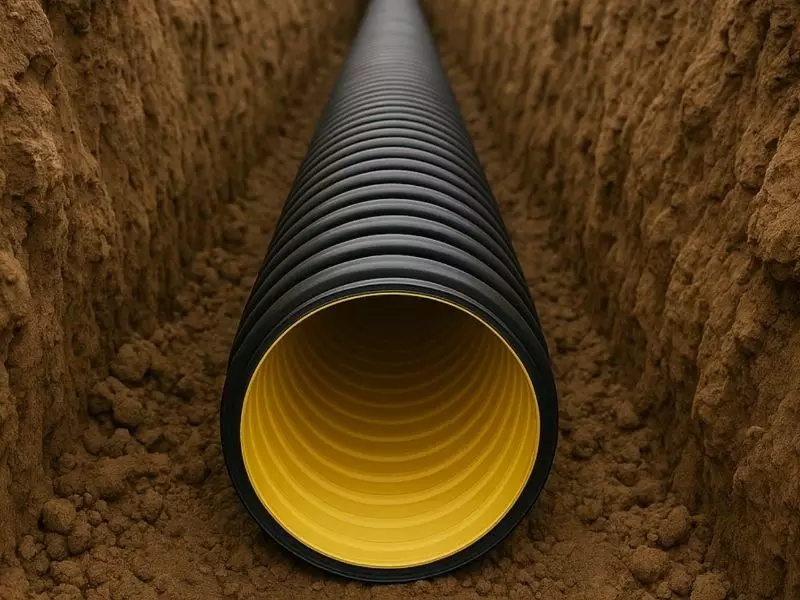
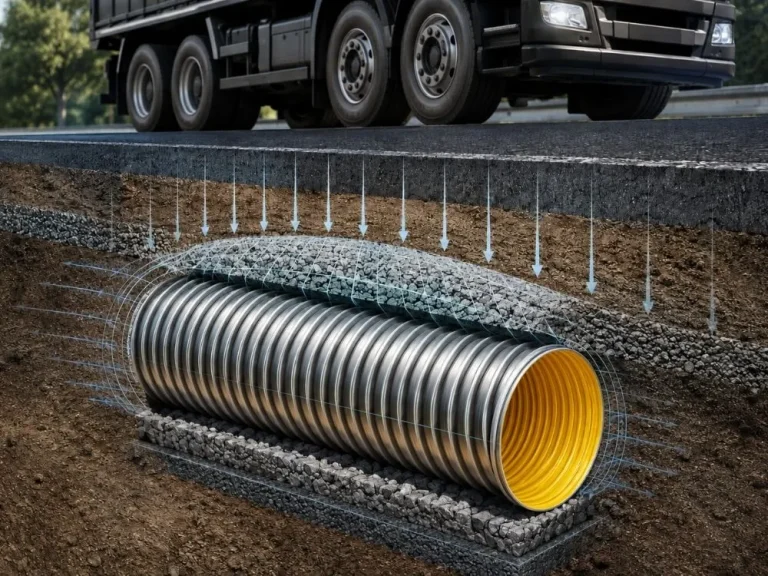
Corrugated pipes are infrastructure systems manufactured from polymeric raw materials using the extrusion method. Thanks to their ribbed (walled) external surface design, they possess a high soil load dissipation capacity. This geometric configuration increases the material's moment of inertia, enabling maximum structural rigidity with minimum wall thickness and raw material consumption.
Areas of Application
Due to their mechanical flexibility and hydraulic advantages, they are predominantly utilized in gravity-driven, non-pressurized pipelines. Municipal sewerage networks, stormwater discharge and collection lines, industrial wastewater drainage systems, highway culvert crossings, and groundwater removal (drainage) projects are the primary fields of application.
The greatest advantage brought by the polymer structure is its complete resistance to biogenic sulfuric acid corrosion induced by hydrogen sulfide (H2S) and to ground chemicals.
Durability Advantages of Corrugated Pipes
Unlike rigid pipes (such as concrete), their viscoelastic nature allows them to flex under dynamic loads—such as earthquakes, soil settlement, or heavy traffic—rather than cracking. This flexibility transfers the stress directly to the bedding and sidefill compaction. When installed with correct compaction ratios, the operational lifespan of the system is projected to be between 50 and 100 years.
Types and Features of Corrugated Pipes
Kuzeyboru corrugated pipe systems are manufactured using High-Density Polyethylene (HDPE) raw material in compliance with TS EN 13476-3 standards. These systems are designed in ring stiffness classes ranging from SN4 to SN16 according to the load profile the project will encounter, and can withstand temperatures between -50 °C and +60 °C.
Standard Corrugated Pipes: This is the basic profile type utilized in urban wastewater discharge, rainwater collection lines, and non-pressurized gravity fluid transport networks in industrial processes.
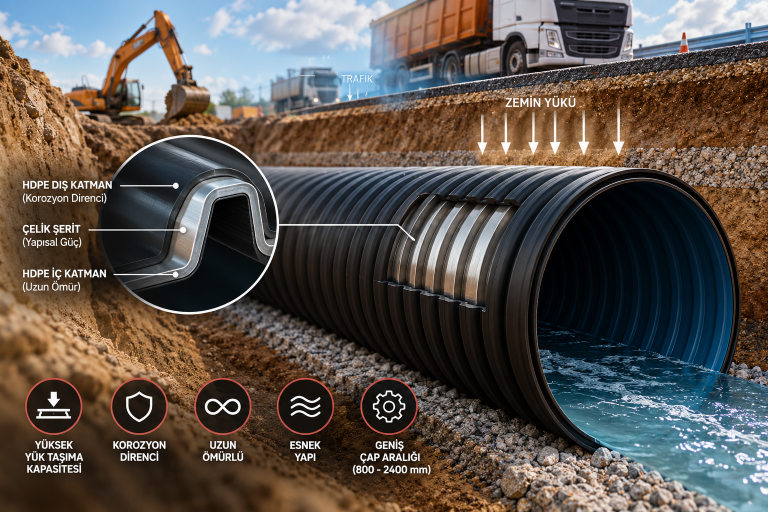
Steel-Reinforced Spiral Corrugated Pipes: These are composite systems that combine the chemical resistance of polymers with the high modulus value of steel. They are produced by integrating a "U"-shaped steel profile wrapped with HDPE layers on both the inner and outer surfaces. The polymer coating completely isolates the internal steel reinforcement from corrosion. Designed for projects requiring high structural strength, they are engineered for HEPP projects and large-diameter sewer lines in nominal diameters ranging from 800 mm to 2400 mm (with stiffnesses of SN4-SN16).
Geotextile-Wrapped Drainage Pipes: These are pipes covered with a non-woven geotextile layer manufactured from 100% plastic fibers through needling and thermal bonding processes. This filtration layer protects the system from climatic conditions, impacts, and sediment or silt that could clog the lumen. These pipes feature an extended underground service life and superior chemical resistance.
Corrugated Perforated (Slotted) Pipes: Manufactured by drilling holes or cutting slots into the outer ribs according to specific engineering designs, these pipes regulate underground water levels and drain surface water. They are governed by R2 class standards under the DIN 4262-1 norm.
Double-Walled Cable Protection Pipes: Manufactured in compliance with TS EN 61386-1 norms, this specialized pipe series is used to safeguard underground fiber optic communication networks, signaling, and power lines. Thanks to its elastic deformation property against sudden loads, it retains its geometry and forms a secure transmission line.
Difference Between Single and Double Wall
Single-walled pipes are flexible elements with undulating forms on both internal and external surfaces; they are mostly preferred for shallow surface drainage or cable protection lines. In double-walled corrugated pipes, while the external surface remains ribbed to provide structural strength, the internal surface is extruded completely smooth to optimize hydraulic flow.
This smooth inner layer achieves a remarkably low Manning roughness coefficient ($n \approx 0.009 - 0.010$) in terms of fluid mechanics, minimizing friction losses in the boundary layer. Consequently, hydraulic conveyance capacity is maximized, and the settling of solid particles that could narrow the lumen is prevented.
Diameter and Size Details of Corrugated Pipes
According to international norms, two main nominal diameters are taken as reference: inside diameter-based (DN/ID) and outside diameter-based (DN/OD) manufacturing. At Kuzeyboru, standard corrugated pipes can be produced in a wide spectrum from DN 100 mm to DN 1000 mm, while steel-reinforced corrugated pipes range from DN 800 mm to DN 2400 mm.
Standard production lengths are generally set at 6 meters to optimize logistics efficiency. Custom lengths can be cut to meet specific project requirements.
Jointing Methods for Corrugated Pipes
1. Integrated Socket Connection Systems
The socket connection method is based on directly providing a socket (bell) form to one end of the pipe simultaneously with the pipe body during the production process, utilizing specialized mold blocks integrated into the corrugator line.
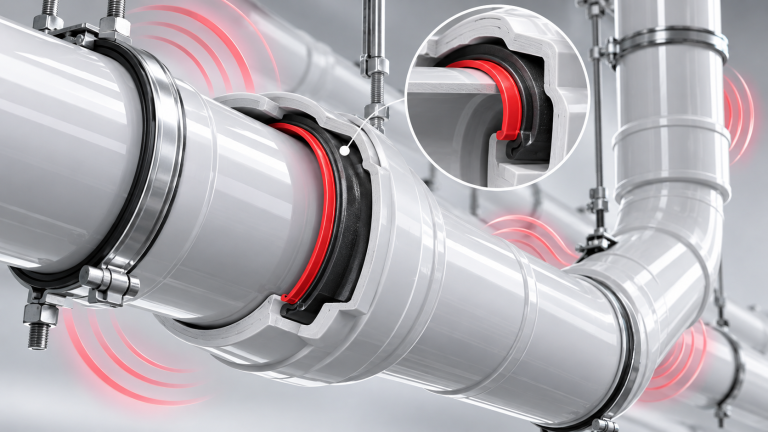
Sealing and jointing rely on inserting an elastomeric gasket—fitted into the profile gaps of the spigot (male) end—into the socket housing of the mating pipe. This system is manufactured in accordance with TS EN 13476-3 standards.
The sealing performance of the joint locations is tested under the EN 1277 standard. With the use of the correct elastomeric gasket, the system guarantees absolute watertightness under 0.5 bar of internal hydrostatic pressure and -0.3 bar of vacuum conditions without undergoing deformation.
2. Electrofusion (EF) Tape Welded Jointing
This is an advanced technological jointing method especially utilized in the integration of steel-reinforced (spiral) corrugated pipes. In this process, the pipes are aligned end-to-end on a horizontal, level surface under clean and dry ambient conditions, and the joint zone is circumferentially wrapped with EF tape.
The polymer melting process, executed by applying electric current to the EF tape terminals, is critical for weld homogeneity. The application is maintained within a temperature band of approximately 190-200°C for a duration of 6 to 15 minutes.
Following the melting phase, the system is kept stationary and left to cool for 15-20 minutes to stabilize molecular bonds. In the final stage of the procedure, a filler welding process is applied to the joint zone, and the physical stability of the pipes is meticulously maintained until the filler weld cools completely and gains its mechanical strength.
Frequently Asked Questions
- What is the significance of trench backfilling regarding soil-pipe interaction?
- Since corrugated pipes are flexible structures, they derive a major portion of their load-bearing capacity from the compacted backfill surrounding them. Compacting the bedding and sidefill with material of appropriate granulometry to a Proctor density exceeding 95% is a critical parameter to prevent elliptical deformation of the pipe.
- What is the technical effect of internal surface smoothness on the flow regime?
- The smooth inner wall ensures a regime close to laminar flow, reducing fluid velocity losses along the pipe boundary. This configuration allows a higher flow rate capacity compared to concrete pipes of the same slope and diameter.