How Is the Soil Load-Bearing Capacity of Steel Reinforced Corrugated Pipes Determined?
In large-scale underground infrastructure projects, the load-bearing capacity of thermoplastic pipes approaches its physical limits as trench depth and traffic loads increase. Steel Reinforced Corrugated Pipes (SRCP – Steel Reinforced Corrugated Pipe), developed to overcome this engineering barrier, combine the corrosion resistance of high-density polyethylene (HDPE) with the exceptional modulus of elasticity of steel within a single composite matrix.
Use of Steel Reinforced Pipes Under Heavy Loads
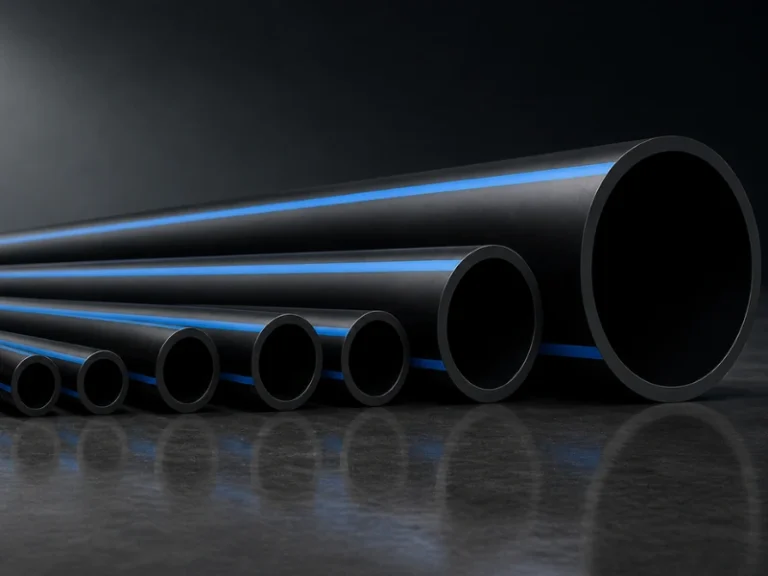
When double-wall HDPE corrugated pipes exceed a certain diameter (typically DN 1000 mm), achieving high ring stiffness (SN8, SN10, or SN16) requires wall thicknesses that become impractical from both economic and extrusion dynamics perspectives. In steel reinforced corrugated pipes, high-strength steel profiles, insulated against corrosion by a polymer layer, are integrated into the external polymer ribs.
Traffic and Soil Load Calculation Formulas
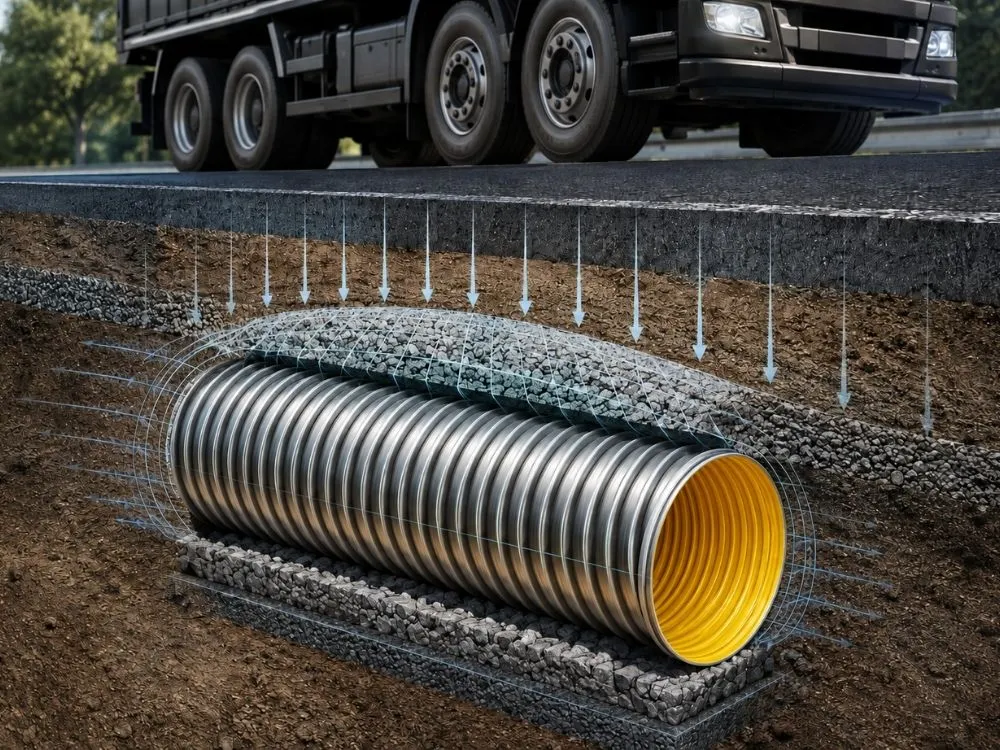
The total load acting on a buried steel reinforced corrugated pipe consists of two main components: dead load (soil backfill) and live load (traffic).
1. Dead Load (Soil Load) Calculation: The soil load acting on a pipe installed within a trench is calculated using Marston Theory. In flexible pipes, the load is less than the weight of the soil prism above the pipe due to friction along the trench walls:
Wc = Cd · w · Bd2
Wc: Static soil load acting on the pipe (kg/m) Cd: Trench load coefficient (empirical value depending on soil type and friction angle) w: Unit weight of the backfill soil (kg/m³) Bd: Trench width (m)
2. Live Load (Traffic Load) Calculation: The dynamic pressure distribution transmitted by surface vehicles (H20 or HS20 highway standards) to the pipe depth is modeled in three-dimensional space using the Boussinesq Equation:
Pz = (3P/2π) · z3 / R5
Pz: Vertical stress at depth z (N/m²) P: Surface point wheel load (N) z: Depth of the pipe below the surface (m) R: Linear distance between the load application point and the point being analyzed (m)
While traffic load is a highly critical factor at shallow burial depths, as depth increases, the live load dissipates according to the Boussinesq distribution, and the soil load (Marston) becomes the primary design criterion.
Diameter Options from 800 mm to 2400 mm
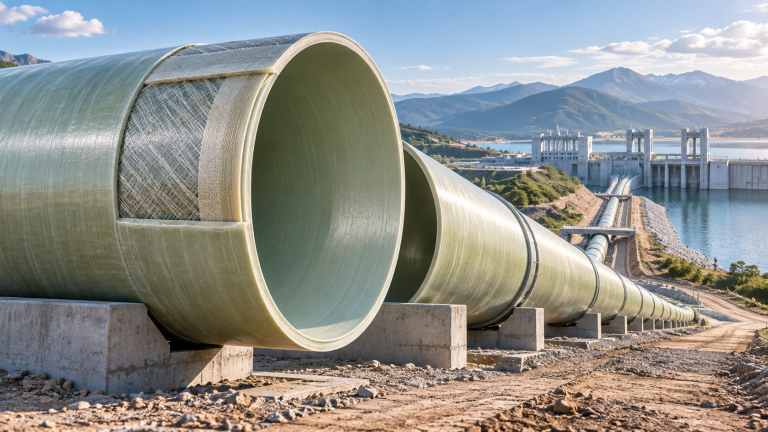
In large-scale infrastructure discharge systems, fluid flow rates are extremely high due to the continuity equation, requiring large cross-sectional areas. Diameter options ranging from 800 mm to 2400 mm ensure safe mass flow in massive flood protection projects, hydroelectric power plant (HPP) transmission lines, and deep-sea outfall projects. The incorporation of steel reinforcement within this diameter range enables the pipe wall to maintain its circular geometry (cross-sectional integrity) despite enormous soil loads, preventing reductions in hydraulic capacity (head loss).
Crushing Resistance and Static Load Analysis
In flexible pipe design, the ultimate performance criterion is not whether the material can carry the load without cracking, but whether the system remains below a specified vertical deflection limit (typically 5%). The long-term underground deformation (Δx) of a steel reinforced pipe is calculated using Spangler’s modified Iowa formula:
Δx = (Dl · K · Wc) / ((E · I / R3) + 0.061 · E′)
Δx: Vertical and horizontal diameter change (deformation, m) Dl: Deflection lag factor (accounts for the creep behavior of the polymer) K: Bedding constant Wc: Total vertical load (N/m) E · I / R3: Pipe ring stiffness E′: Soil reaction modulus (soil stiffness representing the quality of backfill compaction)
This equation mathematically demonstrates that pipe stability depends not only on the steel reinforcement (E·I), but also on the compaction quality of the surrounding soil (E′).
Ring Stiffness Tests in Accredited Laboratories
The practical validation of theoretical geotechnical formulas is achieved through ring stiffness tests conducted in accordance with the ISO 9969 standard. Manufactured steel reinforced corrugated pipes are subjected to radial pressure at a constant rate in accredited laboratories.
SN = (E · I) / D3
SN: Ring stiffness value E: Modulus of elasticity of the material I: Moment of inertia of the cross-section D: Pipe diameter
The force required to deform the pipe by 3% is measured to determine the system’s SN (Stiffness Number - kN/m²) value. Thanks to steel reinforcement, SN8, SN10, or significantly higher stiffness values for special projects can be achieved with ease. These tests demonstrate that the material’s long-term creep behavior and the adhesion integrity at the steel-polymer interface will remain reliable throughout the 50-year design life.
Production Capacity of 223 Thousand Tons
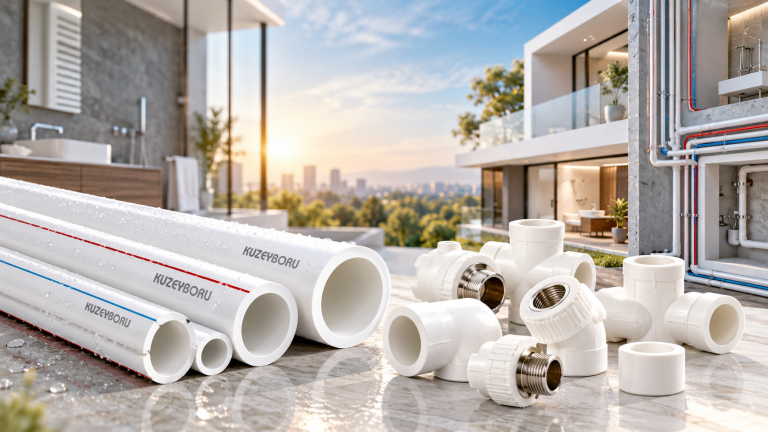
The global supply of advanced engineering polymers and hybrid composite structures requires a massive production infrastructure and flawless quality management. Designed at Kuzey Boru's R&D Center and manufactured in the company's large-scale production facilities with an annual capacity of 223 thousand tons, steel reinforced corrugated pipes represent the power of modern production technologies.
Automation within the extrusion line ensures that steel profiles are embedded into the polymer matrix with millimetric precision and zero air voids (void-free). This production capacity and technological superiority form the foundation of Kuzey Boru's ability to meet the high-tonnage delivery demands of both major national infrastructure projects and challenging construction sites around the world with the same speed and engineering reliability.