Plastic Pipe Types and Areas of Application
Replacing traditional materials in infrastructure, superstructure, and industrial plant projects, plastic pipes sit at the heart of engineering solutions with their high corrosion resistance, structural lightweight properties, and hydraulic efficiency. Their smooth inner surfaces, which minimize friction losses during fluid transmission, directly increase the targeted flow performance. Polymeric pipe systems play a critical role in infrastructure projects thanks to the viscoelastic behavior of thermoplastic and thermoset matrices.
The design of these systems is based on time-dependent mechanical properties such as long-term hydrostatic strength (MRS - Minimum Required Strength), creep modulus, and fatigue resistance.
From a fluid mechanics perspective, the greatest advantage of plastic pipes is the smoothness of their internal walls.
PVC Pipes
Polyvinyl Chloride (PVC) pipes are known for their high rigidity (hardness) and wide-spectrum chemical resistance properties. Thanks to their high-strength structure, they are generally preferred in non-pressurized lines, domestic and industrial wastewater systems, and rainwater drainage.
When analyzed from a flow analysis perspective, PVC's low roughness coefficient prevents solid particles from adhering to the pipe surface and blocks potential blockages that could occur over time. It helps maintain a continuous and orderly laminar flow profile.
PE Pipes
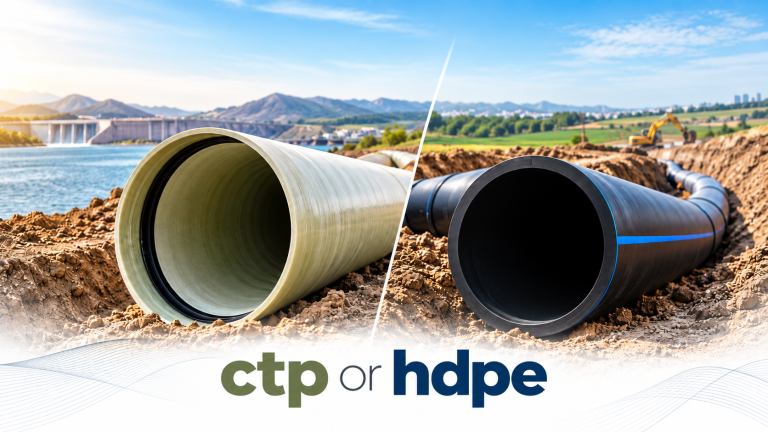
Polyethylene (especially High-Density Polyethylene - HDPE) pipes stand out for their superior flexibility, impact absorption capacity, and 100% leak-proof configurations achieved through butt fusion or electrofusion techniques. They are safely utilized in high-pressure clean water transmission lines, natural gas distribution networks, and challenging marine discharge projects.
Due to their flexible nature, they display high tolerance against soil settlements and seismic movements; they also successfully dampen the destructive effects of water hammer shocks within the system.
PPRC Pipes
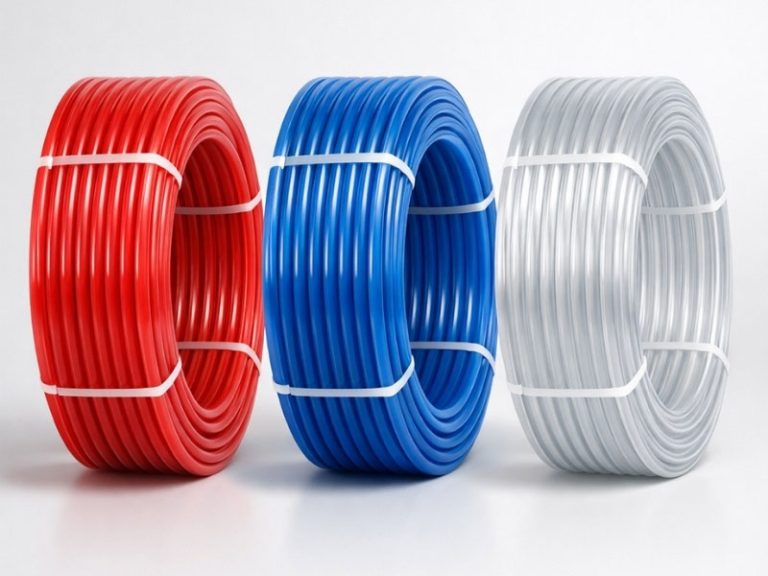
Polypropylene Random Copolymer (PPRC) pipes are indispensable materials for indoor hot and cold water plumbing systems owing to their mechanical and thermal properties. Their resistance to high temperatures (up to 95°C for short periods, and 70°C under continuous flow) and internal pressure represents the greatest engineering advantage of this material.
By virtue of its chemical structure, it is hygienic; it does not corrode, does not alter the odor or taste of water, and does not allow the formation of biofilms or algae on its inner surface.
GRP Pipes
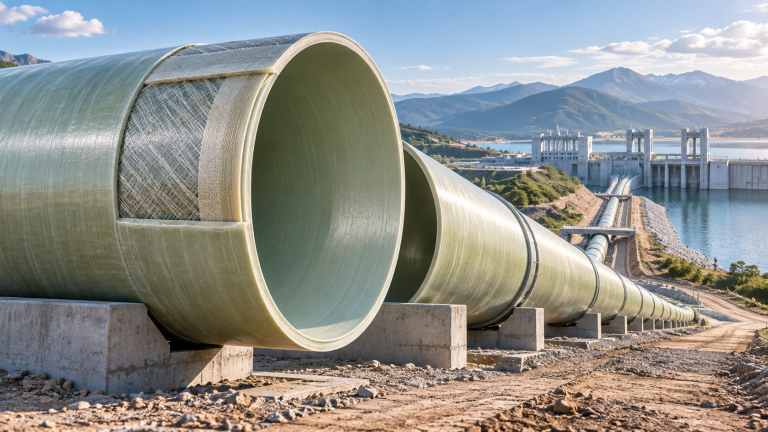
Glass-Fiber Reinforced Plastic (GRP) pipes are manufactured from a composite combination of a thermoset resin matrix and glass fibers. This composite structure provides mechanical strength capable of competing with steel pipes while significantly reducing the overall weight.
They are preferred in very large diameters, main water transmission lines requiring high operating pressure, and penstocks for hydroelectric power plants.
Corrugated Pipes
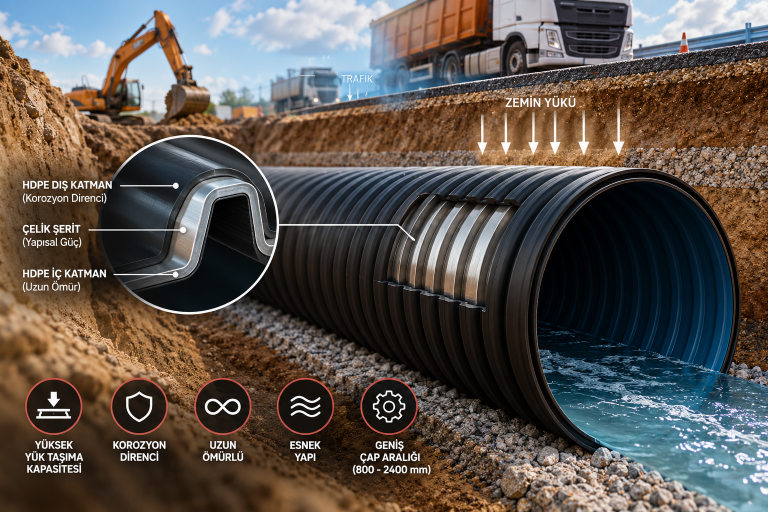
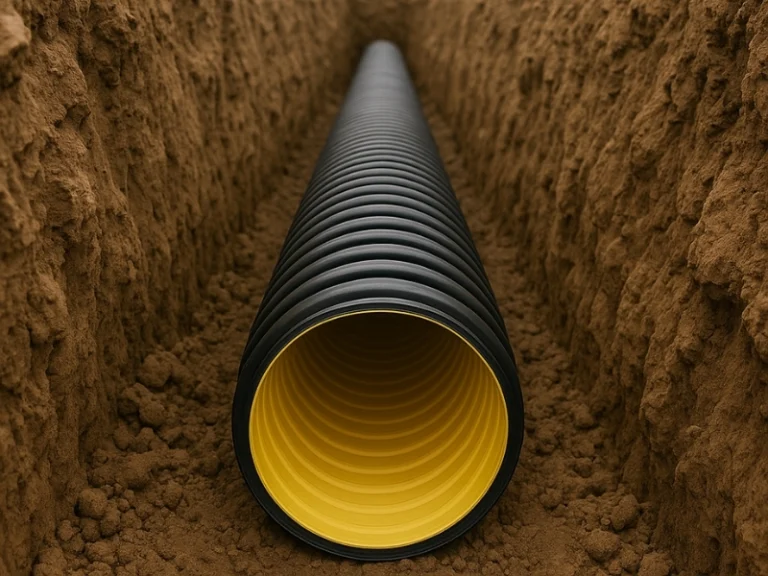
Thanks to a special profile design, they are generally manufactured from PE or PP raw materials so that the outer surface is ribbed (increasing ring stiffness) and the inner surface is smooth (facilitating flow).
Owing to their high ring stiffness classifications, they demonstrate excellent resistance against traffic and underground static loads. They are ideal for gravity-driven (gravity flow) sewer systems.
| Pipe Type |
Key Engineering Feature |
Flow and Performance Advantage |
Ideal Area of Application |
| PVC |
High rigidity and chemical resistance |
Continuous flow with non-sedimenting surface |
Wastewater, drainage, cable conduits |
| PE |
Flexibility and 100% leak-proof sealing |
Water hammer dampening, pressure tolerance |
Pressurized water, natural gas transmission |
| PPRC |
High thermal stability |
Prevention of cross-section narrowing and scaling |
Indoor hot/cold sanitary plumbing |
| GRP |
High strength-to-weight ratio |
Trouble-free high flow transfer in large diameters |
Main transmission lines, industrial plants |
| Corrugated |
Optimized ring stiffness (SN) |
Hydraulic smoothness while resisting external loads |
Gravity sewer, infrastructure systems |
Frequently Asked Questions
- Which engineering parameters should be considered when selecting pipe materials for projects?
The selection process relies on fundamental dynamics such as operating pressure, the velocity of the fluid to be transmitted, its chemical properties, and the operating temperature. Besides these, soil mechanics are highly important: while flexible PE pipes stand out in soils with sismik activity or settlement risks, corrugated pipes with high ring stiffness should be preferred in gravity lines carrying high soil or traffic loads (static/dynamic loads).