What are the pressure and leak tests for PE 80 natural gas pipelines?
Infrastructure Projects
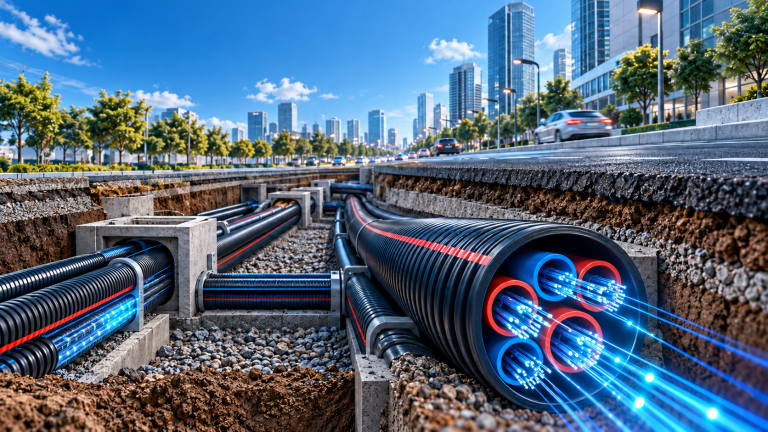
It serves as the main carrier line in the construction of underground networks in urban and industrial development zones. The ribbed structure on the outer surface absorbs traffic (dynamic) and soil (static) loads by flexing and transfers them to the surrounding backfill material.
This structural flexibility ensures that the lines maintain their integrity without breaking during seismic movements, such as earthquakes, or ground settlements.
Drainage Systems
In soils where the groundwater level is high, perforated types are used to remove water from building foundations or road infrastructures. When used with geotextile felts wrapped around them, the entry of fine dust into the pipe is prevented while groundwater is safely discharged along the hydraulic slope.
Wastewater Lines
In domestic and urban sewage discharges, it shows full resistance to chemical corrosion and H2S (hydrogen sulfide) gas. The hydraulic smoothness of its inner wall minimizes the friction coefficient in flow analyses (e.g., in Manning equation parameters).
Stormwater Systems
It offers high hydraulic capacity for the collection and removal of sudden and high-flow surface waters. Thanks to its inner structure that does not create sectional narrowing, it ensures the rapid conveyance of rainwater to discharge channels or reservoirs in areas with high flood risk (especially with Triplex corrugated pipes).
Agricultural Applications
It plays a critical role in the reclamation of agricultural lands, particularly in reducing salinity and draining groundwater (in-field drainage). Furthermore, it provides a reliable infrastructure solution in non-pressurized agricultural irrigation water transmission lines, thanks to its long-lasting structure resistant to soil chemicals.
Frequently Asked Questions
What is Ring Stiffness (SN) and how is it determined in a project?
Ring stiffness is the circular deflection resistance of a flexible pipe against external static (soil) and dynamic (traffic) loads. It is expressed in $kN/m^2$ (e.g., SN4, SN8, SN16). When selecting the SN value for a project, the soil-pipe interaction is calculated by considering parameters such as the burial depth of the pipe, groundwater level, soil type, and the traffic load that will pass over it.
How does the quality of bedding and surround (backfill) processes affect the system in corrugated pipes?
In corrugated pipes, the carrier system is not just the pipe itself, but the pipe + compacted soil duo. If the bottom (bedding) and sides (surround) of the pipe are not compacted in layers with granular material according to the project, the pipe cannot transfer the load to the soil.