

Blog
What is Kuzeyboru Polestra™ Technology?
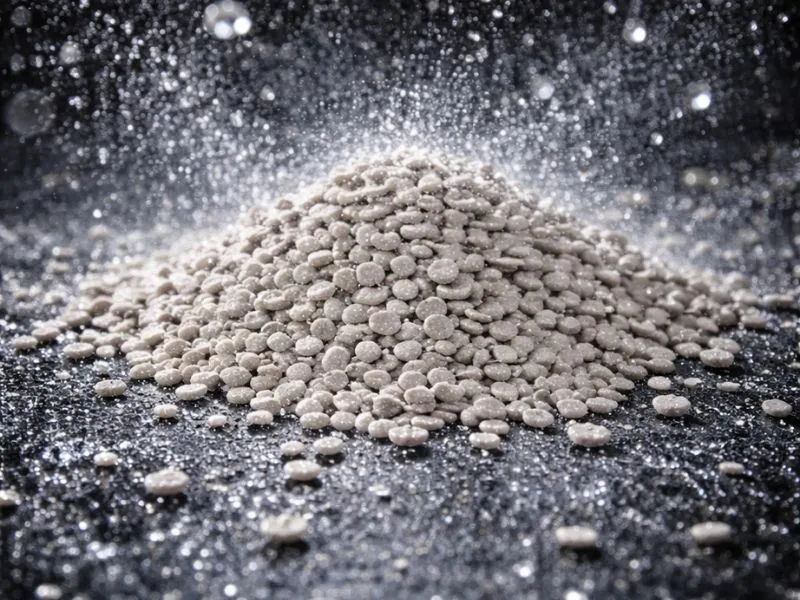
An Innovative Hybrid Filler for Polymer Composite Systems: Kuzeyboru Polestra™ Technology
What is Polestra™? In infrastructure projects, pipe selection is generally cost-oriented. However, the true cost of a pipe that will remain underground for decades is determined not just by its purchase price, but by its durability. That is precisely why we developed Polestra™. Polestra™ is an innovative hybrid filler technology developed by the Kuzeyboru R&D Center for polymer composite systems. Developed to optimize the mechanical and thermal properties of composite systems with a thermoplastic matrix, Polestra™ is an innovative hybrid formulation that surpasses traditional single-component filler approaches. Primarily designed for use in polymer-based product groups, this structure is an advanced engineering solution that simultaneously maximizes high mechanical strength (stiffness, impact damping), superior chemical resistance, structural lightweighting, and industrial-scale cost-effectiveness parameters.
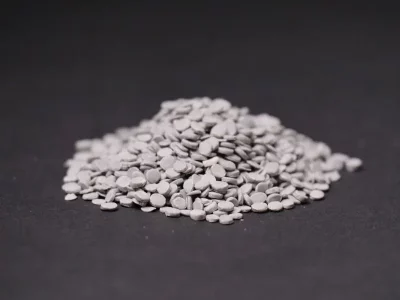
Hybrid filler system in granule form: Polestra™
The thermodynamic and morphological success of Polestra™ relies on the synergistic interaction between the phases within its structure. It is a hybrid filler system reinforced with selected inorganic particles to enhance the mechanical performance and structural stability of the material, and modified with an elastomeric phase to eliminate the potential brittleness risks and interfacial stresses that rigid inorganic structures might create within the matrix.
Thanks to the elastomeric phase, the system builds an excellent bridge between the inorganic fillers and the polymer matrix, creating a structure that increases impact strength.
In the final stage, Polestra™ is formulated in a solid granule morphology where its organic and inorganic components are homogeneously dispersed with high dispersion capability, without disrupting the melt flow in extrusion processes.
Material Characterization - Microstructure Analysis
The effectiveness of the Polestra™ hybrid filler system within the thermoplastic matrix must be evaluated through the morphological structure and interfacial interactions formed by the components.
In this context, the microstructural homogeneity, particle dispersion, and interfacial bonding quality of the hybrid filler material were investigated using Scanning Electron Microscopy (SEM) images.
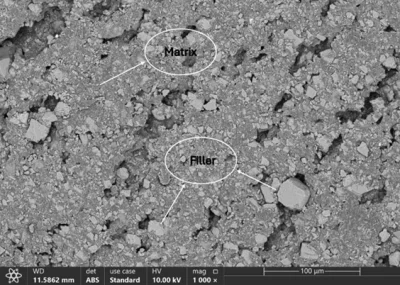
SEM microstructure image of the inorganic hybrid filler system Polestra™
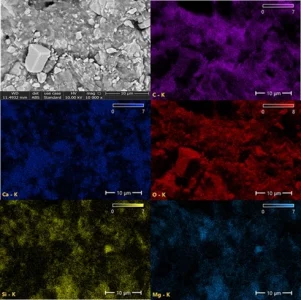
Elemental signal map image of the hybrid filler material Polestra™
Performance Increase in HDPE Double-Wall Corrugated Pipes
In mechanical analyses performed on HDPE pipes additive-modified with Polestra™ hybrid filler, it was determined that the ring stiffness values of the pipes ranged between 9.43 and 12.20 kN/m² (average ≈10.7 kN/m²).
In contrast, it was observed that these values remained at levels between 6.12 and 9.06 kN/m² (average ≈7.45 kN/m²) in reference pipes produced with standard filler formulations.
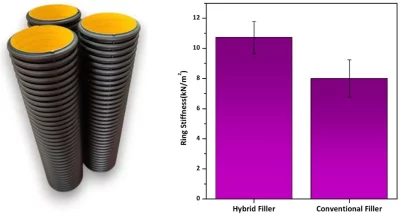
SN8, Ø200 HDPE double-wall corrugated pipes produced with Polestra™ filler technology (Left), Comparison of the ring stiffness property in double-wall corrugated pipes produced with hybrid Polestra™ filler technology and conventional filler (Right)
This significant mechanical increase, corresponding to approximately 43%, is a critical value for the structural integrity of double-wall corrugated pipe systems. This is because ring stiffness is the most fundamental indicator of a pipe's capacity to resist vertical deflection when exposed to soil backfill and dynamic traffic loads in underground infrastructure applications.
The elastomeric modification in the hybrid structure of Polestra™ optimizes load transfer, significantly increasing the material's capacity to damp these external stresses.
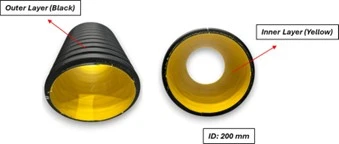
Structural change of SN8, Ø200 HDPE double-wall corrugated pipes produced with Polestra™ filler technology as a result of the ring flexibility test (ID: internal diameter)
The ring flexibility test results demonstrated that all evaluated pipes preserved their structural integrity under the specified deformation, and no visible cracks, delamination (interlaminar separation), or wall collapse occurred.
Effects on the Extrusion Process and Sustainability
The Polestra™ hybrid filler material facilitates processing by improving melt fluidity in extrusion systems and minimizes unit production costs. Its high compatibility with the original polyethylene raw material, particularly in corrugated pipe extrusion lines, significantly reduces scrap rates, offering a sustainable and operationally flexible production model.
The elastomeric phase integrated into the system delivers superior processability thanks to the elasticity it imparts to the melt; it increases extrusion efficiency and die life by damping in-die shear stress.
Patent and Contribution to the Scientific Ecosystem
The Polestra™ hybrid filler technology has materialized as a result of a long-term and systematic R&D vision. The intellectual property rights of this unique formulation have entered the process of being secured via a patent application.
Our research article, which presents the performance increase of Polestra™ in HDPE double-wall corrugated pipe production and the morphological effects of the elastomeric phase-modified hybrid inorganic filler system with full scientific transparency, has been published in MDPI-Polymers, one of the world's prestigious (Q1 class) academic journals in the field of polymer science.
(For the article doi: https://doi.org/10.3390/polym18030385).
Emerging from the laboratories of the Kuzeyboru A.Ş. R&D Center and integrating into the global literature, this qualified publication and patent ecosystem is the most concrete indicator of our mission to produce value-added, innovative, and scientifically grounded sustainable technologies in the plastic pipe industry.
Related Articles

Material Comparison in Infrastructure Projects: GRP or HDPE?
Discover a comprehensive technical comparison between GRP and HDPE pipes for infrastructure

Ground Load Bearing Capacity and Engineering Principles of Steel Reinforced Corrugated Pipes
Discover how steel reinforced corrugated pipes combine polymer flexibility and structural steel

How to Ensure Leakproofness and Sound Insulation When Choosing PVC-U Wastewater Pipes?
In PVC-U wastewater pipes, the correct materials, seal technology, and installation practices are
Related Articles

PPRC Pipes and Fittings: Zero Errors in Hot and Cold Water Installations
PPRC pipes and fittings, which set the standards especially in hot and cold water lines, stand out with…
Selecting HDPE Pipes from 20 mm to 1600 mm: How to Calculate Capacity Based on Diameter Measurements?
Optimize hydraulic capacity and pressure loss from 20mm to 1600mm for efficient infrastructure.
Proper Trench Depth in Telecommunication Pipes
Modern superstructure engineering, the acoustic comfort of living spaces is as critical a design parameter as structural reliability.