

Blog
What is Zeroleak, an innovative sealing and connection technology for CTP pipes?
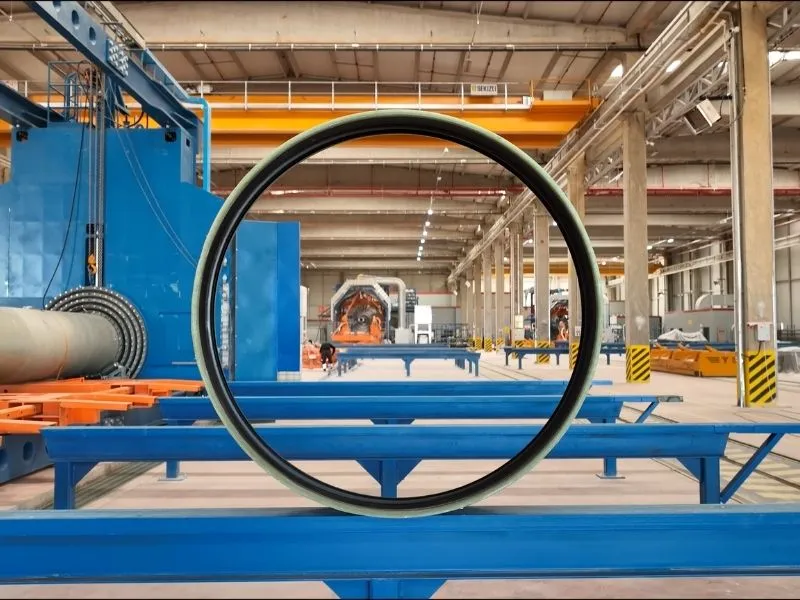
What is ZeroLeak?
The most vulnerable points of GRP pipelines are their joints. No matter how durable the pipe is, if the sealing at the connection point is insufficient, the integrity of the entire system is compromised. The ZeroLeak coupling technology developed by Kuzeyboru A.Ş. is an innovative jointing technology specifically designed to address this problem.
Developed to prevent flow losses, minimize pressure drops, and increase system stability, the fundamental anatomy of ZeroLeak is built upon the principles of high strength and absolute watertightness. The body structure is manufactured using continuous "Filament Winding" technology, which provides exceptional high-pressure resistance and structural integrity.
Consequently, the hydraulic efficiency and operational lifespan of GRP pipelines in infrastructure projects are substantially increased.
Structural and Morphological Design of the Next-Generation GRP Coupling
In the design of the ZeroLeak coupling, a full-surface EPDM lining was preferred over localized internal sealing. This geometry, which maintains full contact with the pipe surface, is supported by double and triple gasket profiles to maximize sealing safety.
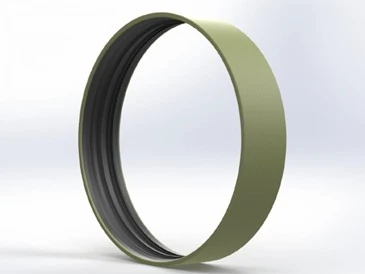
Design of ZeroLeak Sealing Technology
ZeroLeak is specifically engineered for infrastructure projects to minimize flow losses and deliver long-lasting operational performance.
Elastomeric Gasket Engineering and Hydrostatic Sealing
The core engineering anatomy of the product can be systematically detailed as follows:
- Filament Winding Composite Body: Manufactured via continuous filament winding technology, the coupling body provides high circumferential and axial mechanical strength, while the lightweight nature of the composite structure ensures ease of field installation.
- Full-Surface EPDM Inner Lining: Unlike standard localized sealing methods, 100% of the internal surface of the coupling is lined with EPDM. This full-contact geometry creates a maximum contact surface area between the pipe and the coupling, eliminating the risk of leakages.
- Ovality and Dimensional Deviation Control: Thanks to the double and triple gasket profile configuration, complete compatibility and absolute watertightness are achieved even during in-field roundness loss (ovality) and out-of-tolerance pipe joints.
- Homogeneous Load Transfer: The optimized body structure evenly distributes static and dynamic loads at the pipe-coupling joint, preventing localized stress concentrations and increasing overall stability.
- Damping and Compensation: The shock-absorbing structure dampens impacts arising from ground movements and vibrations. It compensates for expansion stresses induced by temperature fluctuations, preserving the long-term durability of the pipeline.
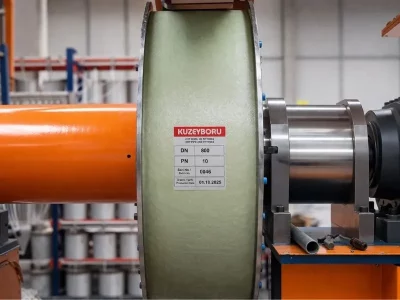
Mechanical Performance: Axial Load Transfer and Ring Stiffness (SN)
The newly developed, innovative GRP coupling technology creates an advanced energy-dissipating network that absorbs external mechanical shocks due to a 3D porous architecture integrated into its composite wall.
This optimization eliminates brittleness risks by dispersing impact energy at a microscopic level. It provides a net increase of 20% to 30% in impact resistance compared to standard manufacturing methods.
Furthermore, resin-fiber material optimizations applied to reinforce the axial load transfer mechanism in underground applications increase the nominal ring stiffness of the coupling by 20%.
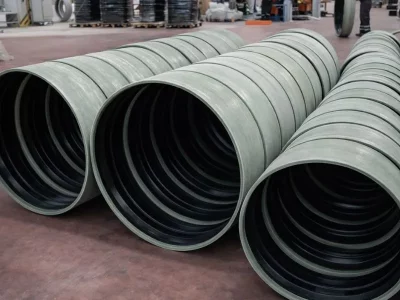
ZeroLeak Couplings manufactured in different diameters
The mechanical enhancements provided entirely eliminate the risk of ovalization and strength losses caused by deformation under long-term static and dynamic loads.
Consequently, equipped with a 3D porous structure and high ring stiffness, this innovative design guarantees that the system perfectly preserves its hydraulic integrity and axial stability throughout its design life.
Systemic Advantages of ZeroLeak Superior Sealing Technology
Manufactured on state-of-the-art automated production lines and subject to strict quality control protocols at each phase, ZeroLeak couplings are verified through rigorous high-pressure testing to deliver uncompromising operational reliability across varying nominal diameters.
The chemical inertness and corrosion resistance of the thermoset composite structure preserve the coupling's structural integrity over long years under aggressive soil conditions and chemical fluid transport. Combined with quick and effortless installation that reduces on-site labor demands, these morphological and mechanical optimizations minimize the total investment and operational maintenance costs (OPEX) in infrastructure projects.
Related Articles

Material Comparison in Infrastructure Projects: GRP or HDPE?
Discover a comprehensive technical comparison between GRP and HDPE pipes for infrastructure

Ground Load Bearing Capacity and Engineering Principles of Steel Reinforced Corrugated Pipes
Discover how steel reinforced corrugated pipes combine polymer flexibility and structural steel

How to Ensure Leakproofness and Sound Insulation When Choosing PVC-U Wastewater Pipes?
In PVC-U wastewater pipes, the correct materials, seal technology, and installation practices are
Related Articles
Quality Control Processes in Pipe Systems: Durability and Service Life Tests Conducted in Accredited Testing Laboratories
A pipeline’s ability to remain in service for 50 years—or even longer—begins with the tests conducted before it…

The Key to Comfort in Underfloor Heating Systems: PE-RT and PE-XB Pipes
The Key to Comfort in Underfloor Heating Systems: PE-RT and PE-XB Pipes In modern building architecture, thermal comfort…
Why Choose Kuzey Boru HDPE Pipes? The Address of Trust in Infrastructure Projects
The performance of HDPE pipes is based on the selection of the right raw materials, controlled production processes,…