

Blog
Selecting HDPE Pipes from 20 mm to 1600 mm: How to Calculate Capacity Based on Diameter Measurements?
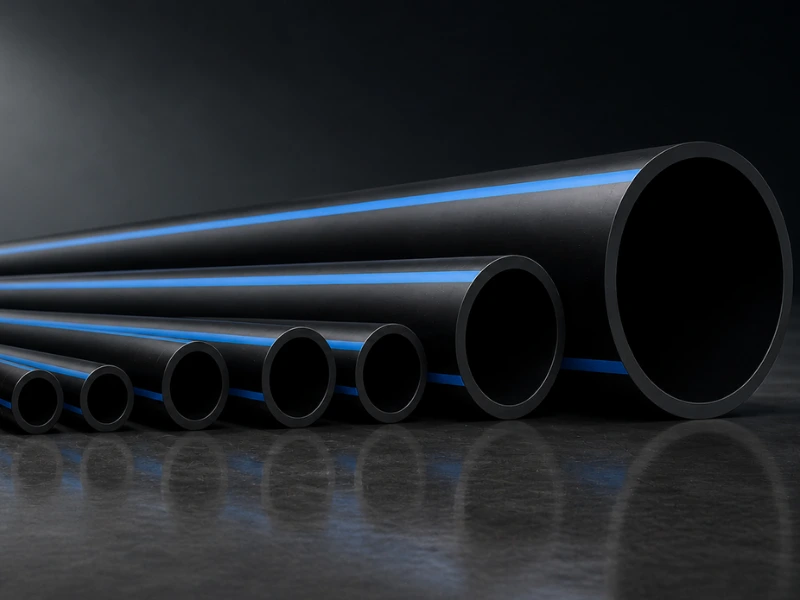
In infrastructure engineering, the efficiency of hydraulic networks is directly dependent on the thermodynamic properties of the fluid to be transported and the geometric characteristics of the selected pipe. High-Density Polyethylene (HDPE) pipes are indispensable products for modern fluid transfer systems due to their absolute resistance to corrosion, viscoelastic structure, and exceptionally smooth internal wall morphology. This blog post examines the hydraulic capacity calculations and engineering criteria behind selecting the correct polyethylene pipe diameter across a wide production range from 20 mm to 1600 mm.
Determining Diameter Based on Energy Capacity and Flow Requirements
The most fundamental step in designing a pipeline is determining the expected volumetric flow rate (Q) and calculating the internal diameter that will transport this flow at the optimum velocity. Diameter selection is formulated using the Continuity Equation, the basic rule of fluid mechanics:

In engineering practice, the optimum flow velocity (v) for potable water lines is generally limited to a range between 1.0 m/s and 2.0 m/s. Velocities that are too low lead to the settling of suspended solids (sedimentation), while velocities that are too high (especially above 3.0 m/s) intensify water hammer fluctuations and increase the risk of cavitation. Selecting the correct diameter involves finding the optimum cross-sectional area that safely conveys the target flow rate within these velocity limits.
Diameter Options from 20 mm to 1600 mm
The diversity of infrastructure projects necessitates a very wide geometric production scale. Advanced extrusion technologies allow for standard HDPE pipe diameter measurements, which are divided into three main engineering categories based on the project’s mass flow requirements:
- Small Diameters (DN 20 mm – DN 110 mm): These are capillary distribution lines generally used in building sanitary plumbing connections, agricultural drip/sprinkler irrigation systems, and telecommunication fiber optic cable protection (corrugated or smooth).
- Medium Diameters (DN 125 mm – DN 630 mm): Standard infrastructure pipes used in the main arteries of urban drinking water networks, industrial process water transfer, and fire hydrant lines, resistant to high-pressure classes (PN 16 – PN 25).
- Large Diameters (DN 710 mm – DN 1600 mm): Macro-engineering structures with massive flow capacities used in giant main transmission lines carrying water from dams to cities, deep sea discharge (outfall) projects, and cooling water discharges for thermal/nuclear power plants.
Hydraulic Pressure Loss Calculations
As fluid moves through a pipe, it loses a portion of its hydraulic energy due to its own internal viscosity and friction against the pipe wall (Head Loss). The greatest advantage of HDPE pipes is that their absolute internal wall roughness value (k) is only around 0.007 mm (this value is 0.05 mm for steel and 1.0 mm for concrete). Continuous head losses in pressurized pipes are generally calculated using the Hazen-Williams Equation:

As understood from the formula, pressure loss is inversely proportional to approximately the 5th power of the pipe diameter.
Measurement Compatibility in Fitting Integration
The most important element ensuring system integrity in HDPE pipelines is the jointing technology. During butt-welding or electrofusion processes, it is a thermodynamic necessity that the Standard Dimension Ratio (SDR = Outer Diameter / Wall Thickness) of the pipe and the fitting be perfectly compatible.
Two pipes with the same outer diameter (e.g., DN 500 mm) but different pressure classes (e.g., PN 10 and PN 16) will have different wall thicknesses, and therefore, different internal diameters (Di). This situation creates a “hydraulic step” at the welding interface, leading to turbulent flow and localized cavitation. Therefore, project design should be based not just on the outer diameter of the pipe, but on the SDR class to calculate the net internal diameter and fitting compatibility.
Project-Specific Custom Production Solutions
Beyond standard molds, every infrastructure project has its own thermomechanical and logistical realities. Kuzeyboru offers specific solutions for your projects through flexible and highly automated production lines:
- Size Optimization: The capability to produce single-piece lengths of 12, 13.5, or 15 meters—adapted to truck/ship logistical limits—to reduce the number of welds and labor costs.
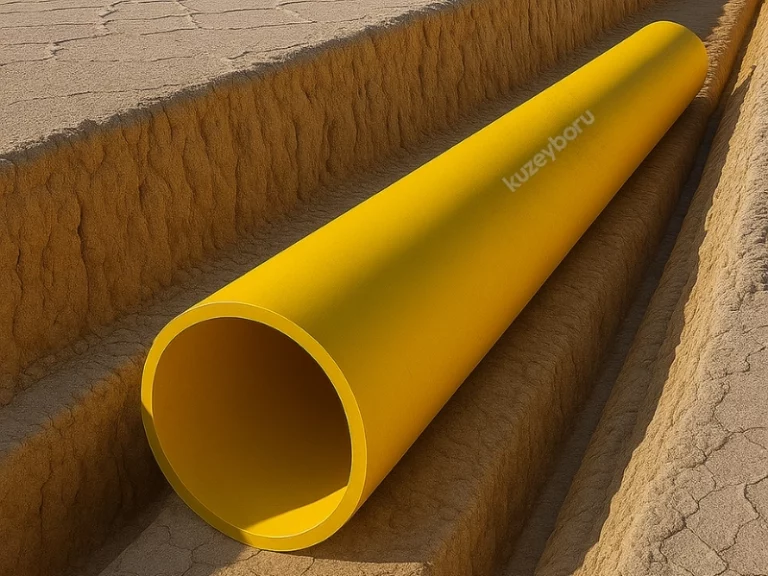
- Color and Line Coding: Project-specific laser marking and color coding according to the intended use (yellow for natural gas, blue for drinking water, brown-striped for wastewater, or full co-extrusion surfaces).
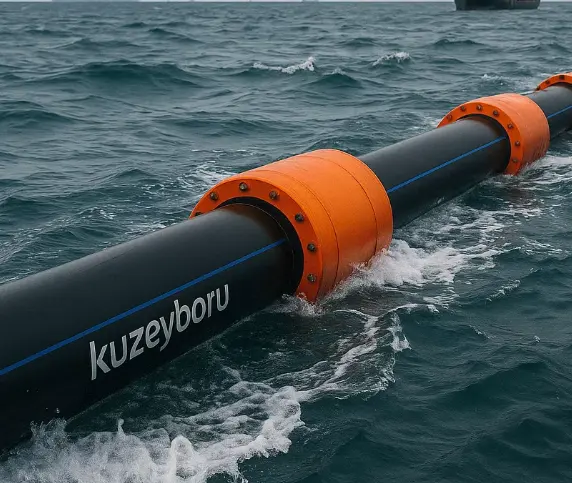
- Offshore and Floating Line Applications: Leveraging the characteristic positive buoyancy of HDPE material to produce specific pipes resistant to hydrodynamic shocks for sea discharge and port dredging projects.
Related Articles

PPRC Pipes and Fittings: Zero Errors in Hot and Cold Water Installations
PPRC pipes and fittings, which set the standards especially in hot and cold water lines, stand out

WHAT IS GRP (GLASS REINFORCED POLYESTER) PIPE? AN INDISPENSABLE CANDLE FOR LARGE-SCALE PROJECTS.
GRP (Glass Reinforced Polyester or Glass Fiber Reinforced Plastic) is a composite material that

The Key to Comfort in Underfloor Heating Systems: PE-RT and PE-XB Pipes
The Key to Comfort in Underfloor Heating Systems: PE-RT and PE-XB Pipes In modern building
Related Articles

What is a check valve and how does it work?
A technical engineering guide to sustainable GRP pipe advantages.
What are the pressure and leak tests for PE 80 natural gas pipelines?
Technical analysis of corrugated pipes in urban infrastructure, storm water, and agriculture.
Use of HDPE Pipes in Sea Discharge Projects
Marine outfall and underwater pipeline projects are chemical conditions coexist.