Quality Control Processes and Accredited Testing Laboratories in Piping Systems
Advanced infrastructure and superstructure systems must offer a service life exceeding half a century against geotechnical stresses from underground loads, hydrostatic internal pressures, and environmental degradation. The ability of thermoplastic pipes to withstand these harsh conditions is guaranteed not by chance on the production line, but through a rigorous and systematic series of pipe quality control tests.
Spanning from the polymer's macromolecular chain structure to the dispatch of the pipe to the field, this process must pass through the impartial and scientific approval of accredited testing laboratories.
1. Impact, Pressure, and Abrasion Tests Applied to Plastic Pipes
The mechanical characterization of a thermoplastic pipe is determined by destructive testing simulating various stress conditions.
-
Hydrostatic Pressure and Creep Tests (EN 1167): The viscoelastic structure of the pipe tends to expand—i.e., creep—over time when subjected to continuous pressure. In these tests, pipe samples are exposed to a specific internal pressure in special conditioning baths, for instance at 20°C or 80°C. The objective is to measure how long the polymer's macromolecular bonds can withstand pressure for hours, or in some cases thousands of hours, without rupturing.
-
Tup Impact Tests (EN 744 / EN 12061): Pipes with a more rigid structure such as PVC-U, or those with cold deformation capability like HDPE, are cooled down to 0°C or -2°C to simulate job site conditions during winter months. A steel weight (striker) of a specific mass is dropped onto the pipe wall in free fall. This test verifies the material's resistance to brittle fracture.
-
Abrasion Tests: Particularly in mining, dredging, and sewage pipes, the hydrodynamic friction created on the inner pipe wall by solid particles within the fluid, such as sand and gravel, is tested. The abrasion resistance of polyethylene and polyurethane-based systems compared to steel pipes is proven through these simulations.
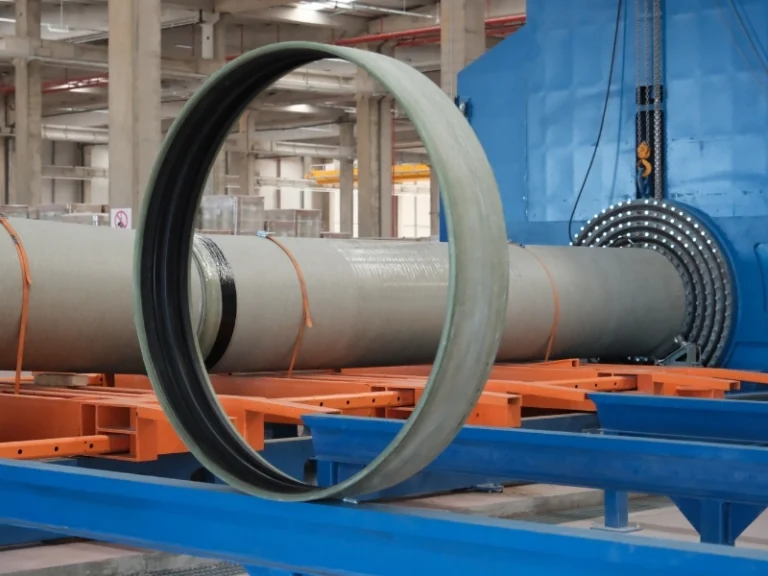
Additionally, the long-term abrasion resistance of GRP pipes is verified internationally via the Darmstadt Abrasion Test conducted under PD CEN/TR 15729.
2. Quality Standards Extending from Raw Material Reception to Shipment
Quality control in pipe manufacturing does not begin with the final product coming off the extrusion line; it starts with the raw material entering the production facility. Zero-defect tolerance relies on a three-stage inspection approach.
i. Incoming Quality Control
Before thermoplastic raw materials are accepted into silos, they undergo comprehensive quality control tests in the laboratory. Density analyses (ISO 1183) ensure the control of the material's density values and structural properties.
Oxidation Induction Time (OIT - ISO 11357-6) tests provide insight into the material's oxidative thermal stability and the effectiveness of the stabilizer system. Melt Flow Index (MFI / MFR - ISO 1133) testing is performed to verify the thermal fluidity and molecular weight distribution of raw material batches in the machine.
Ash Content Testing (ISO 3451) is conducted to measure polymer purity and determine the amount of inorganic residue. Furthermore, Volatile Matter Content (EN 12099) analyses are carried out to determine the amount of gas and moisture that could create micro-voids in the polymer melt during extrusion, leading to mechanical weakness.
ii. In-Line Process Control
During extrusion, ultrasonic sensors scan the pipe wall thickness and outer diameter within milliseconds. Thermodynamic data such as melt temperature, calibration vacuum, and line speed are continuously monitored by automation systems.
Thanks to this continuous monitoring, localized wall thinning that might occur during production is instantly prevented.
iii. Final Quality Control (Batch Release)
Final destructive tests are performed on batch-based samples taken from the extrusion line, proving how theoretical engineering parameters perform in the field.
Along with strict dimensional inspections, tests performed include Elongation at Break (ISO 6259) to prove the material's elastic limits, Ring Stiffness (ISO 9969) to measure resistance against underground static loads, Ring Flexibility (ISO 13968) to determine the lateral deformation the pipe can absorb without breaking, and Rapid Crack Propagation (RCP - ISO 13477) to model failure mechanics under sudden shock.
Following these tests, the product batch is officially approved for shipment.
3. The Importance of Accredited Laboratory Reports in International Tenders
In global infrastructure projects and international EPC contracts, test results obtained from independent and competent laboratories, alongside manufacturer declarations, hold paramount importance in verifying the quality and long-term performance of thermoplastic pipes.
In this context, TS EN ISO/IEC 17025 accreditation is an internationally recognized indicator of competence that guarantees a laboratory's technical capability to perform specific tests, as well as the reliability and traceability of measurement results.
Kuzeyboru R&D Laboratory is accredited by the Turkish Accreditation Agency (TÜRKAK) under the TS EN ISO/IEC 17025 standard. Thanks to TÜRKAK's international recognition within the scope of ILAC-MRA, test reports within the accreditation scope serve as a reliable reference in technical evaluation, quality control, and compliance processes for international projects.
Results obtained from tests such as hydrostatic pressure, ring stiffness, and melt flow rate (MFI) are presented based on defined standards and controlled laboratory procedures.
FAQ (Frequently Asked Questions)
1. What does the hydrostatic pressure test applied to plastic pipes measure?
It is applied to evaluate the pipe's resistance to long-term hydrostatic load under specific temperature and internal pressure conditions, as well as its creep, cracking, or bursting behavior during the test period.
2. How is the lifetime testing (HDB and MRS) of pipes conducted?
Pipe samples are subjected to long-term hydrostatic pressure tests under varying temperature and internal pressure conditions. The resulting strength data are evaluated using statistical methods defined in relevant standards to establish long-term hydrostatic strength curves.
Based on compliance criteria, long-term strength parameters such as HDB or MRS are determined.
3. What accreditation certificates do Kuzeyboru laboratories hold?
Kuzeyboru R&D Laboratories are accredited by TÜRKAK under the TS EN ISO/IEC 17025 standard. Tests within the scope of accreditation are performed based on the laboratory's technical competence, measurement traceability, and compliance with relevant standards.
4. Why is the MFR (Melt Flow Rate) test critical in pipe testing?
MFR (Melt Mass-Flow Rate) or commonly MFI characterizes the flow behavior of polymer melt under specific temperature and load. It is a critical quality parameter in controlling the processability and batch consistency of raw material lots.
5. How can we identify defectively manufactured pipes at a job site without testing?
Visual and dimensional inspections can allow certain potential manufacturing defects to be noticed in advance. Voids or pores inside the wall, significant surface roughness, color and appearance discrepancies, excessive ovality, or notable wall thickness irregularities are key indicators to watch for.
However, these observations alone do not definitively prove that the pipe is defective in terms of performance or compliance. When necessary, verification must be conducted through laboratory testing in accordance with relevant standards.