GRP Pipes vs Conventional Pipes in Industrial Infrastructure
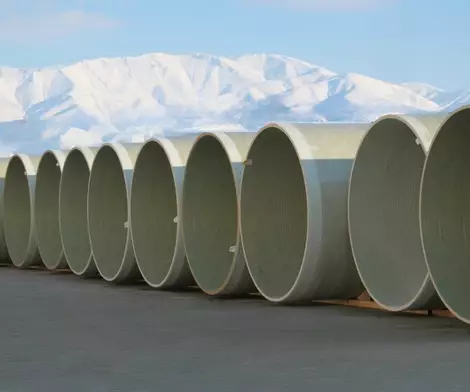
In modern industrial infrastructure projects, the efficiency and structural integrity of fluid transfer systems are directly dependent on the mechanical and thermodynamic properties of the selected pipe material. Conventionally utilized steel, concrete, and ductile iron pipes are increasingly being superseded by Glass Reinforced Plastic (GRP) pipes, owing to their superior polymer matrix composite structures. In this blog post, we will explore the engineering advantages GRP pipes offer over conventional pipes within the framework of industrial infrastructure pipe selection criteria.
Differences Between GRP Pipes and Conventional Pipes
Conventional pipes, such as steel and concrete, have a macroscopically isotropic structure (exhibiting the same mechanical properties in all directions). In contrast, GRP pipes exhibit an anisotropic and custom-designable mechanical behavior due to the orientation of the glass fibers and the viscoelastic characteristics of the polymer resin.
The fiber winding angle during the production of GRP pipes is optimized to maximize the pipe's strength against internal pressure and axial loads (such as soil load and traffic movements). While conventional steel pipes present inertial forces and transportation difficulties due to their high density, GRP pipes offer high specific strength (strength-to-density ratio).
Production and Mechanical Properties
Property
Steel
Cast Iron
Concrete
Composite
Density (g/cm³)
≈ 7.85
≈ 7.05
≈ 2.40
1.6 – 2.0
Tensile Strength (MPa)
300 – 500
400 – 500
Low
100 – 300
Modulus of Elasticity (GPa)
200
170
25-30
20-40
Production Energy
Very High
High
High
Medium
Service Life (years)
30 – 50
50 – 100
50 – 75
50+ (estimated)
Corrosion Resistance
Low
Medium
Medium
Very High
Sources: TS EN 12201, ISO 9080, ASTM D2996, PlasticsEurope (2021), TEPPFA (2019), Callister Materials Science Handbook.
Application and Environmental Performance
Property
Steel
Cast Iron
Concrete
Composite
Unit Weight (kg/m, DN200)
Heavy (~35)
Very Heavy (~55)
Very Heavy (~80)
Light (~12)
Ease of Installation
Medium
Difficult
Difficult
Medium
Maintenance Requirement
High
Medium
Medium
Low
Recyclability
High (100%)
High (100%)
Low (aggregate)
Limited (~30%)
Carbon Footprint (kg CO₂/m)
Very High (~50)
High (~120)
High (~95)
Medium (~25)
Sources: PlasticsEurope EPD (2021), TEPPFA Service Life Report (2019), DVGW Worksheet GW 320-1, ISO 14040 LCA studies, EN 805 (drinking water pipe systems).
Cost Analysis in Industrial Projects
In industrial projects, material selection should be evaluated not only based on the initial investment cost (C_initial) but also through the Life Cycle Costing (LCC) approach. In GRP pipe comparative analyses, the LCC model is formulated as follows:
Operational Costs (C_operation): These are pumping energy costs. Thanks to the low hydraulic roughness of GRP pipes, friction losses are reduced, which dramatically lowers energy consumption.
Maintenance Costs (C_maintenance): While conventional pipes require cathodic protection, internal lining renewal, or leak repairs, these costs are almost zero for GRP pipes.
Transportation and Installation: Due to their lightweight nature, the need for heavy machinery is reduced, and the installation speed is 3-4 times higher compared to conventional systems.
Longevity and Performance Comparison
While the absolute internal surface roughness coefficient of GRP pipes is approximately 0.01 mm, this value is around 0.05 mm for new steel pipes and 1-3 mm for concrete pipes. Over time, due to corrosion and tuberculation, the roughness of steel and concrete pipes increases, the cross-section narrows, and the flow velocity drops, thereby reducing system capacity. GRP pipes, on the other hand, maintain their hydraulic smoothness and nominal flow rate just like the first day throughout their service life of over 50 years.
Corrosion Resistance of GRP Pipes
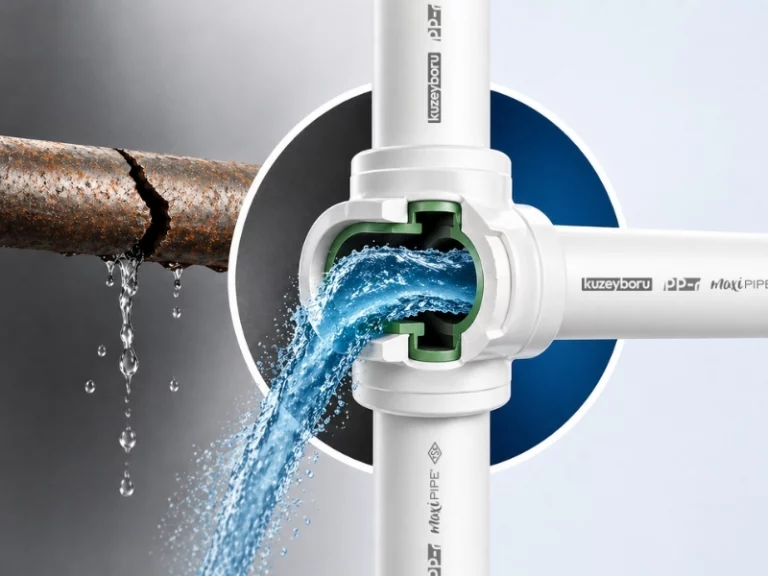
The primary disadvantage of conventional pipes is their susceptibility to electrochemical corrosion. In underground applications, the metal surface degrades rapidly as a result of anodic and cathodic reactions.
GRP pipes, however, do not participate in electrochemical reactions. The thermoset polymer matrix exhibits superior resistance in soil and fluid environments characterized by aggressive chemicals, high acidity (pH<4), or high alkalinity (pH>10). The theoretically zero corrosion rate (CR) eliminates the need for additional insulation or cathodic protection engineering.
Solutions Developed by the R&D Center
As the Kuzeyboru R&D Center, we focus on producing proactive engineering solutions for infrastructure problems. In the design of GRP pipes, using advanced Finite Element Analysis (FEA) software such as Simcenter 3D, soil and traffic loads on the buried pipeline, internal pressure, and long-term creep behavior are simulated, optimizing each pipe according to the field conditions in which it will operate.
By optimizing the glass fiber winding angle, fiber/resin ratio, and layer arrangement in continuous filament winding technology, the ring stiffness (SN class) and hydrostatic strength of the pipes are designed according to the pressure (PN) and diameter (DN) requirements of the project. In this way, pipe solutions tailored specifically to the load and operating conditions are produced for each project.
Sustainable Production Approach
The industrial infrastructure of the future requires not only mechanical strength but also ecological responsibility. The high energy consumed and carbon emissions released in the production of steel and ductile iron pipes contradict environmental sustainability goals.
The production processes of GRP pipes have a low carbon footprint and high energy efficiency. Furthermore, within the framework of circular economy principles, introducing green composite filler materials with recycled carriers and multi-polymers to the sector through R&D studies both prevents material waste and forms the foundation of lightweight, environmentally friendly, and high-strength next-generation pipe systems.