How to Ensure Leak-Tightness and Sound Insulation When Choosing PVC-U Wastewater Pipes?
In modern building engineering, indoor sewerage and wastewater drainage systems are not merely simple pipe networks operating by gravity. These systems are complex hydraulic structures that must withstand chemical waste with continuously varying pH levels, thermal expansion, and hydrodynamic shocks caused by vertical flow.
Today, one of the most practical thermoplastic solutions capable of meeting these requirements is unplasticized PVC-U wastewater piping systems. Two key factors determine the structural service life of a wastewater installation: effective leak-tightness at socket joints and the damping of vibrations (acoustic noise) generated by fluid mechanics.
1. Advantages of PVC-U Material in Indoor Wastewater Systems
PVC-U (Unplasticized Polyvinyl Chloride), one of the fundamental materials used in indoor wastewater installations, does not contain plasticizing agents such as phthalates in its macromolecular structure. This rigid, unplasticized characteristic keeps the polymer's modulus of elasticity at a relatively high level and provides excellent dimensional stability.
Domestic wastewater may vary across a broad pH range due to highly alkaline detergents from washing machines and dishwashers or cleaning acids. The molecular structure of PVC-U provides strong resistance to aggressive chemical corrosion.
In addition, its smooth internal surface helps minimize hydraulic losses in gravity-driven flow and reduces the formation of biofilm, scale, and sediment deposits on the inner pipe wall.
2. Special Gasket Technology for Leak-Tightness and Installation Tips
Leakage in wastewater systems generally occurs at connection points (sockets) rather than through the pipe body itself. PVC-U wastewater pipes use a push-fit socket system, in which leak-tightness is provided by elastomeric gaskets, typically EPDM or SBR, factory-installed inside the socket groove.
The sealing principle of the gasket is based on radial compression when the male end (spigot) is pushed into the socket, creating contact pressure against the pipe wall. However, the long-term performance of this system depends on the proper management of thermal expansion. Changes in wastewater temperature (ΔT) cause linear expansion (ΔL) in the pipe:
ΔL = α · L · ΔT
α: Thermal expansion coefficient of PVC-U material
Installation Tip: After the pipe has been fully inserted into the socket, it should be pulled back by 10 mm (1 cm) to allow for thermal expansion. If this tolerance is not provided, expansion may place excessive stress on the pipe and gasket, shortening the gasket's viscoelastic fatigue life and compromising the leak-tightness of the system.
Petroleum-based oils should never be used during gasket installation, as petroleum derivatives may damage the rubber matrix. Only suitable water-based lubricants should be used.
3. Quiet Wastewater Pipe Designs That Reduce Flow Noise
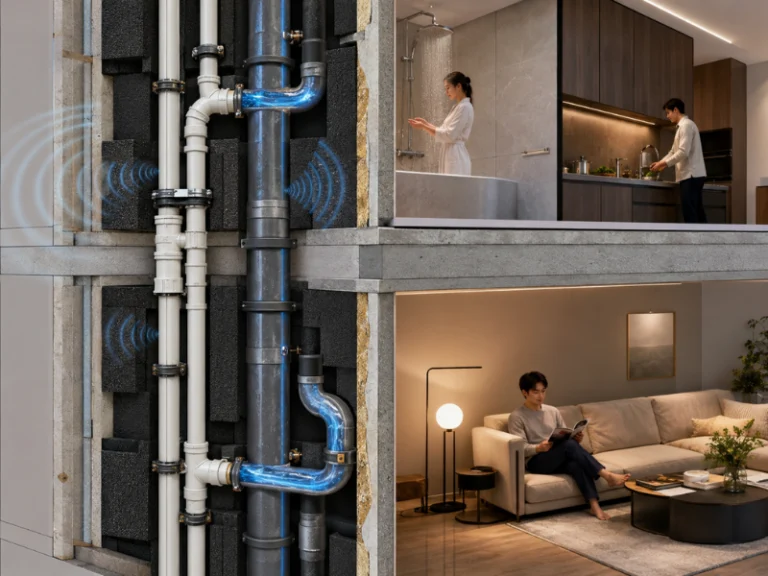
In multi-storey buildings, wastewater flowing freely down vertical stacks causes air and water to mix, creating two-phase flow and significant turbulence inside the pipe.
This hydraulic turbulence generates two main types of noise: Airborne Noise, caused by the vibration of air inside the pipe, and Structure-Borne Noise, generated when vibrations from the pipe wall are transmitted to the building structure through pipe clamps and fixing points.
Standard PVC-U pipes may not provide sufficient mass for advanced acoustic insulation applications. According to the Mass Law in acoustic engineering, the transmission loss of a material is directly related to its mass per unit area.
In modern three-layer low-noise wastewater pipes, mineral fillers such as barium sulfate (BaSO4) or specially selected calcite minerals can be incorporated into the polymer matrix. This mineral modification increases the density of the pipe compared with standard PVC.
The dense and weighted middle layer helps mechanically damp acoustic energy and improve sound insulation performance. To reduce the transmission of structure-borne noise to walls, pipes should also be fixed using acoustic clamps lined with elastomeric insulating material.
Frequently Asked Questions (FAQ)
1. What Is the Difference Between PVC-U and PPR Pipes?
PVC-U is a highly rigid polyvinyl chloride material used primarily in non-pressurized gravity wastewater systems and joined using adhesive or gasketed socket connections. PPR (Polypropylene Random Copolymer), on the other hand, is a more flexible polymer joined by heat fusion (polyfusion welding) and commonly used in pressurized hot and cold potable water installations.
2. What Should the Pipe Slope Be in Indoor Sewerage Systems?
To ensure that wastewater can transport solid particles without leaving deposits behind and maintain a self-cleaning flow, horizontal collector pipes should generally be installed with a slope of between 1.5% and 2% (approximately 1.5 to 2 cm per meter).
3. Are Kuzeyboru PVC-U Wastewater Pipes Fire Resistant?
Due to the chlorine atoms in its macromolecular structure, PVC-U inherently resists flame propagation. Its fire performance is evaluated in accordance with the relevant standards, and the material has self-extinguishing characteristics once the external flame source is removed.
4. Which Fittings Should Be Selected to Help Prevent Blockages in Wastewater Pipes?
Instead of sharp fittings that can increase local hydraulic losses and impact effects, fittings that provide smoother hydrodynamic transitions should be preferred. Appropriate Y-branches and bends can help maintain smoother wastewater flow, while cleanout fittings should be included to allow periodic maintenance and intervention.
5. How Are the Impact and Abrasion Resistance of Kuzeyboru PVC Pipes Tested?
In our accredited laboratories, the pipes are conditioned at low temperatures in accordance with applicable standards to simulate winter construction-site conditions and are subsequently subjected to impact tests.