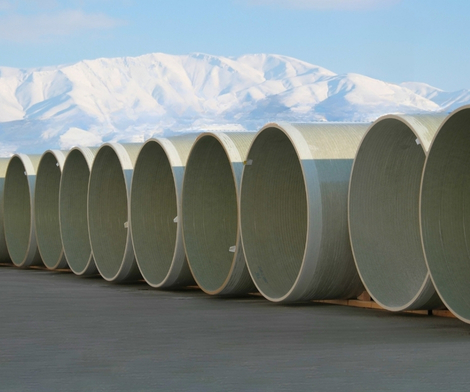
What Is a GRP (Glass Reinforced Polyester) Pipe? An Essential Solution for Large-Diameter Projects
The continuously increasing scale of infrastructure and building projects makes innovative and sustainable solutions in material technologies increasingly important. GRP (Glass Reinforced Polyester or Glass Fiber Reinforced Plastic) is a composite material that offers high strength, flexibility, and a long service life. Particularly in large-diameter water transmission lines, GRP pipes are rapidly replacing conventional pipe types and have become an essential component of major infrastructure projects.
1. Strength Through the Combination of Glass Fiber and Resin Technology
The superior mechanical properties of GRP pipes result from the effective combination of the materials used in their production. They are primarily manufactured by combining glass fiber, thermosetting resin, and silica sand through specialized winding technologies.
While glass fiber provides the pipe with high tensile strength and flexibility, the resin matrix provides chemical resistance and leak-tightness. Silica sand added to the composite structure increases the pipe's stiffness, or ring stiffness, thereby maximizing its resistance to external loads.
Thanks to this specialized technology, GRP pipes provide high structural strength despite being significantly lighter than concrete and steel pipes.
2. Hydraulic Advantages of GRP Pipes Compared with Steel and Concrete Pipes
Energy efficiency and operating costs are critical considerations in large-diameter projects. GRP pipes feature a smooth, glass-like inner surface. Friction-related roughness commonly associated with concrete pipes and scaling or tuberculation that may develop over time in steel pipes do not occur in the same manner in GRP pipes.
In large-diameter transmission lines, friction losses generated by the fluid along the inner pipe wall directly affect the total pumping energy consumption of the project. According to the Darcy-Weisbach equation, local and continuous head losses (hf) within the pipe are directly related to the friction factor (f):
hf = f · (L / D) · (V2 / 2g)
The inner surfaces of concrete pipes may wear over time and develop microscopic irregularities, while steel pipes may gradually lose their original hydraulic cross-section due to corrosion and tuberculation. In contrast, the resin-rich inner liner of GRP pipes provides a highly smooth internal surface.
This smooth internal surface minimizes friction losses. Reduced friction loss can provide significant savings in the pumping energy required for water transmission throughout the operating life of the system. In addition, maintaining the internal diameter over time helps preserve the hydraulic capacity of the pipeline at a high performance level.
Furthermore, the smooth inner surface contributes to reducing sediment deposition and biofilm accumulation.
3. Kuzeyboru GRP Pipe Diameters (200 mm - 4000 mm) and Selection Criteria
The hydraulic requirements of infrastructure projects vary according to flow rate and ground conditions. To provide solutions for different and demanding project requirements, Kuzeyboru manufactures GRP pipes in a wide diameter range from 200 mm up to 4000 mm.
Three fundamental criteria are considered when selecting the appropriate GRP pipe for a project:
- Diameter (DN): Determined according to the required fluid flow rate and system capacity.
- Pressure Class (PN): Selected according to the internal operating pressure of the pipeline and potential water hammer effects.
- Stiffness Class (SN): Determines the pipe's resistance to external factors such as burial depth, soil conditions, and traffic loads.
During diameter optimization, factors such as the kinematic viscosity of the fluid, pipeline gradient, cavitation limits, and water hammer potential should be taken into consideration.
For example, large diameters ranging from DN 3000 to DN 4000 and relatively low pressure classes such as PN 1 to PN 6 may be preferred for the cooling water discharge line of a thermal power plant. In contrast, a hydroelectric power plant (HPP) penstock located in mountainous terrain may be designed with diameters ranging from DN 1200 to DN 1600 and high pressure classes such as PN 25 to PN 32.
The appropriate GRP pipe selection is calculated using the hydraulic continuity equation to achieve minimum friction loss and optimized pumping energy consumption:
Q = υ · π · (D / 2)2
- Q: Volumetric flow rate; the volume of fluid passing through the system per unit of time, for example m3/s or m3/h.
- υ: Flow velocity; the average velocity of the fluid through the pipe cross-section, for example m/s.
- D: Internal pipe diameter; the net internal diameter used in hydraulic calculations, for example m or mm.
- π: Pi constant.
4. Selection Criteria for GRP Fittings
GRP fittings used at points where the pipeline changes direction or diameter, including elbows, tees, reducers, and flanges, should not become weak points in the hydraulic integrity of the system.
Changes in fluid momentum can generate significant axial thrust forces, particularly at elbows in large-diameter and high-pressure pipelines.
Two primary engineering approaches can be used to manage these hydrodynamic forces. Concrete thrust blocks designed according to hydraulic calculations may be installed behind elbows, or restrained joint systems that transfer axial loads to the pipe body can be integrated together with fittings manufactured using biaxial winding technology.
The selection of fittings is directly related to the seismic performance of the system and its thermal expansion and contraction cycles.
5. Jacking Pipe Technology
Microtunneling methods are used in areas where open-trench excavation is not feasible, such as highway crossings, riverbeds, or densely populated urban centers. In this method, GRP pipes are pushed horizontally underground along the excavated tunnel using hydraulic jacks.
While standard GRP pipes are designed primarily for radial loads, including internal water pressure and overlying soil loads, GRP jacking pipes are manufactured using specialized fiber winding angles to provide very high axial compressive strength and withstand the significant jacking forces applied during installation.
Frequently Asked Questions (FAQ)
In Which Sectors and Projects Are GRP Pipes Used?
GRP pipes have a wide range of applications. They are used in drinking water transmission lines, large-scale agricultural irrigation projects, sewerage and wastewater collector systems, hydroelectric power plant penstocks, and large-scale cooling systems in industrial facilities.
How Does the Corrosion Resistance of GRP Pipes Compare with Steel Pipes?
GRP pipes are resistant to corrosion and rust. The corrosion risk associated with steel pipes is not present in the same way in their composite structure. Therefore, they do not require the internal and external protective coatings or cathodic protection systems commonly used for steel pipes. In aggressive soil conditions and challenging chemical environments, GRP pipes can provide long-lasting solutions compared with conventional steel piping systems.
What Leak-Tightness Requirements Should Be Considered During GRP Pipe Installation?
System leak-tightness is provided through special coupling connections equipped with EPDM gaskets. During installation, the pipe ends and gaskets must be completely cleaned of soil, dust, mud, and other contaminants.
Using an appropriate lubricant, the pipes should be inserted into each other without axial misalignment and within the specified angular tolerances. These practices are fundamental requirements for achieving reliable sealing and safe installation.
What Do GRP Pipe SN (Stiffness) Classes Mean?
SN (Nominal Stiffness) indicates the ring stiffness of the pipe against external loads such as soil weight, groundwater pressure, and traffic loads generated by vehicles passing above the pipeline.
Depending on the required burial depth and project conditions, GRP pipes are generally manufactured in stiffness classes such as SN 2500, SN 5000, and SN 10000. Higher SN classes can also be produced according to specific customer and project requirements. As the SN value increases, the structural resistance of the pipe to external loads also increases.
Can Kuzeyboru GRP Pipes Be Used in Drinking Water Projects?
Kuzeyboru GRP pipes can be used in drinking water projects. They are manufactured using special food-grade resins and are designed not to alter the odor, color, or taste of the water. Their structure, designed in accordance with international hygiene requirements, makes them suitable for use in main municipal drinking water transmission networks.