How to Calculate Bending Radius and Flexibility Allowance When Installing PE-XB and PE-RT Pipes in Underfloor Heating Systems
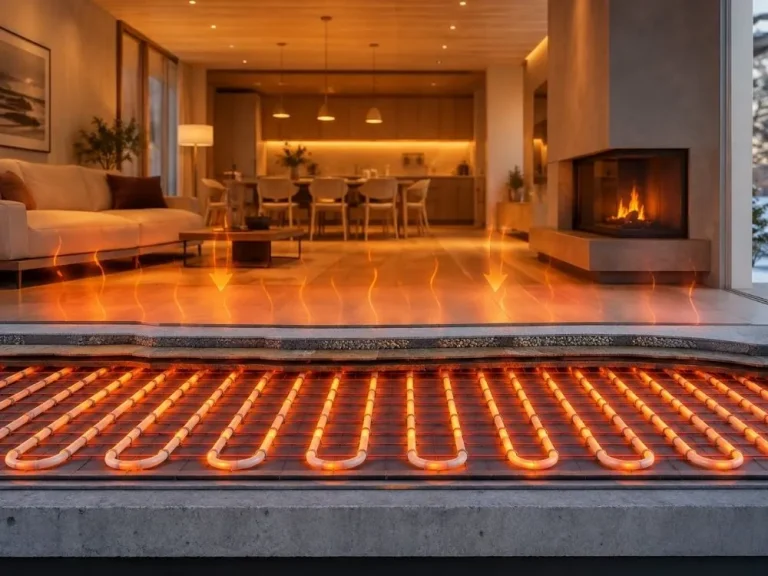
In modern building projects, radiant heating (underfloor heating) systems represent an advanced climate control solution that maximizes thermal comfort and energy efficiency. The polymer pipes at the heart of these systems must be installed in a specific geometric arrangement beneath the screed to ensure uniform heat transfer to the floor structure. During this process, bending is one of the most critical operations, as it approaches the physical limits of thermoplastic materials.
1. Bending Radius and Flexibility of PE-XB and PE-RT Pipes
Two types of advanced engineering polymers are predominantly used in underfloor heating systems: PE-XB (Silane Cross-Linked Polyethylene) and PE-RT (Polyethylene of Raised Temperature Resistance). The differences in their viscoelastic responses to bending originate from a fundamental distinction in their macromolecular structures.
During the manufacturing process, PE-XB develops a three-dimensional network structure through the formation of silane (Si-O-Si) cross-links between polymer chains using the Monosil method. This structure provides the material with exceptional resistance to thermal aging and shape memory properties. However, it also slightly increases the modulus of elasticity, making the material more rigid. PE-RT, particularly Type II resins, does not contain cross-links. Instead, it achieves high-temperature resistance through specially incorporated octene comonomers within the ethylene chains. The absence of cross-links increases chain mobility in the amorphous regions of PE-RT, providing greater flexibility and requiring less force during bending.
2. The Importance of Flexibility in Underfloor Heating Installation
The temperature of the water circulating beneath the floor screed continuously changes according to the operating conditions of the heating system, typically ranging between 35°C and 55°C. Polyethylene has a significantly higher coefficient of thermal expansion (α ≈ 1.5–2.0 × 10⁻⁴ K-1) compared to metals. When the pipe is heated, it tends to expand axially. However, the surrounding screed restricts this expansion.
This restriction generates thermal stresses within the pipe wall. Therefore, sufficient flexibility allowance must be provided at manifold inlets and outlets, expansion joint crossings, and door thresholds between rooms. Furthermore, bending the pipe beyond the material's yield limit during installation may cause microcracks (crazing) on the outer wall and flattening of the internal cross-section. A reduction in the internal cross-sectional area increases localized hydraulic head losses (hL) within the heating circuit, reducing the water flow rate and potentially creating cold spots across the floor surface.
3. Minimum Bending Radius Calculation Formula
When a polymer pipe is bent, tensile stresses develop along its outer wall, while compressive stresses occur along its inner wall. The tightest curve that a pipe can accommodate without compromising its structural integrity is defined as the Minimum Bending Radius (Rmin). The maximum strain along the outer wall (εmax) is calculated using the following formula:
εmax = Dout / (2R + Dout) ≈ Dout / 2R
In this formula, the parameters are defined as follows:
- εmax: Maximum outer fiber strain
- Dout: Outside diameter of the pipe (mm)
- R: Bending radius (mm)
To prevent permanent plastic deformation of polymer chains in polyethylene pipes, the maximum strain (εmax) must remain within safe limits. According to the bending guidelines referenced in the technical literature and installation standards, including DIN 4726 and EN 1264, the following minimum bending radius is recommended for cold bending operations performed using a bending spring:
Rmin ≥ 5 × Dout
For example, when bending a PE-XB or PE-RT pipe with an outside diameter of 16 mm, which is commonly used in underfloor heating systems, the minimum bending radius should be 80 mm when using manual bending techniques or a bending spring. For completely unsupported bending operations performed without a bending spring, an increased safety factor should be applied, resulting in the following requirement:
Rmin ≥ 8 × Dout = 128 mm
4. Methods for Protecting Pipes During Tight Bends
The most critical points in an underfloor heating system are the 90° bends where pipes transition from the horizontal floor surface to the vertical manifold connections. At these locations, the pipes are particularly vulnerable to mechanical impacts during concrete pouring and are frequently subjected to their minimum permissible bending radius.
To prevent excessive bending and localized stress concentrations, bend supports, also known as guide elbows or guide shoes, are used. These protective components, typically manufactured from polyamide or galvanized steel, surround the pipe and maintain the bending radius at precisely five times the outside diameter (5 × Dout), helping prevent localized damage and fracture.
During the installation of PE-XB pipes, controlled thermal treatment may be applied using a hot-air gun at a maximum temperature of 130°C in particularly confined or challenging installation areas to take advantage of the material's shape memory properties. However, it is essential to avoid approaching the polymer's melting temperature.
5. Pipe Installation Patterns That Optimize Heat Distribution
Minimum bending radius limitations directly influence the geometric arrangement of pipes beneath the floor. In serpentine installation systems, pipes must repeatedly form sharp 180° U-bends. This arrangement places additional stress on the pipes by approaching their minimum bending radius (Rmin) limits. Furthermore, the temperature difference (ΔT) between the supply and return water can create uneven thermal zones across the floor surface.
Modern underfloor heating applications generally favor the spiral installation pattern. In this arrangement, the pipes follow a spiral path from the outer edges of the floor toward the center, using wider 90° bends. From the center, the return pipe follows a parallel route alongside the supply pipe until it reaches the manifold.
This installation strategy eliminates the need for repeated sharp 180° bends, helping maintain the pipes within their viscoelastic limits. At the same time, positioning the hottest supply water next to the coolest return water creates a highly uniform temperature distribution across the floor, improving thermal comfort and heating efficiency.
6. Kuzeyboru's High-Temperature Resistance in Building Applications
Underfloor heating systems are designed to withstand high hydrostatic pressures and repeated thermal fatigue beneath the floor screed for many years. Their long-term reliability depends on strict scientific parameters applied throughout the manufacturing process.
PE-XB and PE-RT pipes manufactured using formulations developed at the Kuzeyboru R&D Center comply with international dimensional tolerance standards with millimeter-level precision. Kuzeyboru underfloor heating pipes maintain their macromolecular structure even at peak temperatures ranging from 70°C to 90°C, providing installation flexibility and reliable performance for architectural projects while delivering uninterrupted thermal comfort for more than half a century.