Secrets of Telecommunications Infrastructure Pipe Protection: Fiber Optic Cable Protection
In today's digital world, fiber optic networks form the backbone of data traffic, enabling communication at the speed of light while remaining highly sensitive to physical impacts. The ability of these cables, which contain glass fibers as thin as a human hair, to provide uninterrupted service underground for decades depends directly on the telecommunications infrastructure pipes selected and the protection technologies they offer. Protecting high-cost excavation and installation investments requires more than simply transporting cables from one underground location to another. It also requires protecting them against groundwater, heavy traffic loads, seismic movements, and mechanical stresses during installation.
1. Microduct Pipe Technology in Fiber Optic Networks
While traditional infrastructure systems typically accommodate a single cable inside a large pipe, microduct technology is redefining the standards of modern telecommunications networks. Manufactured from small-diameter, flexible high-density polyethylene (HDPE), microduct pipes maximize the efficient use of space within existing main protective ducts. This technology enables fiber optic cables to be installed inside the ducts using high-pressure air through a process known as air-blowing. Since no mechanical pulling force is applied to the cable, the risk of damaging the optical fibers during installation is eliminated.
Microduct systems also offer significant long-term investment advantages thanks to their modular structure. Multiple microduct bundles installed underground through a single excavation allow unused ducts to remain available for future capacity expansion. When a new subscriber connection or additional line is required, new fiber optic cables can be blown into these empty ducts within minutes without additional excavation. Their compact design provides high duct capacity even in narrow trenches, significantly reducing excavation and backfilling costs, particularly in urban infrastructure projects.
2. Inner Wall Design That Reduces Friction During Cable Installation
One of the most critical stages in fiber optic infrastructure installation is inserting the cable into the protective duct. Over distances of hundreds of meters, friction between the cable's outer sheath and the inner surface of the duct makes cable installation more difficult and may require excessive pulling force. Advanced telecommunications infrastructure pipes are manufactured with specially designed inner walls to overcome this challenge.
Longitudinal microchannels, also known as ribbed inner surfaces, extend along the inner wall of the duct, minimizing the contact area between the cable and the duct surface and directly reducing the coefficient of friction. Thanks to this engineering feature, cables can be installed over significantly longer distances in a single operation, substantially reducing the need for intermediate access chambers and manholes.
3. Protective Pipe Strength Against External Loads and Crushing
Underground telecommunications networks face numerous external threats, including heavy soil loads, heavy vehicle traffic at highway crossings, groundwater pressure, damage from sharp stones, and rodent attacks. Maintaining the pipe's circular shape and preventing ovalization under these demanding conditions protects the sensitive fiber optic cables inside from crushing and the resulting signal loss.
Thanks to their high-strength raw materials and specially designed external surface geometry, telecommunications infrastructure pipes distribute vertical loads to the surrounding compacted soil through controlled flexibility. The flexible and durable polyethylene structure accommodates ground settlement and seismic movements without breaking or cracking, providing a reliable service life of at least 50 years.
Frequently Asked Questions (FAQ)
Which Plastic Pipes Are Used in Telecommunications Infrastructure Projects?
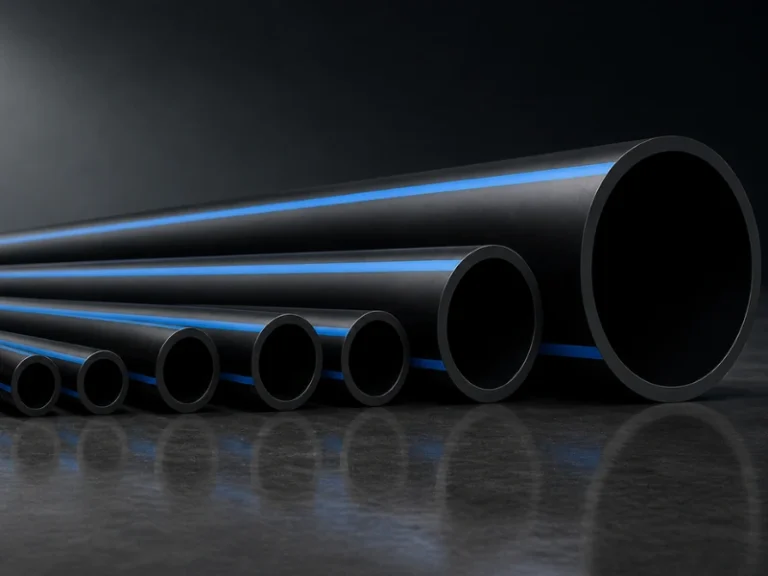
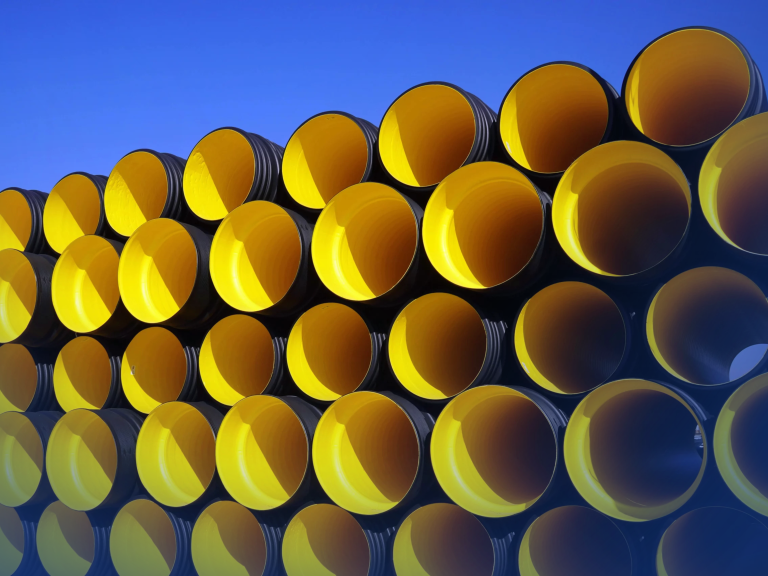
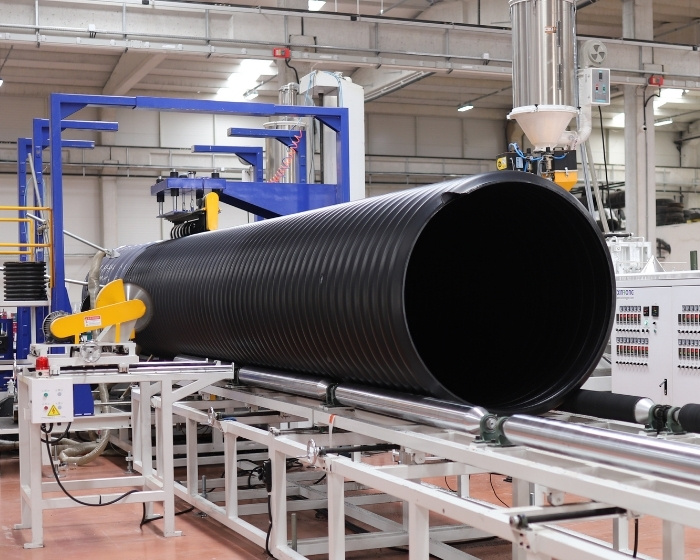
Different types of plastic pipes are selected according to the soil conditions, installation depth, and required network capacity. For intercity backbone networks, horizontal directional drilling (HDD) crossings, and direct burial applications, smooth-surfaced HDPE cable protection pipes manufactured from PE80 and PE100 materials are commonly preferred due to their high flexibility and pressure resistance. In urban networks exposed to heavy traffic loads, road crossings, and shallow excavation areas, double-wall corrugated cable protection pipes are used. These pipes feature a ribbed external structure that increases ring stiffness and a smooth inner surface.
In backbone projects involving multiple operators along the same route or requiring redundant connections, multiduct systems consisting of two, three, or four interconnected ducts are preferred. For Fiber to the Home (FTTH) projects and applications designed to increase capacity by subdividing existing ducts, thin-walled microduct pipes, available individually or in bundles, provide an ideal solution.
What Are the Advantages of Multiduct Fiber Optic Protection Pipes?
Multiduct telecommunications infrastructure pipes offer significant engineering and cost advantages, particularly in large-scale urban networks and highway infrastructure projects. These systems allow three or four separate protective ducts to be installed simultaneously within a single trench, substantially reducing labor requirements and excavation time. Since each interconnected duct is manufactured in a different color or features distinctive colored stripes, identifying which line belongs to a particular operator or service area becomes significantly easier within manholes, eliminating potential confusion.
Thanks to their specialized connection geometry, multiduct pipes can be transported in coils and flexibly accommodate changes in route direction without requiring additional elbows or fittings. Furthermore, while active data transmission continues through one duct, the remaining ducts can serve as backup lines in the event of a failure or remain available for future network capacity expansion.
Why Is the Smoothness of the Pipe's Inner Surface Important During Fiber Optic Cable Installation?
The glass cores inside fiber optic cables have specific tolerance limits against tensile and bending forces. If the inner surface of the duct contains irregularities, burrs, or uneven transitions, cables may become obstructed during installation, resulting in excessive tensile stress. This can cause invisible microbending within the glass fibers, leading to optical signal distortion and increased signal loss along the transmission line.
A rough inner surface may also abrade or damage the cable's protective outer sheath as it travels hundreds of meters through the duct, potentially exposing the cable to moisture and water infiltration over time. From a cost perspective, cables can be installed by air-blowing over distances of up to 1,500 meters in ducts with smooth, low-friction inner surfaces, whereas this distance may be reduced by half in rough-surfaced ducts. Shorter installation distances result in the need for additional connection boxes, more manhole construction, and a greater number of fiber fusion splices, which can contribute to increased signal loss.
Which Crushing and Impact Tests Do Kuzeyboru Telecommunications Pipes Undergo?
To ensure the safety of infrastructure investments, Kuzeyboru conducts rigorous quality control tests in its accredited laboratories throughout every stage of production, in accordance with international standards. During ring stiffness and crushing resistance tests, pipe samples are subjected to vertical forces using specialized testing equipment that simulates soil and traffic loads. The samples are compressed until they reach a specified deformation level, allowing their compliance with crushing resistance classes or ring stiffness ratings such as SN4 and SN8 to be verified.
To simulate demanding winter installation conditions and impacts from falling stones, impact resistance tests are conducted under both normal and low-temperature conditions. Pipe samples are conditioned at subzero temperatures before weights are dropped from specified heights to determine whether cracking or breakage occurs. In addition, long-term internal pressure and hydrostatic strength tests are performed to evaluate the pipes' leak-tightness and material durability. Tensile strength, elongation at break, and coefficient of friction tests are also conducted to verify the pipes' flexibility during horizontal directional drilling applications and the low-friction performance of their inner surfaces.