Use of Corrugated Pipes in Rainwater Harvesting and Storage Systems
Global climate change and rapid urbanization disrupt the natural hydrological cycle, leading to severe urban flooding on one hand and the depletion of freshwater resources on the other. In modern infrastructure engineering, the most rational way to manage this dual crisis is to capture surface runoff at its source and reuse it, which is known as rainwater harvesting. As a superior alternative to the high costs and leakage risks of traditional reinforced concrete cisterns, high-strength polyethylene (HDPE) based rainwater harvesting pipes and modular storage systems provide outstanding performance in both conveyance and underground reservoir designs.
1. Rainwater Collection Systems Against Climate Crisis and Drought
Impervious surfaces in cities, such as roofs, roads, and parking lots, prevent rainwater infiltration into the soil, thereby increasing the surface runoff coefficient. The potential rainwater discharge rate (Q) that can be collected from a catchment basin is modeled using the Rational Method in hydrology:
Q = (C · I · A) / 360
Q: Maximum surface runoff discharge (m3/s)
C: Runoff coefficient (between 0.85-0.95 for roofs and asphalt surfaces)
I: Design rainfall intensity (mm/hour)
A: Catchment area (hectares)
High-volume water masses calculated using this equation cause capacity overflows in treatment plants and trigger floods when discharged directly into the municipal sewer system. However, when this water is collected through properly engineered corrugated pipe networks, it can be used in landscape irrigation, industrial cooling cycles, and gray water (toilet cistern) supplies, reducing municipal water consumption by up to 40%. Thanks to their non-polar and chemically inert macromolecular structures, HDPE corrugated pipes do not react with slightly acidic rainwater (pH 5.5-6.0), thus preserving the chemical quality of the collected water.
2. Designing Large-Diameter Corrugated Pipes as Storage Tanks
The largest engineering cost in rainwater harvesting is the construction of the underground volume where the collected water will be stored. Large-diameter corrugated pipes, particularly those ranging from DN 1000 mm to DN 2400 mm (steel-reinforced corrugated series), are connected in parallel manifold lines (battery systems) to transform into high-capacity modular underground water storage tanks (detention/retention tanks).
The total storage volume (Vstorage) of a cylindrical corrugated pipe network is determined by the following geometric formula, based on the internal diameter (ID) and line length (L):
Vstorage = N · (π · ID2 / 4) · L
Here, N represents the number of parallel-connected pipe arrays. For instance, just 1 meter of a corrugated pipe with an internal diameter of ID = 2000 mm stores approximately 3.14 m3 (3,140 liters) of water.
While traditional rectangular-section reinforced concrete tanks suffer from high stress concentrations at corner points, circular-section corrugated pipe tanks distribute surface soil loads (Marston load) and parking/road traffic loads (Boussinesq load) homogeneously across the entire circumference via the circular arch action principle. Thanks to this structural advantage, underground water storage tanks can be safely constructed directly beneath green spaces or heavy-duty parking lots, maximizing urban land conservation.
3. Filtration and Drainage Infrastructure in Kuzeyboru Corrugated Systems
The long-term and efficient operation of rainwater storage systems relies on the proper filtration of incoming water and the controlled evacuation of excess water. Leaves, sand, silt, and other solid particles carried from surfaces along with precipitation can accumulate in storage areas and negatively impact system performance. Therefore, rainwater collection systems utilize auxiliary infrastructure elements such as hydrodynamic separators, pre-filtration units, and settling chambers.
The first flush of water carrying dust, sediment, and other pollutants accumulated on surfaces at the beginning of rainfall can be diverted away from the main storage line using appropriate routing and pre-treatment systems. This aims to reduce the solid particulate and pollutant load of the water reaching the storage area.
Frequently Asked Questions (FAQ)
1. Why are corrugated pipes preferred in rainwater harvesting?
They are preferred because their high ring stiffness allows them to withstand heavy soil and traffic loads, they can be installed much faster than reinforced concrete cisterns without breaking during seismic movements, and they preserve water safely for decades with 100% corrosion resistance.
2. How is an underground water storage tank built using corrugated pipes?
The ends of large-diameter (DN 1000 - 2400 mm) corrugated pipes are sealed with watertight bulkhead caps and connected in parallel lines using specially prefabricated tee and manifold collector fittings to form a modular underground reservoir battery.
3. How does the inner surface smoothness of Kuzeyboru corrugated pipes affect water purity?
The smooth and non-polar polyethylene inner wall hydrodynamically prevents microorganisms from attaching to the surface to form a biofilm (algae/bacteria) layer and stops suspended solids from settling and causing odors.
4. What should the SN rating be in underground water storage systems?
Depending on the surface load of the area where the storage tank will be installed, it should be selected as a minimum of SN8 under green spaces and parks, and SN12, SN16, or project-specific values (especially steel-reinforced series) under parking lots or highways with heavy vehicle traffic, depending on the burial depth.
5. How is watertightness guaranteed in rainwater collection lines?
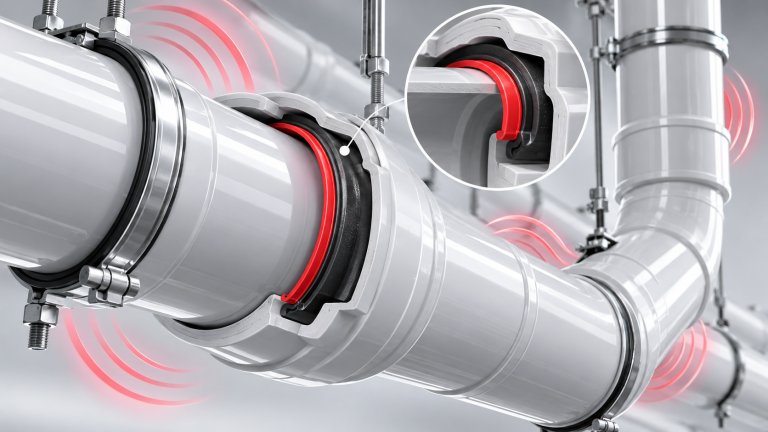
High watertightness against internal and external hydrostatic pressure is ensured through socketed/spigot connections with EPDM elastomeric gaskets compliant with EN 1277 standards or extrusion/electrofusion welding technologies applied in fully sealed storage manifolds.