What Is Maximum Heating Efficiency with High-Temperature Resistant PE-RT Pipes?
What Is PE-RT Pipe and Its Role in Heating Systems
PE-RT (Polyethylene of Raised Temperature Resistance) is a specialized type of polyethylene designed to withstand elevated temperatures. Thanks to the branched chains in its molecular structure, it offers higher thermal stability and mechanical strength compared to conventional PE (polyethylene) materials.
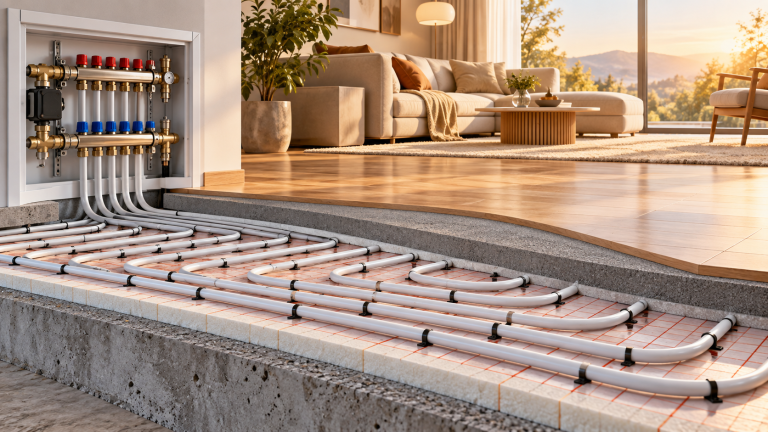
The primary function of pipes used in underfloor heating systems is to transfer heat with minimal loss. In this context, PE-RT pipes offer:
Continuous operation at high temperatures (typically 70–95°C)
Long service life under pressure (design life of 50 years or more)
Chemical and mechanical resistance
These advantages make PE-RT pipes a reliable solution for modern heating systems.
In terms of heat transfer, pipe performance can be expressed by the following equation.
Q=U⋅A⋅ΔT
Where; Q: Heat Transfer Rate (W) U: Overall Heat Transfer Coefficient (W/m²K) A: Heat Transfer Surface Area (m²) ΔT: Temperature Difference (K)
Thanks to the optimized surface structure and low thermal resistance of PE-RT pipes, the U coefficient is increased, improving overall system efficiency.
Structural Durability at High Temperatures
One of the key advantages of PE-RT pipes is their ability to maintain their mechanical properties at elevated temperatures. This characteristic results from the balance between the crystalline and amorphous phases of the pipe material.
The behavior of the material under temperature can be examined using the extended form of Hooke’s Law.
σ=E(T)⋅ε
σ: Stress (MPa) E(T): Temperature-Dependent Modulus of Elasticity ε: Strain
In PE-RT materials, E(T) decreases in a controlled manner as temperature rises; however, this reduction still provides performance comparable to cross-linked polyethylene (PEX). Creep resistance under high temperature and pressure is also highly critical. In this regard, PE-RT pipes offer the following advantages.
Resistance to long-term thermal stress
Resistance to microcrack formation
Flexibility compatible with thermal expansion
Efficient Heating with Maximum Heat Transfer
The goal of underfloor heating systems is to achieve uniform temperature distribution and low energy consumption. PE-RT pipes play an important role in achieving this goal thanks to their low thermal resistance.
The heat transfer performance of the fluid inside the pipe is evaluated using the Reynolds number.
Re=(ρ⋅v⋅D)/μ
Re: Reynolds Number
ρ: Fluid Density (kg/m³)
v: Flow Velocity (m/s)
D: Pipe Diameter (m)
μ: Dynamic Viscosity (Pa·s)
Thanks to the low internal surface roughness of PE-RT pipes:
Turbulent flow occurs more efficiently
Pressure losses are minimized
The heat transfer coefficient increases
This means more heating with less energy consumption throughout the system.
Comfortable and Energy-Efficient Homes
One of the most important advantages of underfloor heating systems is their ability to provide uniform temperature distribution throughout the space. Thanks to PE-RT pipes,
Temperature differences within the room are minimized
Low-temperature operation becomes possible (35–45°C water temperature)
In terms of energy consumption, system efficiency is expressed by the following COP (Coefficient of Performance):
COP=Q_out/W_in
Q_out: Delivered Heating Energy W_in: Energy Consumed
The low-temperature operating advantage provided by PE-RT pipes significantly increases COP values, especially when used with heat pump systems.
Kuzeyboru Flexible Pipe Technology
PE-RT pipes developed with modern manufacturing techniques provide both flexibility and durability. The flexible structure of these pipes:
Reduces the risk of breakage during installation
Minimizes the need for fittings
Lowers labor costs
In addition, oxygen-barrier PE-RT pipes reduce the risk of corrosion within the system. This feature is particularly important for extending the service life of metal components.
Innovation and Sustainability Vision
Energy efficiency and sustainability are fundamental requirements of modern heating systems. PE-RT pipes:
Reduce energy consumption
Lower carbon emissions
Are manufactured from recyclable materials
From a sustainability perspective, system efficiency can be evaluated as follows:
η=(Useful Energy)/(Total Energy)
In systems using PE-RT pipes, the η value increases, providing a more environmentally friendly solution.