Pipe Selection in Agricultural Irrigation Projects: HDPE or PVC?
Global climate change and the increasing strategic importance of water resources have made it essential to design modern agricultural irrigation networks with the highest levels of hydraulic and mechanical efficiency. In the design of pressurized irrigation systems, agricultural irrigation pipe selection plays a central role in engineering decisions. Choosing the right material not only ensures the efficient transmission of water with minimal losses but also directly determines the network's initial investment cost, energy consumption during operation, and overall economic service life. Today, two primary materials from the thermoplastic family stand out in agricultural infrastructure projects: High-Density Polyethylene (HDPE - PE100) and Unplasticized Polyvinyl Chloride (U-PVC). Although both polymers offer high corrosion resistance and low internal surface roughness compared to metal pipes, their molecular structures and mechanical properties create significant differences under field conditions.
1. Ground Movements and the Need for Flexibility in Agricultural Fields
Agricultural fields are constantly exposed to stress due to seasonal groundwater level fluctuations, swelling and shrinkage cycles of clay-rich soils, freeze-thaw effects, and dynamic surface loads generated by heavy agricultural machinery. These variable ground conditions cause axial and radial deformations in buried or above-ground pipelines. Thanks to their semi-crystalline molecular structure, HDPE pipes exhibit high flexibility, a low modulus of elasticity, and an elongation at break exceeding 600%. This ductile structure allows the pipe to adapt to ground settlement and topographical slopes without breaking. In contrast, U-PVC pipes have an amorphous structure, a higher modulus of elasticity, and a more rigid character. This increased rigidity raises the risk of brittle fracture under concentrated loads or sudden ground movements.
Hydraulic shock waves, commonly known as water hammer, can occur in agricultural irrigation networks due to the sudden activation of pumping stations, power outages, or rapid valve closures. These pressure surges can temporarily increase the internal pipe pressure far beyond normal operating levels. The propagation speed of pressure waves is directly related to the modulus of elasticity of the pipe material. The low modulus of elasticity of HDPE pipes helps absorb pressure waves, keeping maximum pressure increases at significantly safer levels compared to PVC pipes. Furthermore, HDPE pipes can follow the natural curves of the terrain with a bending radius of approximately 20 to 25 times their outside diameter without requiring additional elbow fittings, whereas changes in direction in PVC pipelines generally require additional fittings.
2. UV Resistance and Service Life Comparison
In agricultural irrigation projects, some transmission pipelines are installed underground, while hydrant connections, field distribution lines, quick-coupling sprinkler pipes, and drip irrigation manifolds are directly exposed to atmospheric conditions and ultraviolet (UV) radiation from the sun. When polymer materials are exposed to sunlight, UV photons can break chemical bonds within polymer chains, causing photo-oxidative degradation. In PVC pipes that are not protected with appropriate stabilizers, UV exposure may result in discoloration, the formation of surface microcracks, and a rapid reduction in impact resistance. Therefore, the long-term use of standard U-PVC pipes in open areas under direct sunlight is not generally recommended from an engineering perspective.
During the production of black HDPE pipes intended for agricultural irrigation, carbon black is homogeneously incorporated into the raw material at a concentration of 2% to 2.5% by weight, together with antioxidant stabilizers. Carbon black absorbs UV radiation at the surface, preventing degradation of the polymer matrix. HDPE (PE100) pipes manufactured in accordance with applicable standards have a minimum design service life of 50 years at a reference temperature of 20°C and the specified design pressure, potentially reaching up to 100 years depending on application conditions. Thanks to their UV resistance and tolerance to thermal expansion, HDPE pipes maintain their long-term structural integrity in outdoor agricultural environments. Although PVC pipes also offer a long service life in underground applications, they remain more sensitive to environmental aging in above-ground agricultural installations.
3. Analysis of Investment Costs and Installation Convenience
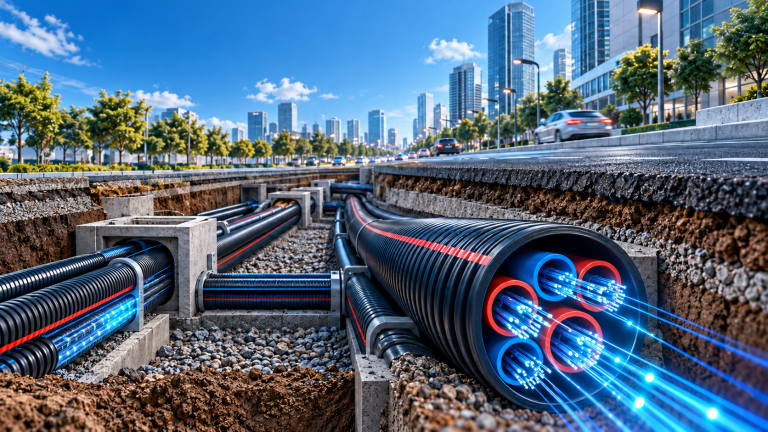
From an engineering economics perspective, agricultural irrigation pipe selection should consider not only the purchase price per meter of pipe but also the system's total Life Cycle Cost (LCC). Joining HDPE pipes through butt fusion or electrofusion creates a continuous, monolithic pipeline with joint strength comparable to that of the pipe itself. This fully leak-tight structure eliminates the need for additional concrete thrust blocks to resist axial tensile forces. Although socket-and-gasket joining systems used in PVC pipelines offer faster installation, concrete thrust blocks may be required at high-pressure directional changes to prevent pipe joints from separating. Furthermore, the gradual loss of flexibility in elastomeric gaskets may lead to water leakage over time.
From a logistics and field installation perspective, HDPE pipes can be manufactured in coils of 100 or 200 meters for diameters of up to 110 mm, reducing the number of joints in field distribution networks by as much as 90%. PVC pipes, which are typically supplied in straight lengths of 6 meters, require a joint approximately every 6 meters, creating additional potential leakage points. Moreover, the flexible structure of HDPE pipes allows installation in narrower trenches, reducing excavation and bedding costs. Although both pipe types minimize friction losses thanks to their low internal surface roughness, the high resistance of HDPE pipes to impact and freezing conditions helps minimize maintenance and repair expenses throughout their operational service life.
Frequently Asked Questions (FAQ)
Which Is More Economical for Agricultural Irrigation: HDPE or PVC Pipes?
The ability to install HDPE pipes in coils reduces the need for fittings and labor, allows narrower trench excavation, and eliminates the need for concrete thrust blocks, resulting in significant savings during initial installation. In addition, their fully leak-tight fusion-welded joints prevent water and pumping energy losses. Combined with a service life exceeding 50 years and minimal maintenance and repair requirements, these advantages enable HDPE pipe investments to achieve a relatively short payback period.
Which Pipe Diameters Should Be Used for Drip Irrigation Mainlines?
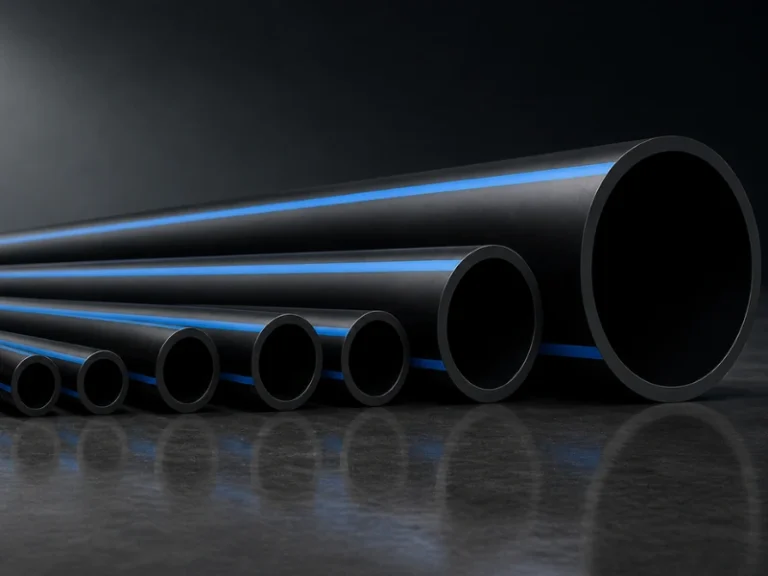
The diameters of main transmission pipelines and distribution manifolds in drip irrigation systems are determined through hydraulic calculations based on the size of the agricultural land, the design flow rate associated with crop water requirements, pipeline length, and topographical elevation differences. As an engineering criterion, the objective is generally to maintain water flow velocities in main pipelines within the range of 1.5 m/s to 2.0 m/s while minimizing friction losses. In practice, pipe diameters of 63 mm, 75 mm, 90 mm, and 110 mm are commonly preferred for mainlines and distribution manifolds in small and medium-sized agricultural fields. For large agricultural enterprises and irrigation cooperatives, PE100 pipes with diameters starting from 125 mm and extending to 315 mm, 400 mm, and larger are widely used in main transmission networks.
Are Kuzeyboru Irrigation Pipes Protected Against UV Radiation?
Kuzeyboru's HDPE / PE100 agricultural irrigation pipes and quick-coupling sprinkler pipes, manufactured in accordance with international quality standards and TS EN ISO 4427 requirements, are designed to provide protection against UV radiation. During production, high-quality carbon black and UV stabilizers are homogeneously incorporated into the raw material formulation, allowing harmful solar radiation to be absorbed at the pipe surface. As a result, Kuzeyboru irrigation pipes maintain their molecular structure even when exposed to direct sunlight, significant day-to-night temperature fluctuations, and demanding environmental conditions in open agricultural fields. This protection enables the pipes to deliver reliable performance for decades without becoming brittle, developing cracks, or losing pressure resistance.
Which Pipe Type Should Be Selected to Prevent Breakage in Uneven Terrain?
HDPE (PE100) pipes should be preferred to prevent pipe breakage in uneven, sloping, rocky agricultural fields or areas exposed to potential ground settlement. The high flexibility and elongation at break of HDPE pipes allow them to naturally follow the contours of the terrain while absorbing stresses caused by ground movements. Furthermore, HDPE pipes provide high mechanical resistance against external impacts, slow crack propagation caused by contact with sharp stones, and water hammer pressure surges frequently experienced in sloping terrain due to pressure differences.
How Is the Operating Pressure of Agricultural Irrigation Pipes Determined?
The selection of the nominal pressure rating (PN / bar) for agricultural irrigation pipes is determined by calculating the Total Dynamic Head (TDH) and the hydrodynamic conditions to which the system will be exposed. This calculation considers the geometric elevation differences between the water source and the highest and lowest points of the agricultural land, continuous head losses caused by friction within the pipeline, and local head losses generated by equipment such as valves, elbows, and filters. The minimum outlet pressure required for drip emitters or sprinkler heads to operate at their optimal flow rates is then added to the calculated value, together with an additional safety allowance for potential water hammer pressure surges during pump startup and shutdown. Based on the resulting maximum system pressure, an appropriate standard pressure class, such as PN6, PN10, PN12.5, or PN16, is selected to ensure the operational safety of the irrigation network.
Sustainability in agricultural irrigation investments is directly associated with minimizing water losses and improving energy efficiency. Technical analyses demonstrate that HDPE (PE100) pipes offer a highly reliable engineering solution for agricultural irrigation pipe selection in terms of adaptability to ground movements, UV resistance, leak-tight fusion joining capabilities, and long-term cost advantages. Selecting pipes with appropriate diameters and pressure ratings according to the project's topographical and hydraulic requirements ensures that irrigation networks maintain high performance for decades.