Kuzeyboru HDPE Wear and Pressure Resistance in Mining Infrastructure Lines
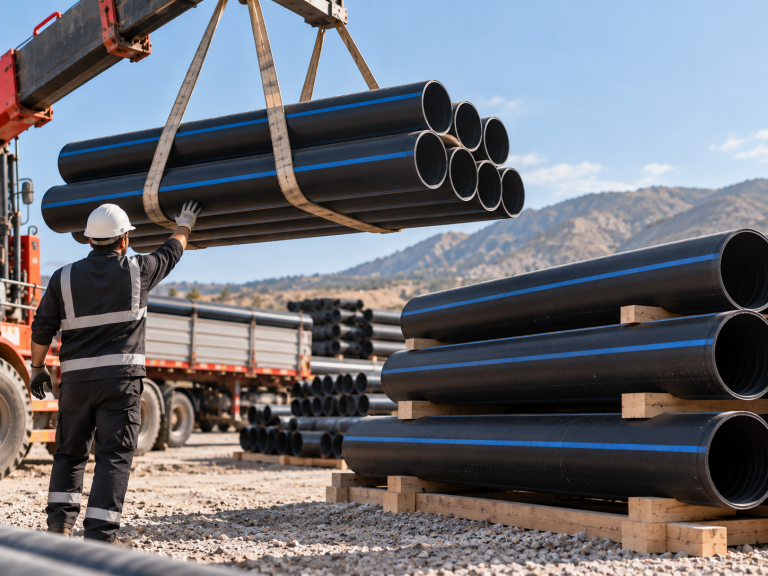
The mining industry represents the most challenging operating environment in piping engineering due to the transfer of high-concentration solid-liquid mixtures (slurry), the management of leaching solutions with extreme pH values, and a constantly changing dynamic field topography. Traditional metallic pipes rapidly lose wall thickness due to both mechanical erosion and electrochemical corrosion during ore processing and tailings disposal operations. Under these severe operating conditions, high-molecular-weight bimodal mining pipelines (HDPE 100) have become the primary infrastructure standard ensuring operational continuity in mining sites, thanks to their viscoelastic damping capacity and chemical inertness.
1. Abrasive Fluids and Slurry Transport in the Mining Sector
Fluids transported in mineral processing and tailings dam lines are multiphase slurry flows consisting of sharp-edged quartz, silica, pyrite, and crushed rock particles suspended in water. The volumetric wear loss (Wv) caused by these solid particles impacting the pipe inner wall increases exponentially with fluid velocity (V) and particle kinetic energy:
Wv ∝ Vn · dpm
Here, dp denotes the solid particle diameter, and n represents the material-dependent velocity exponent (typically 2.5–3.0).
In materials with high rigidity such as steel, fast-flowing hard mineral particles strike the pipe surface, inducing micro-shearing and fatigue micro-cracks that rapidly erode the wall. Kuzeyboru HDPE 100 pipes, on the other hand, operate via an elastic resilience mechanism enabled by their long polymer chains and low modulus of elasticity. When a sharp mineral particle strikes the polyethylene wall, the surface flexes at a microscopic level, damping the impact energy and deflecting the particle back into the flow axis without tearing material from the wall. Furthermore, the smooth inner surface of HDPE (k ≈ 0.007 mm) reduces boundary layer friction, preventing solid particles from adhering to the wall and offering a tribological service life 3 to 5 times longer than that of steel pipes.
2. Kuzeyboru Polyethylene Resistance Against Aggressive Chemicals
Heap leaching processes used to extract valuable metals such as gold, copper, and nickel from ore require pipelines to operate directly with concentrated chemicals. Concentrated sulfuric acid (H2SO4, pH < 1.5) is utilized in copper mining, while highly alkaline sodium cyanide (NaCN, pH > 10.5) solutions are employed in gold mining. In addition, Acid Mine Drainage (AMD), generated by the oxidation of pyrite in underground mine waters, is corrosive enough to perforate metallic pipelines within a few months.
Kuzeyboru HDPE pipes offer a broad chemical resistance profile due to their non-polar hydrocarbon chain structure and semi-crystalline polymer morphology. The low electrical conductivity of polyethylene provides a significant advantage against the electrolytic and galvanic corrosion mechanisms commonly observed in metallic materials. In accordance with chemical resistance data evaluated under ISO/TR 10358:2021, HDPE pipes can be utilized in the conveyance of numerous acidic and alkaline solutions, saline fluids, and industrial process chemicals. For transporting leaching solutions, flotation process fluids, and high-salinity waters encountered in mining operations, appropriate material selection should be made considering fluid chemical composition, concentration, temperature, and operating conditions.
The resistance of HDPE pipes to metallic corrosion, along with their abrasion resistance and leak-proof jointing achieved through proper joining methods, offers significant advantages for long-lasting, reliable, and low-maintenance piping systems in mining and industrial process applications.
3. Infrastructure Lines That Flex Without Crushing Under Heavy Vehicle Traffic
Mines are not static facilities; as ore veins progress, pipelines must be dismantled, relocated to new sectors, laid on stepped pit slopes, and routed beneath haul roads traversed by rock trucks weighing hundreds of tons.
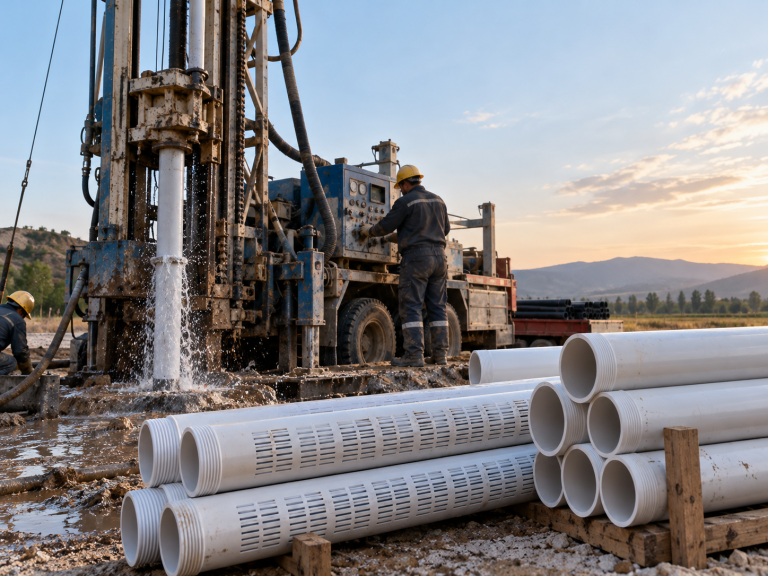
Rigid pipes fracture under seismic shock waves from blasting or ground settlement in mining sites, leading to line shutdowns. The high impact strength and viscoelastic structure of Kuzeyboru HDPE 100 pipes allow them to absorb local ground settlements by flexing along their own axis (within minimum bending radius limits of Rmin ≥ 20 · D). Along haul roads used by heavy mining trucks, immense wheel loads (P) acting on the pipe are transferred to the surrounding compacted backfill soil through controlled radial deflection (Δy) of the pipe. In deep-well dewatering lines requiring high internal hydrostatic pressure (PN16, PN25, PN32), hoop stress (σh) in the pipe wall is safely managed using Barlow's formula:
σh = [P · (D − t)] / (2 · t)
This mechanical integrity guarantees continuous operation of the mining infrastructure without crushing or bursting, even under high-tonnage dynamic loads and pump surge shocks (water hammer).
Frequently Asked Questions (FAQ)
Why are HDPE pipes preferred over steel pipes in mining operations?
While steel pipes rust rapidly in acidic mine waters and erode under hard ore particles, HDPE pipes are 100% corrosion-resistant, offer up to 4 times longer wear life than steel thanks to their elastic inner surface, and can be transported and installed much faster on-site due to their lightweight structure.
How can pipe wear be prevented during slurry (mine tailing) transport?
Pipe wear is prevented by maintaining fluid velocity above the critical settling velocity but below excessive erosion limits, selecting pipes made from high-density PE 100 resin with elastic damping capabilities, and periodically rotating the pipe 90°–120° around its axis to distribute wear evenly across the entire inner wall.
What wear tests do Kuzeyboru mining pipes undergo?
In accredited laboratory processes, in addition to standard hydrostatic pressure (EN 1167) and tensile/burst tests, pipes undergo Darmstadt-principle (DIN 19534) slurry abrasion simulations—where pipes are cyclically eroded with a quartz sand-water mixture—and Rapid Crack Propagation (RCP) testing.
Which polyethylene grades are used in chemical acid pools?
In heap leaching and acid pools, 100% virgin PE 100 pipes with maximized Environmental Stress Crack Resistance (ESCR) and bimodal molecular weight distribution are used, while PE 100-RC (Crack Resistant) grade pipes are selected for sites with extreme point loads.
Why is joint weld quality vital in mining pipelines?
In mining pipelines carrying high-pressure toxic/acidic chemicals, a defective butt fusion joint can cause high-velocity solid particles to strike weld beads and create localized turbulent erosion perforations, or result in line failure under tensile loads, triggering environmental and occupational safety disasters.