Why Choose Kuzeyboru Corrugated Pipes? Infrastructure and Sewerage Solutions
One of the greatest engineering challenges of modern urbanization is developing underground infrastructure networks that operate silently while safely conveying enormous volumes of wastewater and stormwater. The success of a sewerage project depends on the long-term resistance of the selected material to geotechnical stresses, chemical corrosion, and hydrodynamic abrasion. Among thermoplastic systems that have replaced traditional rigid pipes, such as concrete and cast iron, the answer to why Kuzeyboru corrugated pipes should be preferred lies in advanced polymer science and precision extrusion technology.
1. Load-Bearing Strength of Kuzeyboru Corrugated Pipes Against Soil Loads
An underground pipe is exposed to significant static and dynamic stresses generated by the overlying soil prism (Marston load) and surface traffic (Boussinesq load). The ability of thermoplastic pipes to withstand these loads is defined by their Ring Stiffness (SN).
The outer wall of Kuzeyboru corrugated pipes features a specially designed rib geometry. In material science, the stiffness formula is expressed as follows:
SN = (E · I) / Dm3
Here, E represents the modulus of elasticity of High-Density Polyethylene (HDPE), I represents the second moment of area per unit length of the pipe wall, and Dm represents the mean diameter. Kuzeyboru's innovative profile design maximizes the second moment of area (I) without increasing the polymer mass. This optimized rib architecture enables the production of pipes with ring stiffness classes of SN4, SN8, or higher stiffness classes tailored to specific project requirements while minimizing raw material consumption. Rather than resisting external loads through rigid structural behavior, the pipe flexes through viscoelastic deformation and transfers the applied loads to the surrounding compacted soil. This mechanism helps prevent structural collapse and excessive ovalization.
2. Time Savings Through Practical Socket and Coupling Systems
In infrastructure projects, construction site labor and heavy equipment operations represent a major portion of total investment costs (CAPEX) and operating expenses (OPEX). Closing an open trench as quickly as possible is a critical engineering objective in terms of both safety and cost optimization.
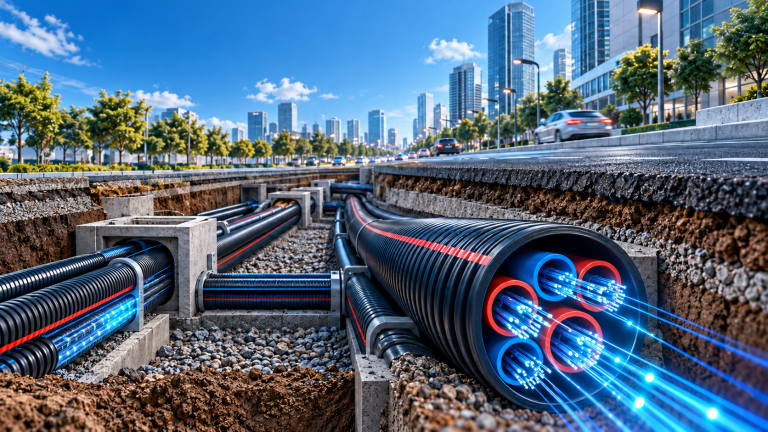
Kuzeyboru corrugated pipes are delivered to construction sites with integrated bell-and-spigot connections manufactured directly on the production line or with modular coupling systems. These mechanical connections operate by inserting the male end (spigot), fitted with an elastomeric sealing gasket, into the female end (socket). This joining method eliminates the need for welding equipment, generators, or chemical adhesives at the construction site. The radial compression of the gasket provides immediate mechanical engagement. This practical installation method increases laying speed by at least three to four times compared to concrete pipes, resulting in substantial time savings in construction schedules.
3. Leak-Tightness Assurance and Environmental Sustainability
One of the most serious challenges in sewerage networks is wastewater leakage through pipe joints into the surrounding environment (exfiltration) or groundwater entering the sewerage system (infiltration). Wastewater leakage contaminates soil and groundwater resources, while groundwater infiltration unnecessarily increases the hydraulic load on wastewater treatment plants, resulting in additional energy consumption.
Kuzeyboru's specially designed EPDM elastomeric gaskets fit precisely into the grooves between the pipe profiles, generating high hydrostatic contact pressure. When pipe and fitting systems equipped with elastomeric sealing rings are tested in accordance with ISO 13259, they can withstand a water pressure of 0.5 bar for 15 minutes without leakage. Furthermore, the inherent 100% recyclability of HDPE and its low surface roughness coefficient (k ≈ 0.01 mm), which helps prevent sediment accumulation in gravity-flow systems, support sustainable engineering approaches aimed at minimizing the environmental footprint of infrastructure projects.
Frequently Asked Questions (FAQ)
What Diameter Ranges Are Available for Kuzeyboru Corrugated Pipes?
Our standard corrugated pipes are manufactured in diameters ranging from DN 100 mm to DN 1000 mm. However, for large-scale discharge projects requiring significantly higher flow capacities and larger diameters, our Steel-Reinforced Corrugated Pipe series offers solutions with diameters ranging from DN 800 mm to DN 2400 mm.
Why Should Kuzeyboru Corrugated Pipes Be Used in Sewerage Networks?
There are two fundamental hydrodynamic reasons. First, their exceptionally smooth inner surfaces minimize localized hydraulic losses and help prevent sediment accumulation. Second, thanks to their flexible structure and socket connections, they can accommodate seismic movements and ground settlement without the brittle fracture behavior commonly associated with concrete pipes. By absorbing underground movements, these pipes offer a design service life exceeding 50 years.
What Is the Difference in Strength Between Steel-Reinforced Corrugated Pipes and Standard Corrugated Pipes?
Standard corrugated pipes derive their load-bearing capacity from the modulus of elasticity of HDPE (E ≈ 1 GPa) and their profile geometry. In contrast, steel-reinforced corrugated pipes incorporate steel profiles embedded within the polymer structure, utilizing the significantly higher modulus of elasticity of steel (E ≈ 200 GPa). As a result, steel-reinforced pipes can achieve exceptionally high ring stiffness and resistance to structural buckling at much larger diameters without increasing polymer consumption. These pipes can be manufactured in stiffness classes such as SN8, SN10, and SN16, as well as higher stiffness classes designed for specialized projects.
Are Kuzeyboru Corrugated Pipes Resistant to Acidic Wastewater?
Yes. Polyethylene (PE)-based corrugated pipes are widely used in industrial and domestic wastewater applications due to their high chemical resistance to many acidic and alkaline substances. However, chemical resistance does not depend solely on pH levels. It may vary depending on factors such as the type and concentration of the chemical, operating temperature, exposure duration, and the composition of the surrounding environment. Therefore, particularly in applications involving highly concentrated or high-temperature aggressive chemicals, it is recommended that the pipe's chemical resistance be evaluated separately according to the relevant operating conditions. Under suitable operating conditions, PE-based corrugated pipes can provide high chemical resistance for long-term use in many acidic wastewater environments.
Why Are the Manufacturer's Quality Control Processes Important When Purchasing Corrugated Pipes?
Once polymer pipes are buried underground, they remain out of sight for decades. The long-term viscoelastic creep performance, Oxidation Induction Time (OIT), and Environmental Stress Crack Resistance (ESCR) of pipes leaving the production line can only be verified through accredited laboratory testing. Kuzeyboru's rigorous testing protocols, developed in accordance with international standards such as EN 13476, help eliminate the risk of potentially catastrophic infrastructure failures during the project design stage, ensuring long-term reliability and structural performance.