How to Weld PPR Pipes?
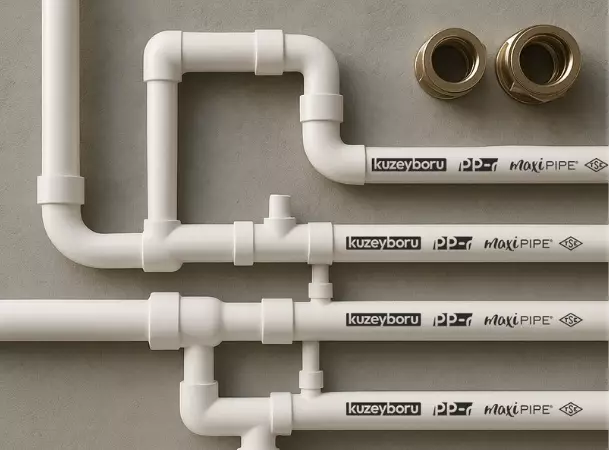
In modern building installations, the leaktightness of polymer-based lifelines is achieved by melting and fusing the pipes and fittings at a molecular level, rather than mechanically compressing them. This process applied to PPR (Polypropylene Random Copolymer) systems is technically referred to in the literature as polyfusion (socket) welding. A correct PPR welding process ensures that the polymer chains interdiffuse at the interface, transforming two separate components into a single monolithic mass.
Surface Cleaning Prior to PPR Pipe Welding
For a successful polymer weld, it is essential to create a completely homogeneous contact area with high surface energy. The outer surface of the pipe and the inner surface of the fittings must be cleared of contaminants such as dust, moisture, or oil before being inserted into the welding machine. Otherwise, a microscopic layer of moisture remaining on the interface vaporizes suddenly due to the welding temperature of 260°C, generating micro-bubbles (voids) within the molten polymer matrix. This condition significantly reduces the pressure resistance of the material. Furthermore, cutting the pipe at a precise 90-degree (perpendicular) angle using specialized pipe cutters is a prerequisite that guarantees an equal thermal contact surface at every point and a homogeneous distribution of pressure during insertion into the heating element (welding socket).
Welding Machine and Socket Utilization
The equipment providing heat transfer in polyfusion welding consists of heating sockets coated with polytetrafluoroethylene (PTFE/Teflon). The Teflon coating prevents the polypropylene, whose melt viscosity decreases (becoming fluid), from adhering to the metal. The standard temperature to be applied in the PPR welding process is 260°C (with a tolerance of ±10°C). This temperature is not chosen at random; it is the optimum temperature at which the crystalline structure of the PPR material is completely disrupted, transitioning into an amorphous and fluid phase, while the long polymeric chains have not yet undergone thermal degradation (burning/charring).
Heating, Joining, and Cooling Times
PPR pipe welding consists of three fundamental thermal phases: Heating (Melting), Joining (Diffusion), and Cooling (Recrystallization). Standardized heating times based on the pipe diameter (e.g., 5 seconds for a 20 mm pipe) must be strictly followed. Once removed from the welding socket, the heated pipe and fitting must be joined within a very short timeframe. The greatest assembly error committed during joining is inserting the parts by twisting (rotating) them into each other. The twisting force subjects the linear polymer chains—which are still in the liquid phase and attempting to interpenetrate—to shear stress, causing them to rupture. The components must be pushed axially in a straight line and then held stable until they regain their rigidity (during the cooling period).
The Impact of Welding Defects on Installation Lifespan
Deviations in welding parameters directly threaten the hydrodynamic performance of the installation. In a pipe that is overheated or pushed excessively into the fitting, the molten polymer overflows toward the inner diameter of the pipe, creating a restriction (internal bead). This internal bead formation causes a localized head loss in fluid mechanics. In the restriction zone, the flow velocity increases locally, triggering turbulence. This condition not only imposes an extra load on the pumps in the system (leading to energy waste) but also causes erosion and early fatigue cracks on the inner wall of the pipe over time due to the cavitation effect at the restriction point.
Kuzeyboru Quality in Building Systems
The success of a welding process depends as much on the molecular structure of the raw material used as it does on the quality of workmanship. PPR pipes and fittings manufactured at Kuzeyboru facilities are extruded from highly pure, original polymers possessing optimum Melt Flow Index (MFI) values. Kuzeyboru's special formulation offers an ideal viscoelastic fluidity at 260°C, preventing adhesion to the welding machine. In this manner, even minor temperature or time deviations under site conditions are compensated for, guaranteeing leak-free monolithic connections with a service life of 50 years backed by perfect interdiffusion.
Corporate Eco-Friendly Production Vision
Building projects of the future prioritize ecological responsibilities. Kuzeyboru optimizes its PPR production processes in line with sustainability principles and digital traceability capabilities, keeping its water and energy footprints at a minimum level. Our thermoplastic systems, featuring a 100% recyclable structure, generate significantly lower carbon emissions during the production stage compared to metals. Providing the transport of clean water in the most hygienic and safest way, Kuzeyboru manufactures modern installation infrastructures while simultaneously protecting the life source of future generations through eco-friendly engineering methods.