Soil Load and Strength Calculations in Steel-Reinforced Corrugated Pipes: A Guide for Infrastructure Engineers
In infrastructure projects, particularly in stormwater, sewage, and industrial wastewater lines, pipe selection is the most critical engineering decision that dictates the system's lifespan. Today, conventional materials have been superseded by steel-reinforced corrugated pipes, which combine the corrosion resistance of polymer with the mechanical strength of steel.
Especially in large-diameter lines such as 800 mm to 2400 mm, the soil load and dynamic traffic forces acting on the pipe require rigorous engineering calculations. For infrastructure engineers, it is essential to technically examine the soil load, strength calculations, and static/dynamic behavior analyses of steel-reinforced corrugated pipes.
Steel-Reinforced Strength
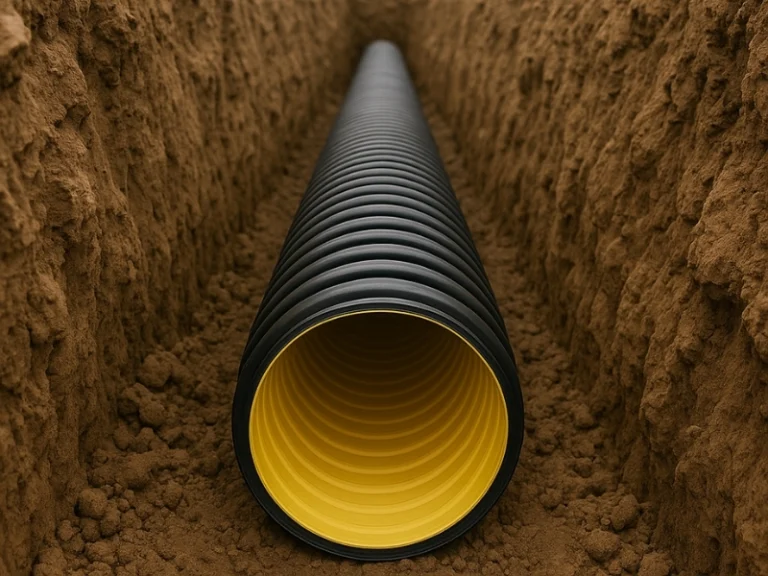
Steel-reinforced corrugated pipes are classified within the "flexible pipe" category. Unlike rigid pipes (e.g., concrete), flexible pipes do not absorb superimposed loads directly within their own structure; instead, they transfer the load to the surrounding compacted soil backfill through lateral deflection. This interaction ensures that the soil and the pipe function together as a composite structure.
In these pipes, which are produced by encapsulating the steel profile with HDPE (High-Density Polyethylene), the steel backbone maximizes ring stiffness, while the polymer outer surface prevents chemical reactions and abrasion. This unique soil mechanics behavior allows the pipe to resist deformation while simultaneously accommodating seismic movements.
Soil Load Calculation in Steel-Reinforced Pipes
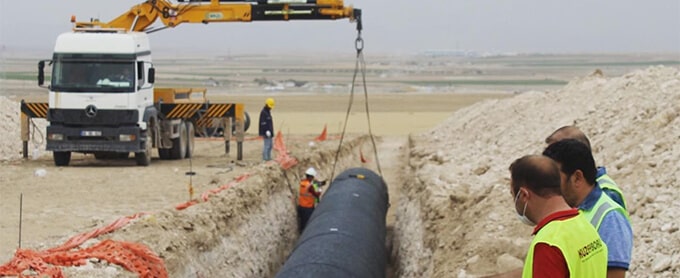
In soil load calculations, the weight of the soil prism acting on the pipe laid within the trench is taken as the basis. In infrastructure engineering, this load is typically calculated using Marston's Theory. The standard static soil load formula is expressed as follows:
Wc = Cd × w × Bd²
Wc: Soil load acting on the pipe
Cd: Load coefficient (dependent on soil type and trench width)
w: Unit weight of the backfill material
Bd: Trench width
This formulation allows us to determine the safest static strength limit by taking into account not only the soil directly above the pipe but also the frictional forces generated along the trench walls.
Static and Dynamic Traffic Load Effects
Pipelines pass under highways, airports, or heavy industrial facilities. Therefore, not only the static soil load but also the dynamic traffic load (live loads) must be taken into account.
Dynamic loads are calculated according to standards or by using Boussinesq stress distribution equations. As depth from the surface increases, the impact of the traffic load decreases logarithmically. Thanks to their profiled structures, steel-reinforced corrugated pipes dampen these shock impacts (dynamic loads) originating from the surface, transferring them to the lateral backfill and preventing localized stress concentrations.
SN Value Selection in 800 mm - 2400 mm Diameters
In large-diameter infrastructure projects (800-2400 mm), the standard for the pipe's resistance to external loads is determined by the SN (Nominal Stiffness - Ring Stiffness) value (SN4, SN8, SN10, SN16, etc.). Thanks to steel reinforcement, these pipes can achieve high SN values unattainable by standard plastic pipes, with a much lighter body structure.
The SN value is expressed in general engineering practice with the following formula:
SN = (E × I) / D³
E: Modulus of Elasticity of the material (Steel reinforcement dramatically increases the E value here)
I: Moment of inertia of the wall
D: Mean diameter of the pipe
As the diameter (D) increases (especially 1000 mm and above), the Moment of Inertia (I) and the Modulus of Elasticity (E) must be very high to maintain stiffness. Exactly at this point, steel-reinforced strength comes into play, guaranteeing high SN values even at massive diameters such as 2400 mm.
Buckling and Deflection Resistance Tests
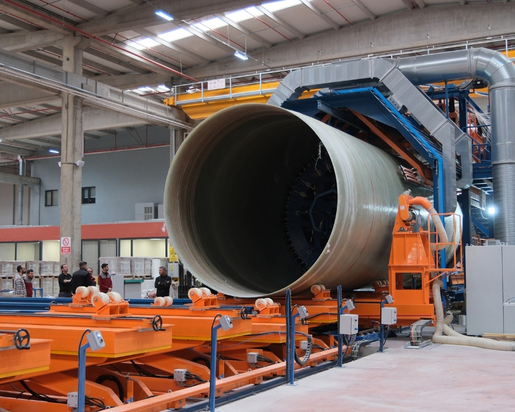
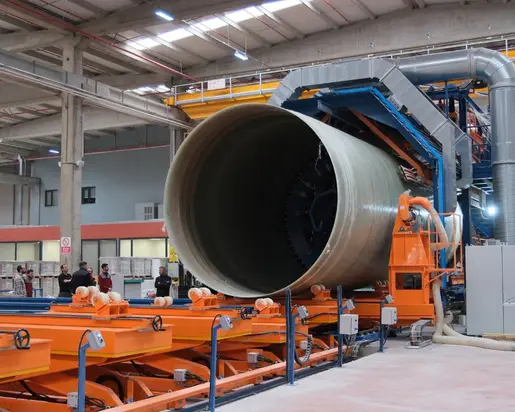
The success of an infrastructure project is possible through the verification of theoretical calculations in R&D and quality control laboratories. Steel-reinforced corrugated pipes are subjected to rigorous testing according to international standards (e.g., EN ISO 9969) before being deployed to the field.
Ring Stiffness Test: The pipe's millimeter-scale deformation resistance against lateral forces is measured.
Deflection Test: It is tested whether the pipe maintains its structural integrity (without the separation of steel and polymer) even under internal diameter reductions of up to 30%.
Buckling Analyses: The buckling resistance of the pipe is calculated under conditions of high groundwater levels or excessive vacuum.