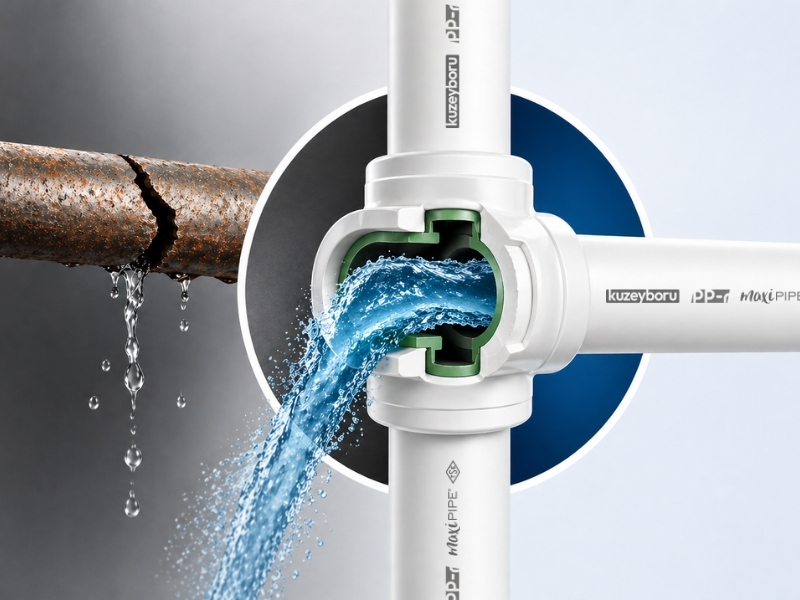
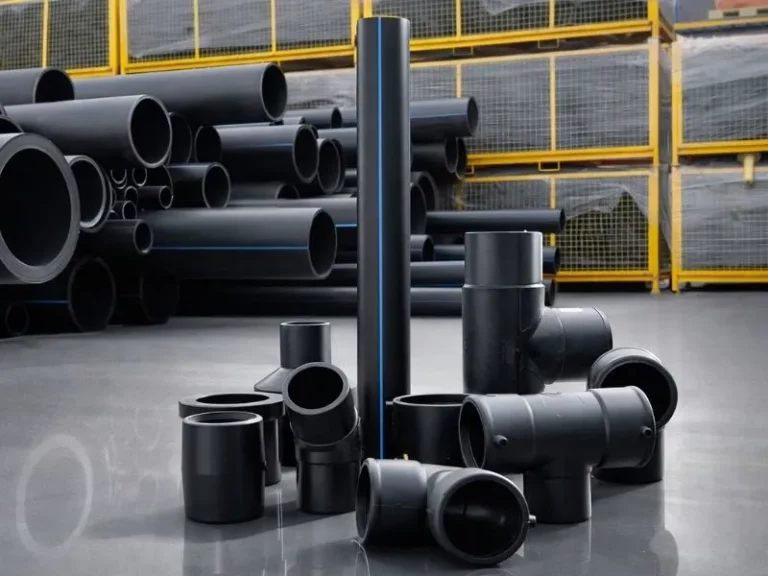
Polypropylene Random Copolymer pipes are widely utilized in modern superstructure plumbing and heating projects owing to their high molecular weight polymer chain structures, chemical resistance, and thermal stability. Ensuring that the system maintains its thermodynamic and hydrodynamic integrity throughout its design life (typically 50 years) depends on the execution of welding and installation techniques aligned with polymer material science principles. Smooth pipe interiors minimize hydraulic head losses. According to the Darcy-Weisbach equation (hf = f × (L/D) × (v²/2g)), keeping the friction factor (f) low directly improves the energy efficiency of the system. However, achieving this efficiency requires proper joining techniques that safeguard the macromolecular structure.
Preparations for PPR Pipe Welding Process
Polyfusion (socket) welding, the most common joining method in PPR systems, fundamentally relies on interphase diffusion of macromolecules driven by thermal activation. Proper surface preparation is critical for seamless diffusion. A cut perpendicular (90°) to the pipe axis must be performed; otherwise, asymmetrical thermal penetration occurs during insertion into the heating die.
Cleaning the oxidation layer and micro-contaminants (dust, grease, moisture) with suitable solvents like isopropyl alcohol prior to welding removes barriers that would otherwise prevent polymer chains from forming covalent and Van der Waals bonds.
Adjusting Welding Temperature and Duration
Due to the viscoelastic nature of polymers, the welding process must be executed within a specific thermal window. For PPR material, the optimal die set (heating element) temperature is around 260°C. In the context of Fourier's Law of Heat Conduction (q = -k∇T), heating time (th) based on wall thickness must be meticulously monitored.
Underheating (the risk of a "cold joint") fails to impart sufficient activation energy for chain mobility in the polymer's amorphous regions, preventing intermolecular entanglement. Conversely, overheating causes thermal degradation of the material, significantly lowering the melt flow index (MFI) and leading to structural deformation.
Common Installation Errors and Solutions
The most common field installation error is internal diameter restriction caused by overheating or excessive insertion force. This cross-sectional reduction generates local (minor) head losses in the system (hk = K × (V²/2g)). The resistance coefficient K in the formula spikes abruptly due to constriction, imposing an additional thermodynamic workload on circulation pumps.
As a solution, precise pre-marking of the insertion depth on the pipe and applying strictly axial (linear) pushing force without any torsional (twisting) motion during heating element insertion are essential.
Anti-Vibration Measures in Installation Passages
The coefficient of linear thermal expansion (α) for polymer pipes is characteristically higher than that of metals. For standard PPR pipes, this value is approximately 0.15 mm/m·K. Temperature fluctuations and sudden pressure surges in fluid dynamics (water hammer) induce vibration and expansion in the system. The thermal expansion formula is expressed as follows:
∆L = L0 × α × ∆T
In piping passages and long runs, expansion loops (U-bends), properly spaced fixed and sliding brackets based on engineering calculations, and vibration isolators (rubber-lined clamps) must be utilized to absorb this expansion (∆L). These measures minimize fatigue stress and crazing (micro-cracking) on the material.
Full Support with After-Sales Services
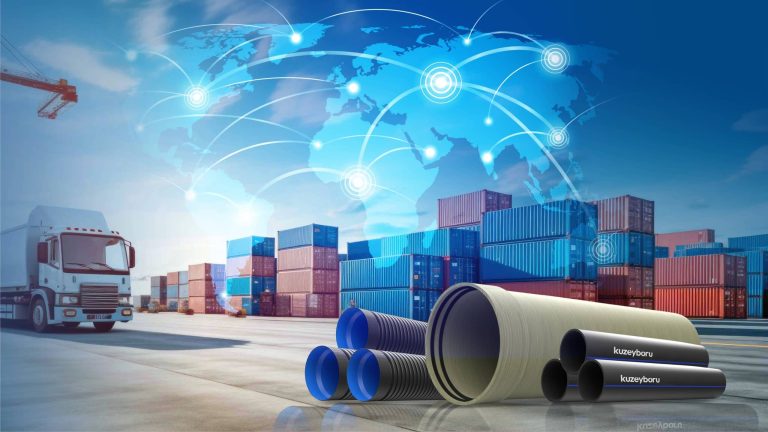
The hydraulic and structural success of a superstructure project relies as much on proactive engineering support as on manufacturing quality. At Kuzey Boru, we integrate our deep expertise in structural mechanics and flow analysis into our after-sales services. Validated through long-term hydrostatic strength testing in our laboratories in accordance with international standards such as ISO 15874-2 and TS EN 13476-3, our products are supported on-site to ensure they deliver the same superior performance. Facing hydrodynamic and structural challenges during complex site conditions or commissioning phases, Kuzey Boru’s technical team delivers permanent engineering solutions.
A Corporate Vision Supporting Female Employment
At Kuzey Boru, we firmly believe in the analytical strength of our female engineers and technical experts at every stage, from R&D processes to advanced product quality planning and high-tech production lines. Female employment, an integral part of our corporate vision, goes beyond promoting gender equality; it embeds multi-faceted problem-solving capabilities and innovative engineering approaches at the heart of Kuzey Boru culture. Our female engineers leave their mark on industry-shaping projects and cutting-edge polymer technologies.