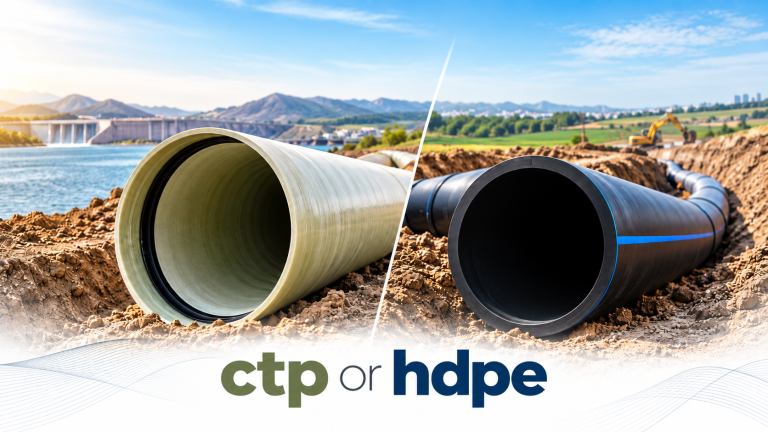
Glass Fiber Reinforced Plastic (GRP) pipes are advanced composite structures formed by the combination of a thermoset resin matrix, continuous glass fiber windings, and silica sand. Especially in large-scale infrastructure projects, they have replaced traditional steel or reinforced concrete systems due to their corrosion resistance and high specific strength (strength/density ratio).
What Are GRP Pipe Types?
The classification of GRP pipes is primarily based on the type of resin used (polyester or vinylester) and the production technology (Continuous Filament Winding or Centrifugal Casting).
The lamination sequence in the pipe wall consists of three main morphological zones: an inner resin-rich barrier layer (liner) that provides chemical resistance, a middle structural layer with sand additives that meets mechanical loads (ring stiffness), and an outer protective layer that resists environmental conditions (UV, soil chemistry).
How to Select a Project-Specific Diameter?
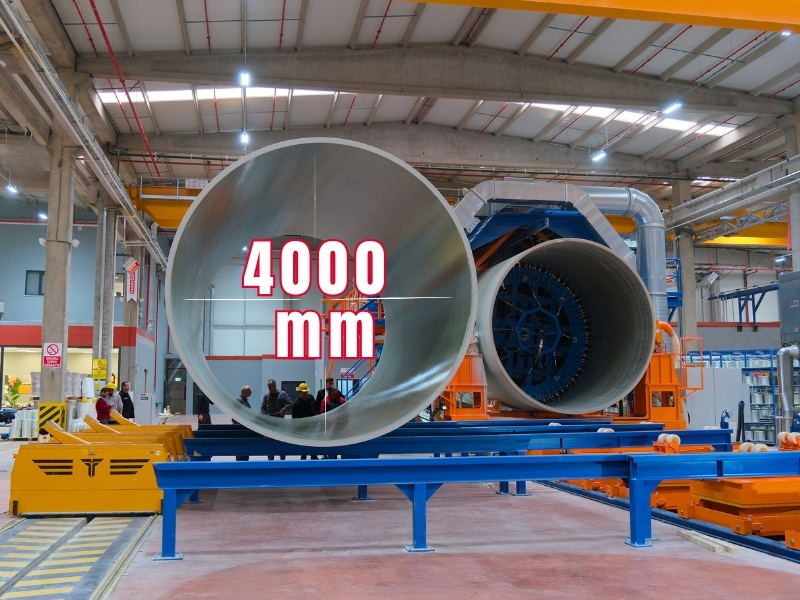
In a wide production scale starting from DN 200 mm up to DN 4000 mm for massive infrastructure lines, GRP pipe selection requires a complex fluid and static analysis beyond mere flow rate requirements.
During diameter optimization, the kinematic viscosity of the fluid, slope of the line, cavitation limits, and water hammer potential must be taken into account. For instance, while giant diameters and low pressure classes (PN 1 - PN 6) in the DN 3000 - DN 4000 range are preferred for the cooling water discharge line of a thermal power plant, diameters in the DN 1200 - DN 1600 range and very high pressure classes (PN 25 - PN 32) are projected for a hydroelectric power plant (HEPP) penstock pipeline in a mountainous terrain.
Hydraulic Design Principles
The greatest advantage of GRP pipes against steel and concrete systems is their roughness coefficients in the Colebrook-White or Hazen-Williams equations. The absolute internal wall roughness value (k) of GRP pipes is approximately 0.01 mm (this value is around ≈1.0 mm for concrete and ≈0.05 mm for steel). This hydraulic smoothness minimizes boundary layer separations and head losses caused by turbulent flow. In engineering, this allows for the selection of a smaller GRP pipe diameter compared to a concrete pipe to carry the same flow rate, or a dramatic reduction in the energy consumption (OPEX) of pumping stations in the network.
Fitting Selection Criteria
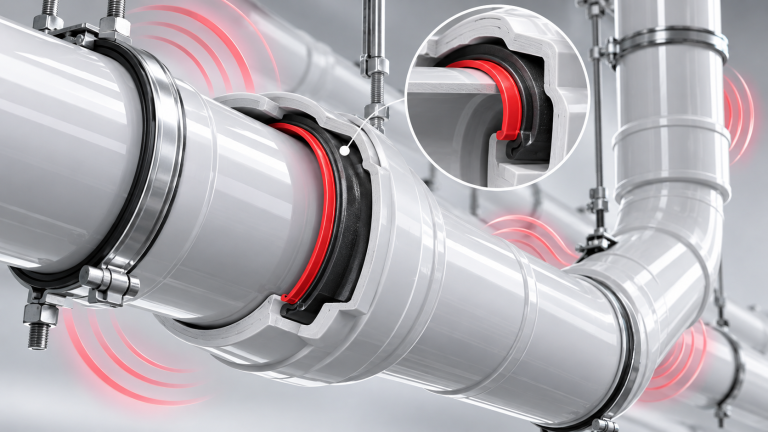
GRP fittings (elbows, tees, reducers, flanges) used at points where the pipeline geometry changes direction or diameter must not be the weak link of the system's hydraulic integrity. The momentum change of the fluid in the system creates massive axial thrust forces at the elbows, especially in large-diameter and pressurized lines.
To damp these hydrodynamic forces, two engineering approaches exist: either concrete thrust blocks suitable for hydraulic calculations are poured behind the elbows, or restrained joint systems that transfer axial loads to the pipe body and fittings produced with biaxial winding technology are integrated. Fitting selection is directly related to the seismic resistance and thermal expansion/contraction cycles of the system.
Durability Tests in Accredited Laboratories
The structural fatigue and viscoelastic creep behaviors that a GRP pipe will be exposed to during its 50-year design life are simulated in accredited laboratories according to international standards (ISO, EN, ASTM) during the production stage.
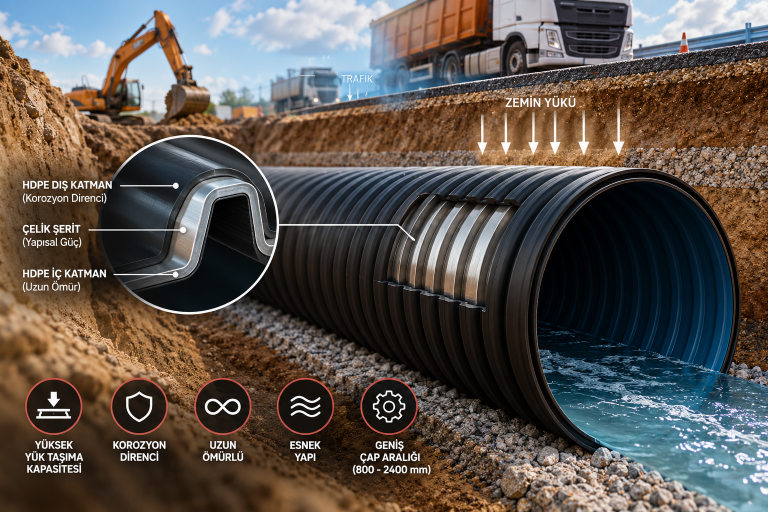
- Ring Stiffness Test (ISO 7685): Measures the vertical deformation (deflection) resistance of the pipe against external static (soil) and dynamic (traffic) forces. It is classified from SN 2500 to SN 10000.
- Hydrostatic Pressure and Burst Tests: Verify the structural integrity of the pipe against stresses well font-weight: bold; above its nominal pressure (PN).
- Strain Corrosion Test: Determines the long-term chemical degradation limits of the composite structure in acidic (e.g., H2SO4) environments and under constant bending strain.
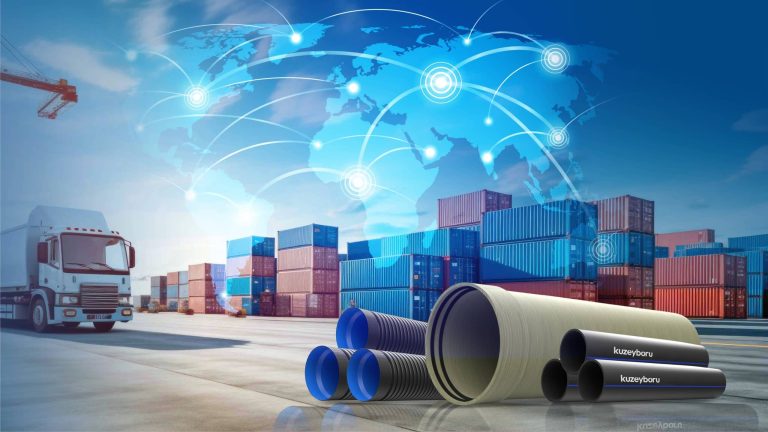
A Global Brand Exporting to 105 Countries In infrastructure engineering, design starts on paper, but success is proven in the field. Kuzey Boru has transformed into a global engineering power by combining its GRP pipe production capacity ranging from DN 200 mm to DN 4000 mm with world-class automation technologies and advanced material science. Especially the logistics of large-diameter (DN 2000 and above) GRP pipes requires shipping engineering in itself.
Kuzey Boru minimizes transport costs through telescopic loading (nesting) optimizations and special handling apparatus, directly supporting the investment feasibility of projects.
Today, our pipe exports to 105 different countries across 5 continents with challenging geographical conditions and strict technical specifications are the clearest guarantee of the uninterrupted hydraulic performance of each product coming out of our accredited laboratories, lasting for decades in underground and aboveground networks.