Sockets (couplings) specified in thermoplastic systems, particularly high-density polyethylene (HDPE) or polypropylene (PP), align two pipe ends on the same axis to maintain the linear stability of the pipeline. Elbows, which divert the flow direction at specific angles (typically 45° or 90°), serve as primary variables in calculating systemic turbulence and pressure drops. Tee (T) components are critical fittings that allow branching options away from the main distribution line to alternative directions.
Flanges utilized where the system interfaces with mechanical equipment like valves or transitions to alternative material types must be manufactured with precise tolerances conforming to international engineering standards (ISO, EN). Additionally, unions—preferred for ease of maintenance and demountable connections—are reinforced with elastomeric sealing rings to deliver operational flexibility.
Plastic Pipe Fittings and Application Areas
The deployment matrix of plastic pipe fittings spans a broad industrial spectrum depending strictly on the material's chemical resistance profile and mechanical tensile strength. In municipal infrastructure projects, particularly potable water networks and agricultural irrigation systems, socket and elbow variants suitable for electrofusion or butt-fusion welding are widely specified due to their superior seal integrity. In wastewater and sewage networks, tee (T) and wye (Y) branch connections featuring high inner surface smoothness are prioritized to optimize gravity flow and minimize solid deposit accumulation.
In industrial processing plants and chemical process lines, flange connections that offer high resistance to corrosive media form a critical interface when transitioning from metallic pipelines to plastic lines, or at periodic maintenance access points of pump-and-valve stations. Within building internal plumbing networks, the integration of unions provides installation convenience in confined spaces and extends the system's operational lifespan by dampening mechanical stresses.
Each of these components, ranging from high-pressure natural gas grids to low-pressure drainage configurations, is specifically selected and integrated based on standard classifications tailored to the project's hydraulic requirements and environmental stress factors.
The Necessity of Fittings in Plastic Pipe Systems
Although a pipeline conceptually represents the shortest path between two coordinates, topographical variables in the field and operational mandates render the use of fittings unavoidable. The primary driver for integrating fittings in plastic piping networks is the balance between the pipeline's natural flexibility limits and the project's spatial geometric constraints. Standard manufactured pipe lengths (typically 6 or 12 meters) are restricted due to logistics and jobsite handling boundaries. This physical limitation makes connecting elements like sockets a fundamental requirement to achieve continuity across long-distance mainlines.
However, the necessity for fittings extends far beyond simple distance extensions. From an engineering perspective, fittings play a critical role in resisting dynamic loads generated at redirection points, joining mismatched pipe diameters while minimizing hydraulic head losses, or extracting lateral branch outflows. Especially when considering the high thermal expansion coefficients inherent to thermoplastics, demountable joints such as flanges and unions become a technical obligation to manage systemic stresses and integrate mechanical instruments like valves and pumps seamlessly.
Types of Connecting Elements
Connecting elements in plastic piping systems are categorized based on their jointing methodology and sealing mechanisms. This classification correlates directly with the project’s nominal pressure class (PN) and the Standard Dimension Ratio (SDR). Fundamentally, these joint configurations are evaluated across two main groups: permanent (monolithic) joints and demountable connections.
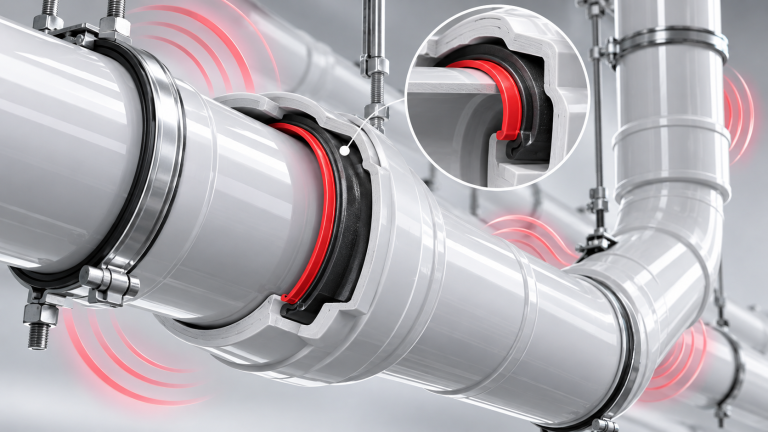
Permanent joints are dominated by electrofusion and butt-fusion welding methods, which fuse polymer molecular chains at a structural level. In this methodology, the fitting itself acts as the jointing medium via embedded electrical resistances or heating plates. Conversely, mechanical connecting elements featuring socketed push-fit configurations (gasket-sealed) offer structural flexibility and rapid installation advantages, particularly in gravity-fed wastewater lines.
In high-pressure clean water or gas distribution grids, transition adapters facilitating metal-to-plastic conversions, along with threaded union connections, guarantee zero-leakage via mechanical locking mechanisms. Each connection profile must be executed under standardized torque and temperature values calibrated to the visco-elastic properties of the specific polymer material (such as PE100, PVC, or PP-R) and environmental field conditions.
Utilization of Sockets and Elbows
In the execution of plastic pipeline engineering, sockets and elbows constitute the foundational components defining the geometric configuration of the network. Sockets primarily serve two structural objectives: the linear alignment of continuous runs and the localized repair of localized pipe defects.
In engineered applications, electrofusion sockets generate a joint interface equivalent to the tensile strength of the pipe itself, owing to homogeneous heat distribution across the fusion zone. However, the most critical parameter during socket installation is ensuring that the pipe ends are perfectly axial (linear) and that the outer polymer oxidation layer has been meticulously peeled using proper mechanical scraping tools prior to welding. Failure to do so induces "cold joints," creating weak zones prone to catastrophic failure under high operating pressures.
Elbows introduce directionality to the fluid matrix but simultaneously introduce hydraulic risks such as friction head loss and water hammer phenomena. Utilizing two 45° elbows instead of a single sharp 90° turn reduces fluid turbulence where feasible, thereby increasing the system's overall energy efficiency.
Furthermore, in high-pressure networks, elbow vectors are subjected to intense axial thrust forces caused by fluid momentum changes. Consequently, the system must be stabilized using concrete thrust blocks (anchors) at elbow locations, particularly in subterranean buried applications, to prevent joint displacement. A properly engineered socket and elbow configuration ensures a pipeline operates free from mechanical stresses throughout its structural design life.
Flange Jointing Methodologies
Flanged connections in plastic piping systems represent the most reliable mechanical interface that simultaneously preserves structural rigidity and permits periodic dismantling. This methodology is the standard engineering solution at transition junctions where polyethylene (PE) or polypropylene (PP) lines interface with cast steel valves or other metallic pipeline apparatus. The flange joint assembly consists of a flange adaptor (stub end) welded to the pipe tip, a backing ring made of coated steel or composite matrix slipped over the adaptor, and heavy-duty bolting hardware.
From a structural engineering standpoint, the success of this connection depends entirely on precise torque management and correct elastomer gasket selection. Tightening bolts in an incremental, crosswise (star) sequence ensures a completely uniform pressure distribution across the mating faces; this prevents local warping of the flange face and subsequent leakage.
Additionally, the compatibility of the selected elastomeric gaskets (EPDM, NBR, etc.) with the chemical characteristics of the fluid medium and operational temperatures directly impacts the pipeline's lifecycle cost. Flanged joints remain indispensable in industrial piping layouts due to their inherent vibration-dampening capacity under high-pressure classes and the operational speed they afford during maintenance turnarounds.
Technical Installation Guidelines
The theoretical mechanical strength of plastic pipe fittings can only be achieved in the field through a disciplined installation protocol. To guarantee an enduring, leak-free piping network, the following technical criteria must be strictly enforced:
- Surface Preparation: Prior to any welding or mechanical joining phase, moisture, particulate dust, and specifically the superficial polymer oxidation layer on the pipe and fitting interfaces must be removed using mechanical scraping tools. Microscopic contaminants on the surface inhibit complete molecular chain entanglement, creating a localized structural weak point.
- Alignment and Structural Anchoring: Axial misalignment during assembly induces severe bending stresses on the fittings. To mitigate this risk, pipelines must be aligned using appropriate alignment clamps and structural supports to prevent external load transfer to the joint interface.
- Thermal and Mechanical Tolerances: In electrofusion or butt-fusion configurations, cooling durations dictated by ambient temperature parameters must be strictly observed. Subjecting a joint to hydraulic pressure or physical movement before recrystallization is fully complete induces micro-cracking within the polymer matrix.
- Calibrated Torque Control: In mechanical flanged or union connections, operators must avoid the misconception that over-tightening improves seal integrity. Excessive torque deforms plastic threads and crushes elastomeric gasket matrices; thus, the utilization of a calibrated torque wrench matching manufacturer-specified values is mandatory.
Frequently Asked Questions (FAQ)
- Should electrofusion or butt-fusion welding be specified for plastic pipe fittings?
- While both methodologies deliver absolute structural fusion, the choice depends on application constraints. Butt-fusion represents a highly cost-effective solution for large-diameter pipelines on linear layouts. However, in restricted spaces, vertical installations, or repair operations, electrofusion is technically superior as it eliminates the need for lateral pipe movement and features a significantly lower margin of operational error.
- Do fittings possess the same operational lifespan as the straight pipeline?
- Fittings manufactured to international standards and installed via verified protocols possess a design lifespan identical to the pipeline itself (typically a minimum of 50 years). However, because fittings act as stress concentration points within the network topology, they are far more susceptible to external anomalies—such as water hammer, excessive thermal expansion, and poor trench bedding—than unjointed pipe sections.
- What triggers leak failures in flanged pipe connections?
- The primary catalyst for flanged joint failure is uneven bolt torque application. When bolts are not tightened incrementally and in a reciprocal sequence, it creates an axial skew across the flange adaptor face, preventing the gasket from seating uniformly. Furthermore, selecting a gasket grade incompatible with the system's nominal pressure (PN) or the chemical fluid profile escalates the risk of failure.
- How can pressure drop across fittings like elbows and tees be minimized?
- Systemic pressure drops are a direct function of turbulence generated when fluid changes momentum. To smooth out fluid vectors, replacing a single sharp 90° elbow with two calibrated 45° elbows can reduce hydraulic head losses by approximately 20% to 30%. Additionally, ensuring that the roughness coefficient of the fitting’s inner wall matches the pipe matrix and avoiding internal bead flash during the welding phase is highly critical.