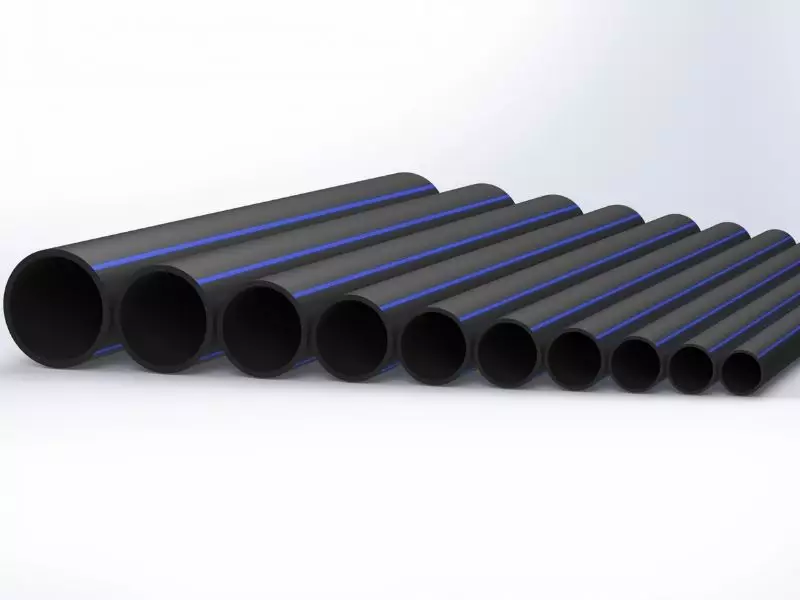
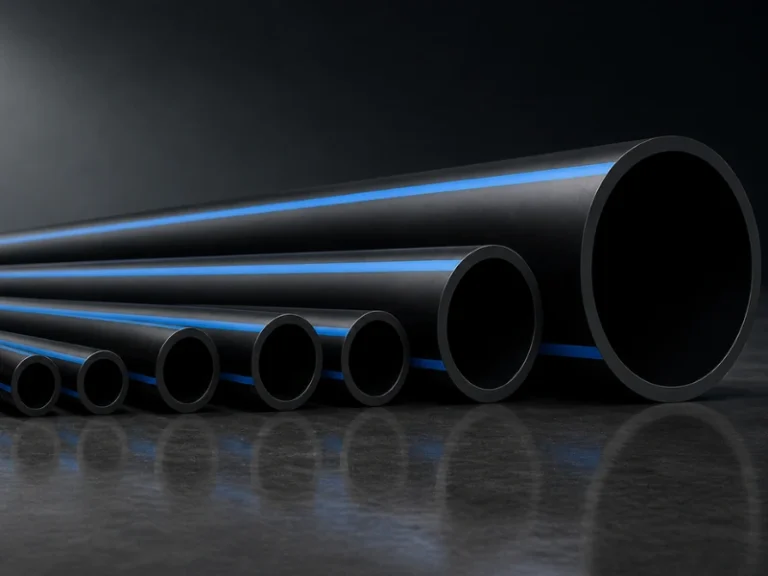
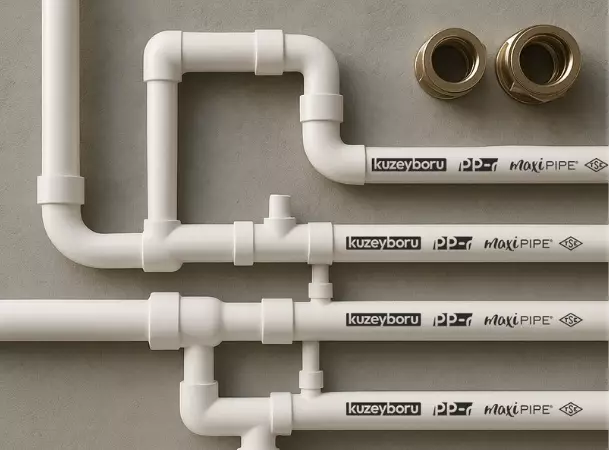
Hydraulic efficiency and structural integrity in polymeric pipe systems depend entirely on the dimensional stability of the product. In the journey of a plastic pipe from the extrusion line to the project site, plastic pipe measurements are rigidly standardized by international norms (ISO, EN, DIN).
This standardization is a critical engineering requirement to ensure that pipes fit perfectly with fittings (couplings, flanges, elbows), sealing tolerances are maintained, and the system meets the targeted flow-pressure balance.
What is a Plastic Pipe Diameter?
In technical terminology, pipe diameter does not refer to a single value, but rather to the whole set of parameters that form the cross-sectional geometry of the pipe. These parameters are examined across three main axes:
Outside Diameter (OD): The widest distance between the outer surfaces of the pipe. Sizing in the plastic pipe industry is generally categorized based on the outside diameter.
Inside Diameter (ID): The net cross-sectional diameter with which the fluid comes into contact and which determines the actual flow rate.
Wall Thickness (s): The polymer layer between the outside diameter and inside diameter. It determines the nominal pressure (PN) the pipe can withstand.
The relationship between these three parameters is expressed in engineering by the equation $OD = ID + 2s$. In addition, the Standard Dimension Ratio (SDR), which is the ratio of the outside diameter to the wall thickness, is the most fundamental indicator defining the mechanical resistance of the pipe against pressure.
Plastic Pipe Measurement Units
In the global plastic pipe sector, dimensioning is carried out via the metric system depending on the area of application. The metric system is dominant in infrastructure projects (potable water, sewage, natural gas) and diameters are expressed in millimeters (mm) (e.g., DN110, DN500).
Standard Plastic Pipe Diameters
Although a general pipe diameter chart referenced by engineers and installers in project designs varies depending on the type of material (HDPE, PP, PVC), there are generally accepted standard stages in the metric system. Below is a cross-section of nominal diameter (DN) values frequently encountered on a sectoral basis:
Installation Type
Frequently Used Nominal Diameters (DN-Outside Diameter)
Indoor / Potable Water
20 mm, 25 mm, 32 mm, 40 mm, 50 mm
Infrastructure / Pressurized Water
63 mm, 90 mm, 110 mm, 160 mm, 225 mm, 315 mm
Sewage / Drainage
200 mm, 300 mm, 400 mm, 600 mm, 1000 mm and above
Correct Diameter Selection
The heart of any project is the optimum pipe diameter calculation process. Selecting a diameter that is smaller than required leads to excessive velocity, friction-induced pressure losses (cavitation), and water hammers in the system. On the other hand, selecting a diameter larger than necessary drops the velocity, leading to sediment accumulation inside the pipe (especially in wastewater lines) and high investment costs.
The continuity equation taken as a basis in diameter calculation is the most fundamental rule of hydraulics: $Q = V \times A$ (Flow Rate = Velocity x Cross-Sectional Area). Based on this equation, the ideal inside diameter ($D$) for a circular cross-section pipe is derived using the following formula: