In polymeric pipe systems, joint making is a process of integrating two different solid phases through thermal, chemical, or mechanical means to form a single monolithic structure (or a rigid mechanical node), rather than a simple assembly operation. This process must be carried out within the viscoelastic limits dictated by the thermoplastic nature of the material. A successful joining mechanism depends directly on fundamental morphological parameters such as:
- The melting temperature of the polymer (Tm),
- The glass transition temperature (Tg), and
Plastic pipe joints are fundamentally based on two main philosophies:
Welding Joining Methods
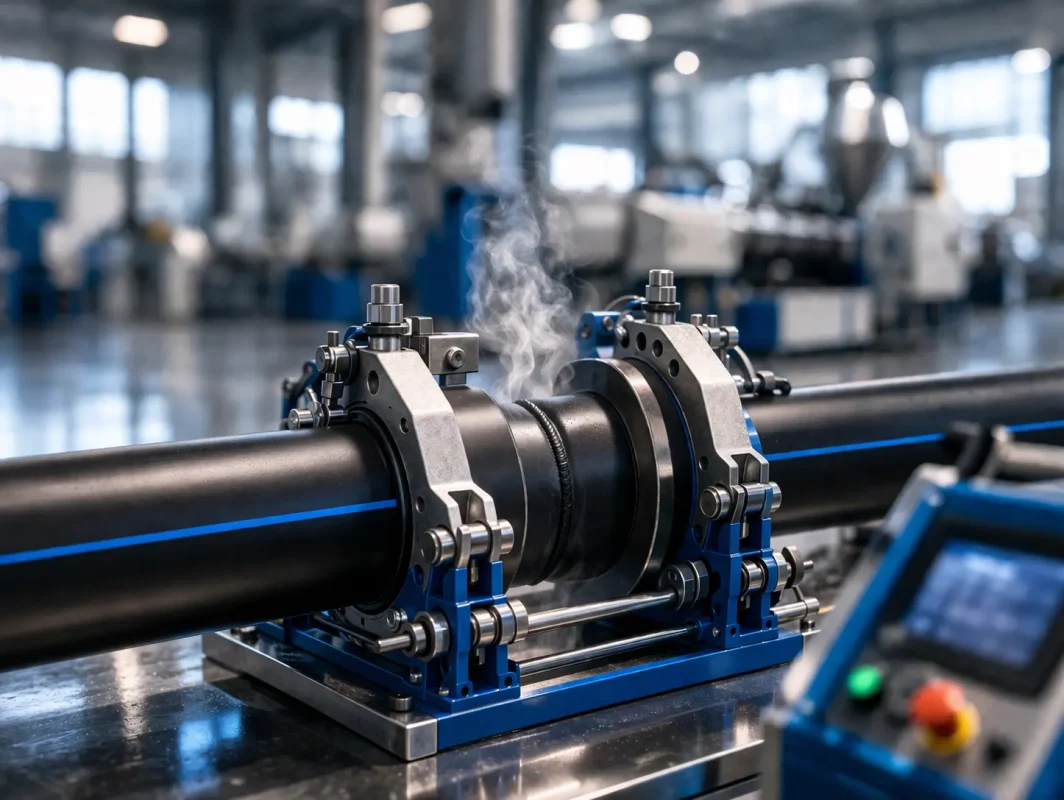
The welding (fusion) process is based on the principle of polymer chains interdiffusing under heat and pressure to form a homogeneous network. In industrial infrastructure, the most common method is butt fusion.
In butt fusion, for high-density polyethylene (HDPE) pipes for instance, the interface temperature is typically brought between 200°C and 220°C. This range is well font-weight: bold; above the Tm value of the material (approximately 130°C) and allows the polymer to transition into a viscous flow form. The joining pressure applied after the removal of the heating plate (generally 0.15±0.01 MPa) triggers the molten chains to diffuse into one another.
The most critical parameter of the process is the cooling phase. For crystallization in the joint area to be completed in the same morphology as the main body of the pipe, the system must cool under pressure to ambient temperature by natural convection; otherwise, residual stresses will cause micro-cracks.
Socketed Connections
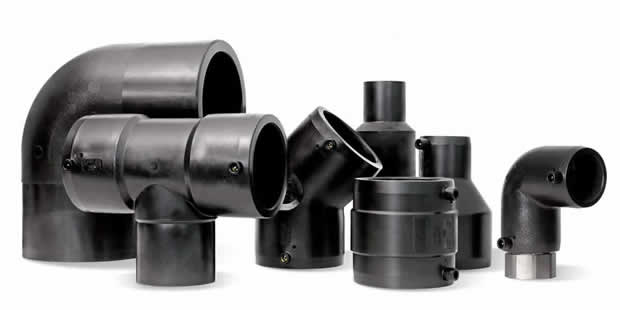
Socketed connections refer to the thermal joining of pipe ends by inserting them into a coupler (socket). The most technological variation of this category is electrofusion (EF) welding. Copper or alloy wire resistances with a specific ohmic resistance are placed on the inner surface of EF couplers during the manufacturing stage.
The welding machine transmits the voltage and time required by the fitting to the system via a barcode reader. The current passing through the wires melts the surrounding polymer according to the Joule heating principle (P = I2R). Since the thermal expansion of the polymer is restricted by the outer wall of the coupler, a high auto-pressure (melt pressure) directed from the molten zone to the cold zone (towards the inside of the pipe) occurs.
This pressure ensures molecular mixing, creating a flawless sealing zone. In EF welding, Melt Flow Index (MFI) compatibility is the primary thermodynamic variable determining fusion quality.
Contaled Systems
These are connection types that do not require thermal welding and are based on the compression mechanics of the viscoelastic material. In gasketed systems, the sealing barrier is generally provided by elastomeric materials such as EPDM (Ethylene Propylene Diene Monomer) or NBR (Nitrile Rubber).
The hydraulic success of the system relies on the principle that the contact pressure (Pcontact) generated by compressing the elastomer must always be greater than the hydrostatic internal pressure (Pinternal) within the pipe. Elastomers are incompressible materials with a high Poisson's ratio (approximately 0.5). When the pipe is pushed into the socket (muff), the gasket deforms in the radial direction and completely fills its seat.
Sealing Precautions
For sealing at the molecular level, it is mandatory that the joint area is cleared of physical and chemical contamination. Especially after the production of polyethylene pipes, an inactive oxidation layer with a thickness of a few microns forms on the pipe surface due to the effect of atmospheric oxygen and UV. Shaving off this layer with mechanical scrapers up to a depth of 0.2 mm before electrofusion or socket welding is a critical sealing precaution.
In addition, "ovality" caused by post-extrusion residual stresses or storage conditions in thermoplastic pipes can disrupt the clearance gap tolerance between the socket and the pipe, leading to a loss of melt pressure and the formation of a "cold weld". The use of rounding clamps before joining is a requirement of engineering standards.
"Test and Control Methods
The structural integrity of the joining operations is validated by destructive and non-destructive testing (NDT) methods.
- Non-Destructive Testing: The most frequently applied method in the field is the hydrostatic pressure test (ISO 1167). The system is filled with water, brought up to generally 1.5 times the design pressure, and the pressure drop is monitored. In advanced industrial applications, Phased Array Ultrasonic Testing (PAUT) devices are used to detect air voids or cold weld defects at the joint interface.
- Destructive Testing: In a laboratory environment, specimens taken from the welded area are subjected to a Tensile Test or a Peel Test. In a successful weld, the failure is expected to occur not from the weld interface (brittle failure) but from the body of the pipe itself (ductile yielding).
Frequently Asked Questions
- Can polyethylene pipes with different MFI (Melt Flow Index) values or different classes (e.g., PE80 and PE100) be welded together?
Yes, they can be welded. However, what needs to be considered here is the difference in their melt viscosities. In butt fusion, the material with lower melt viscosity tends to flow more from the heating plate. To manage this situation, standard pressure/time tolerance ranges must be maintained, and the use of electrofusion (EF) couplers should be preferred; since EF couplers can easily tolerate MFI differences (generally in the range of 0.2 to 1.4 g/10 min) thanks to the auto-pressure within the limited volume.
- Do elastomeric gaskets used in gasketed plastic pipe systems lose their sealing property over time?
By the nature of elastomers, it is inevitable for them to experience a viscoelastic stress relaxation over time under continuous compressive strain. However, high-quality EPDM gaskets manufactured in accordance with the DIN EN 681 standard are formulated to keep the contact pressure font-weight: bold; above the hydrostatic pressure throughout the 50-year design life of the pipeline. Excessive chlorine exposure or out-of-limit operating temperatures can accelerate this relaxation process, increasing the risk of leakage.
- What is a "Cold Weld" and can it be detected by a hydrostatic pressure test in the field?
A cold weld is a condition where polymer chains fail to interdiffuse at the molecular level due to a lack of heating or pressure, insufficient surface scraping, or contamination, exhibiting only a weak superficial adhesion. Hydrostatic pressure tests in the field (especially short-term tests) may remain insufficient in detecting cold weld defects; because the system can temporarily bear the instantaneous pressure with this weak adhesion, but over time, sudden failures occur due to environmental stress cracking (ESC). Therefore, reliability is ensured through datalogger (parameter readout) analyses obtained from fully automated CNC welding machines and ultrasonic testing (NDT).