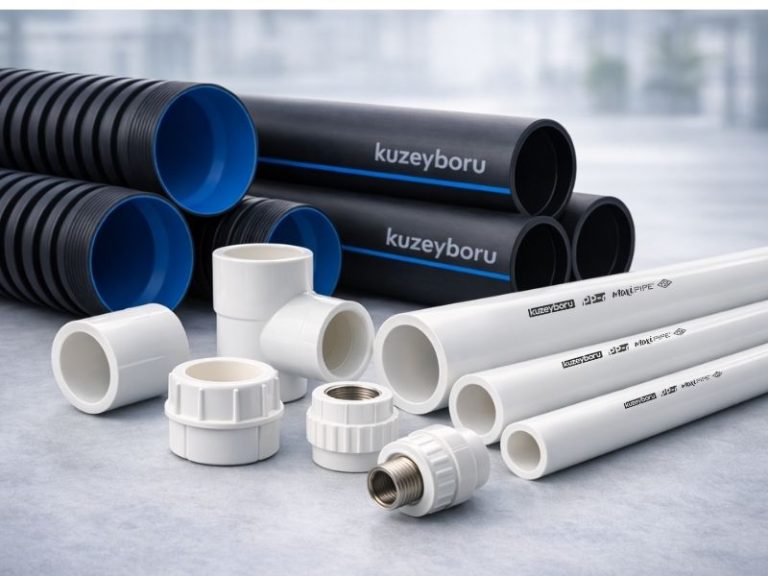
Positioned at the intersection of polymer science and infrastructure engineering, PVC-U (Unplasticized Polyvinyl Chloride) pipes constitute one of the fundamental building blocks of modern piping systems with their structural rigidity, high chemical resistance, and cost-effectiveness. The absence of plasticizer additives in its macromolecular structure grants this amorphous thermoplastic a high modulus of elasticity and mechanical toughness.
PVC-U Pipe Production Standards and Quality Criteria
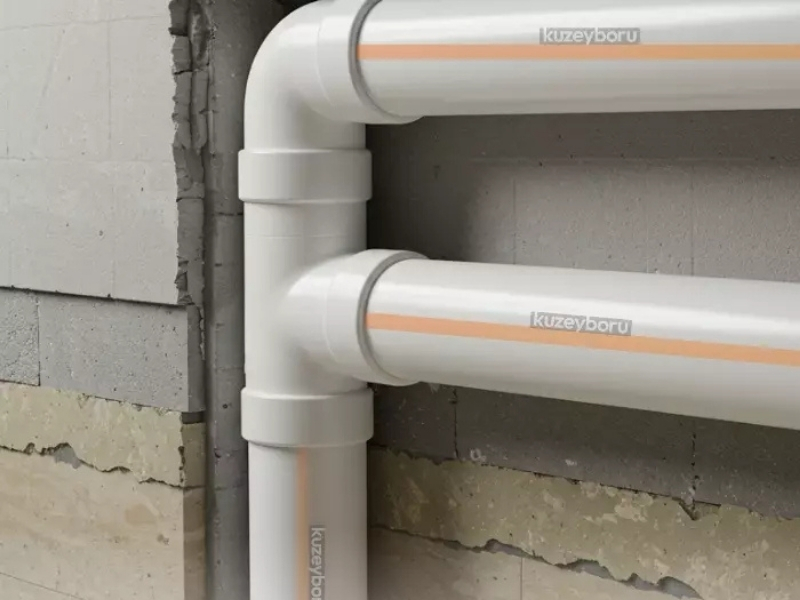
Quality in PVC-U pipe production relies on compounding the original polymer with the correct stabilizers and processing aids at optimum ratios. The temperature profile in the extrusion line, the melt pressure, and the cooling (calibration) speed directly affect the final crystallinity ratio and morphological homogeneity of the material. The quality of a flawless PVC-U pipe is measured by its wall thickness uniformity, surface smoothness, axial alignment, and its viscoelastic response against mechanical stresses.
Is Economical and Safe Installation Possible?
Although the concepts of economy and safety are often thought to be inversely proportional in infrastructure and superstructure projects, PVC-U systems provide this balance through their thermodynamic and mechanical advantages. The specific gravity of PVC-U pipes ($\approx 1.35 – 1.46\text{ g/cm}^3$) is much lower compared to cast iron or concrete pipes. While this lightness reduces transportation costs in logistical operations, it optimizes installation and labor costs by minimizing the need for heavy machinery on-site.
Furthermore, push-fit or solvent welding jointing techniques offer rapid and leak-proof installation. PVC-U’s high resistance to corrosion and galvanic reactions reduces the system’s operational and maintenance (OPEX) costs to near zero, making it possible to establish both an economical and safe infrastructure network throughout its 50-year design life.
Approval by International Standardization Organizations
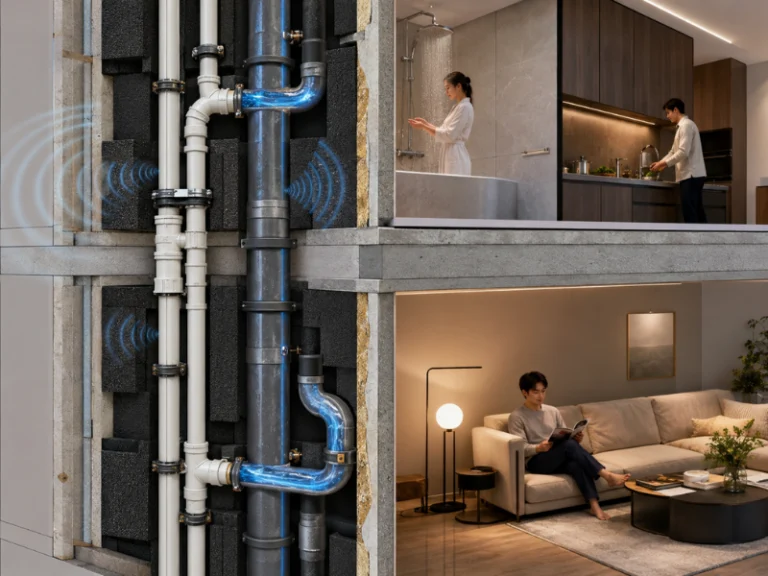
The acceptability of a material in global engineering projects is measured by its compliance with the norms of independent standardization organizations. In PVC-U pipe production; EN ISO 1452 is taken as reference for pressurized drinking water lines, EN 1401 for underground non-pressure sewerage and drainage systems, and EN 1329 for soil and waste discharge systems inside buildings. These norms define all geometric and physical limits, from outer diameter tolerances to wall thickness, and from long-term hydrostatic strength to ring stiffness (SN). Integrating production with these standards means that hydraulic integrity in infrastructure networks across different climates and geographies is guaranteed at an international level.
Wall Thickness and Density Criteria
The pressure rating and geotechnical load-bearing capacity of PVC-U pipes are designed using a geometric parameter called the Standard Dimension Ratio (SDR). SDR is the ratio of the pipe’s nominal outer diameter ($d_n$) to its nominal wall thickness ($e_n$), and it directly affects the nominal pressure (PN) the system can withstand:
SDR = $d_n$ / $e_n$
A low SDR value indicates a thicker pipe wall and, consequently, higher pressure resistance. The density criterion indicates the purity of the polymer matrix. In an ideal PVC-U formulation, the specific gravity must remain within the standard limit values. Using excessive amounts of inorganic fillers (e.g., calcite, $\text{CaCO}_3$) increases the material’s density, but severely lowers its impact strength and tensile strength, leading to brittle failure.
Strength and Quality Control in an Accredited Laboratory
PVC-U pipes emerging from the production line are subjected to thermomechanical tests in accredited laboratories against structural fatigue and external stress scenarios:
- Drop Weight Impact Test (EN 744): Measures the material’s ability to absorb impact energy and its crack resistance at low temperatures such as 0°C.
- Vicat Softening Temperature (EN 727): Determines the dimensional stability of the material under heat (typically must be $\ge 79^\circ\text{C}$ for PVC-U).
- Longitudinal Reversion (EN ISO 2505): Analyzes the shrinkage in the pipe due to the release of residual stresses formed in the polymer chains during extrusion under heat. Having this ratio below the standard limits (5%) proves that the pipe will not experience thermal deformation in the field.
Eco-Friendly Carbon Footprint Management
In infrastructure engineering, ecological sustainability is a design variable just as critical as hydraulic performance. PVC-U requires a much lower Embodied Energy during its production compared to metals or reinforced concrete systems. Energy optimizations in the extrusion process and the 100% thermoplastic recyclable nature of the material minimize the carbon footprint on a Life Cycle Assessment (LCA) basis. This environmentally conscious production approach contributes directly and positively to modern green building certification (LEED, BREEAM) processes.
A Quarter Century of Trust Since 2001
Engineering theories take shape on the production line, but the real character of a material is proven by its time-defying field performance. Founded in 2001, Kuzey Boru combines its quarter-century of expertise in plastic pipe manufacturing with the latest innovations in global polymer technologies. Every single pipe emerging from our advanced extrusion lines and accredited quality control laboratories is a tangible commitment to Kuzey Boru’s engineering vision building the future, and a quarter-century of unwavering trust securing underground networks in over 100 countries.