

Blog
What is PP-R tubing?

PP-R Pipes: Properties, Advantages, and Application Areas
PP-R (Polypropylene Random Copolymer), also referred to as "Type 3" in polymer science literature, is a thermoplastic material obtained by randomly distributing ethylene molecules into propylene chains. This unique macromolecular structure has revolutionized plumbing systems by providing an excellent balance between crystallinity and flexibility.
Among the primary engineering advantages of PP-R pipes, their superior resistance to corrosion and chemical degradation ranks first. Issues that impair hydraulic efficiency in conventional metal pipes, such as scaling, rusting, or diameter reduction, are entirely eliminated within this polymer matrix.
Since its thermal conductivity coefficient is extremely low compared to metal pipes (PP-R: ≈0.24 W/mK; Steel: ≈50 W/mK; Copper: ≈390 W/mK), it ensures energy conservation within the system by offering low heat loss advantages, thereby minimizing insulation costs.
The wide product range offered on the basis of diameter and pressure class (PN) allows for specific solutions to be generated for the diverse hydraulic and architectural requirements of projects.
Application Areas of PP-R Pipes
Thanks to its viscoelastic properties and compliance with international health standards (FDA, KTW, NSF), the industrial spectrum of PP-R pipes is remarkably broad. With a non-toxic structure that leaves no odor or taste in the water, it stands as a global standard for potable water installations. Its high heat tolerance makes it the most reliable choice for hot and cold water lines in buildings.
In addition, heating systems where corrosion resistance is critical, as well as centralized heating and cooling systems in large-scale commercial buildings, represent other sectors where PP-R pipes are frequently preferred.
Owing to their chemical inertness, they also build a long-lasting and secure infrastructure for industrial plants where acidic or basic fluids are transferred, as well as for pool and spa systems where chlorine and other disinfectant chemicals are heavily utilized.
Fittings
The hydraulic integrity of a PP-R system depends on the geometric and dimensional stability of the fittings used alongside the pipes. Elbows, tees, and reducers are utilized for routing the system and taking branches.
Furthermore, composite fittings containing brass or stainless steel inserts (internal/external threads) are integrated into the system to allow transitions to fixtures, valves, or metallic plumbing components. These metal-inserted components are manufactured using a special injection molding technology that maintains sealing safety despite the differing thermal expansion coefficients of polymer and metal.
Installation Methods
The primary factor behind the widespread adoption of PP-R pipe systems in the industry is the easy installation dynamics they provide. The fundamental jointing technique, polyfusion (socket welding), is based on simultaneously melting the outer wall of the pipe and the inner wall of the fitting using a teflon-coated heater (welding die) maintained at a temperature range of 260°C to 270°C.
When the molten polymer chains interlock and cool down, the pipe and the fitting theoretically fuse into a single homogeneous mass. This process is completed within seconds, allowing the piping system to be commissioned rapidly.
Sealing Properties
In a polyfusion welding process carried out by adhering to the correct temperature, heating time, and insertion depth parameters, the joint junction becomes stronger than the pipe body itself. This homogeneous molecular fusion guarantees that the system remains leakproof for a lifetime (minimum 50 years), even in applications requiring high pressure resistance (such as PN20 or PN25). Unlike gasketed or threaded mechanical joints, there is no sealing element that will loosen or deform over time, reducing the risk of fatigue-induced leaks to zero.
Glass Fiber Reinforced Composite PP-R Pipes
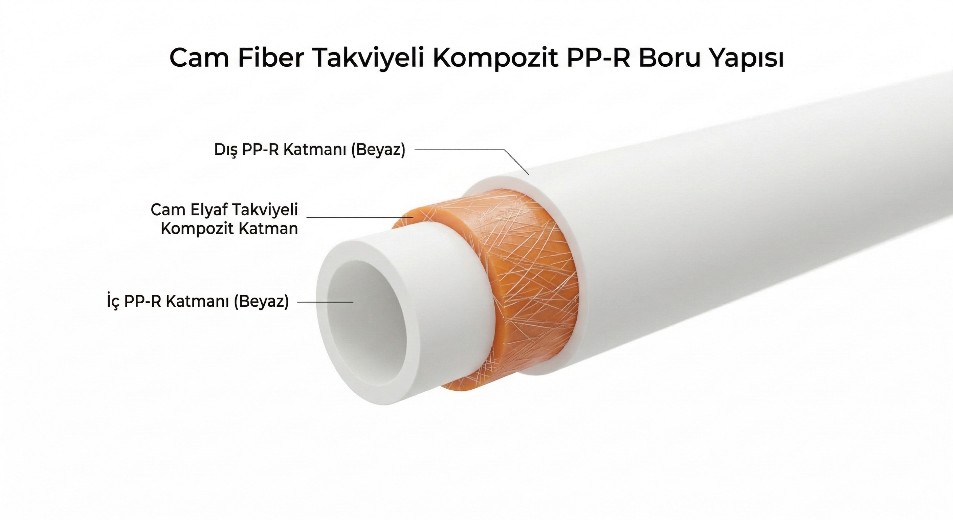
High linear thermal expansion coefficient, which is the biggest engineering constraint encountered due to the nature of thermoplastics, has found an innovative solution with glass fiber reinforced composite PP-R pipes. These pipes feature a three-layer (A/B/A) co-extrusion structure comprising standard PP-R layers on the inside and outside, and a special PP-R copolymer compounding enriched with glass fibers in the middle layer.
This middle composite core layer reduces the thermal expansion coefficient of the material by approximately 75% compared to a standard PP-R pipe (from 0.15 mm/mK down to 0.035 mm/mK levels).
Particularly in hot water and heating lines, pipe sagging (snaking) is prevented, the number of required pipe clamps is reduced, and a much more stable mechanical structure is obtained by increasing the overall rigidity of the system.
Frequently Asked Questions
- Do PP-R pipes affect potable water quality (taste, odor, pH)?
No. Polypropylene Random Copolymer is a chemically inert and biologically inactive material. It does not alter the pH value of water, does not form rust or scale, and does not impart any odor, color, or taste to the water. It is a polymer approved by international health authorities for food and drinking water transfer (Food Grade).
- What engineering measures should be taken in the field against the thermal expansion problem of PP-R pipes?
Standard PP-R pipes tend to expand during hot water cycles. To manage this, expansion compensators called "omega" or "U-bends" must be designed on long linear lines. A more practical and cost-effective solution is to choose glass fiber reinforced composite PP-R pipes, which have a much lower thermal expansion coefficient.
- What are the most common installation mistakes made in PP-R pipe welding?
The most common mistake is that the welding die (welding machine) temperature is far below or above 260°C. Low temperature causes poor adhesion, known as "cold welding"; while high temperature or keeping the pipe on the heater longer than necessary causes the material to melt excessively and narrow the inner diameter (cross-sectional clogging). Additionally, a wet or dirty pipe end prevents molecular fusion.
Related Articles

Material Comparison in Infrastructure Projects: GRP or HDPE?
Discover a comprehensive technical comparison between GRP and HDPE pipes for infrastructure

Ground Load Bearing Capacity and Engineering Principles of Steel Reinforced Corrugated Pipes
Discover how steel reinforced corrugated pipes combine polymer flexibility and structural steel

How to Ensure Leakproofness and Sound Insulation When Choosing PVC-U Wastewater Pipes?
In PVC-U wastewater pipes, the correct materials, seal technology, and installation practices are
Related Articles
Hydraulic Design and Project Planning Principles for Large-Diameter GRP Pipelines
Discover the engineering calculations that maximize hydraulic capacity in large-diameter GRP pipelines, friction loss analyses, and zero-risk infrastructure…

What are the different types of plastic pipes?
Discover durable plastic pipe types for advanced engineering projects.
Proper Trench Depth in Telecommunication Pipes
Modern superstructure engineering, the acoustic comfort of living spaces is as critical a design parameter as structural reliability.