Core Production Materials of GRP and HDPE Pipes
The structural differences in polymer science lie at the core of the distinct behaviors these two pipe types exhibit in the field.
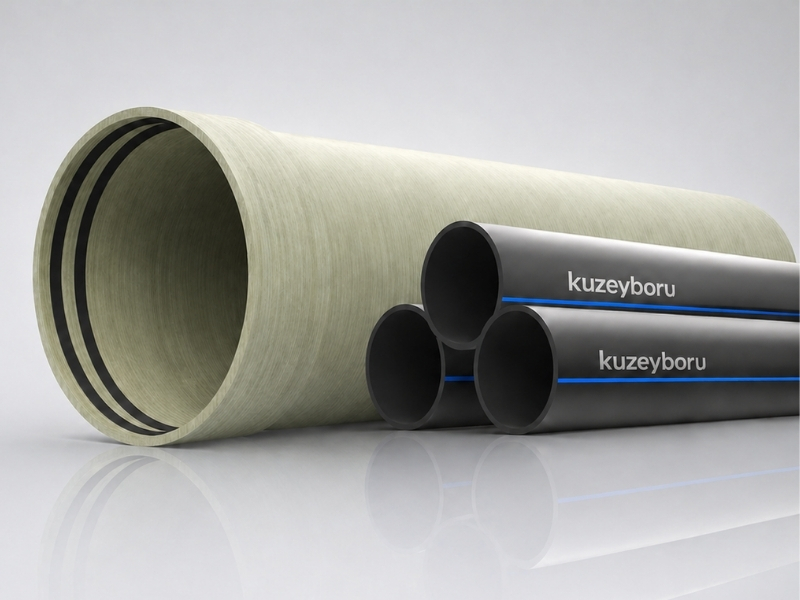
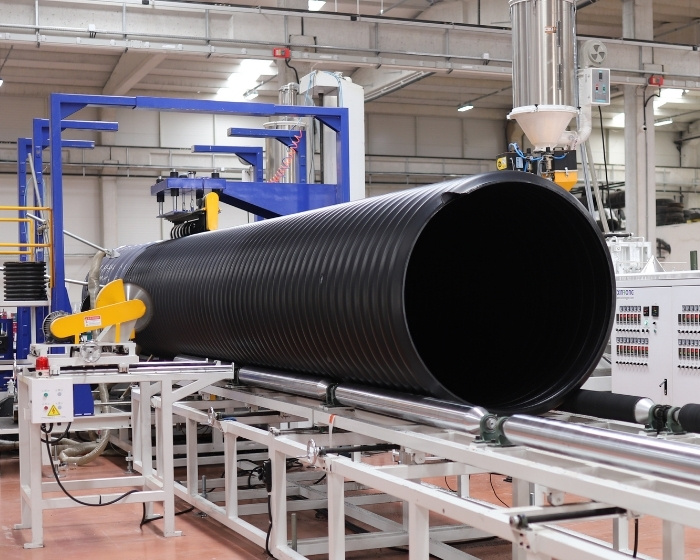
- GRP (Glass Reinforced Plastic): It is a thermoset composite material. While polyester or vinylester resins form the matrix phase, continuous fiberglass windings, chopped fiberglass strands, and silica sand are added to the system to provide mechanical strength. Once the polymerization process (curing) is complete, the material gains a cross-linked and irreversible solid morphology. This provides GRP with an exceptionally high specific strength (strength-to-density ratio) and rigidity.
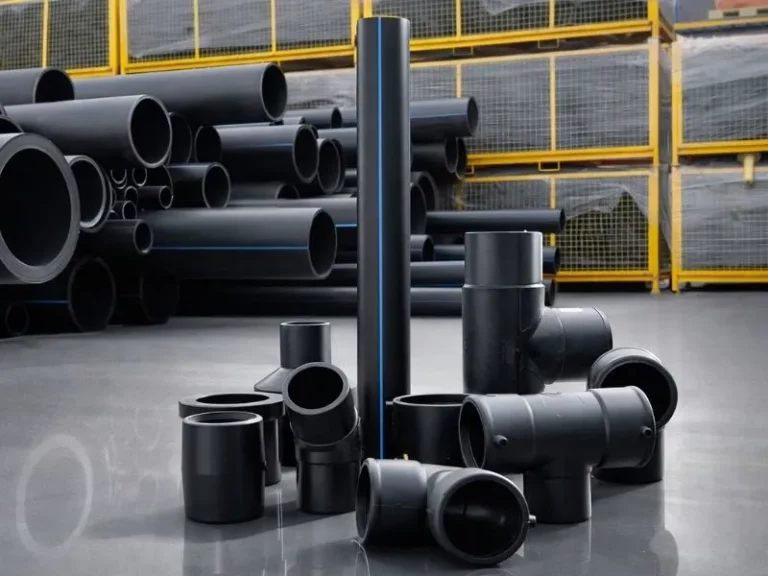
- HDPE (High-Density Polyethylene): It is a thermoplastic with a semi-crystalline structure. It is formed by the combining of long ethylene chains ([-CH2-CH2-] n) consisting only of carbon and hydrogen atoms. There is no inorganic filler or reinforcement in its macromolecular structure. This allows the material to have a flexible, ductile, and impact-resistant nature.
Flexibility Performances Against Ground Movements
In addition to internal hydrostatic pressure, underground pipelines are also exposed to differential ground settlements, seismic fluctuations, and traffic loads (H20/HS20).
Thanks to their low modulus of elasticity and viscoelastic structures, HDPE pipes act as excellent dampeners against these geotechnical movements. They can deform without breaking by flexing like a spring in earthquake zones or areas with landslide risks. Having a cold bending radius of up to 20 to 25 times the pipe outer diameter offers the advantage of flawless adaptation to the topography.
In contrast, composite GRP pipes exhibit a more rigid behavior axially despite their high ring stiffness. They accommodate ground settlements or seismic movements through the angular deflection tolerances provided by the elastomeric-gasketed couplings at the joint points, rather than through the pipe body itself. Geotechnical bedding and backfilling engineering in GRP lines require much stricter compaction compared to HDPE to prevent point loads.
Hydraulic Pressure and Diameter Options (300-4000 mm vs 20-1600 mm)
The flow rate (Q) requirement of the project and the operating pressure (PN) of the line are the most decisive quantitative parameters in material selection.
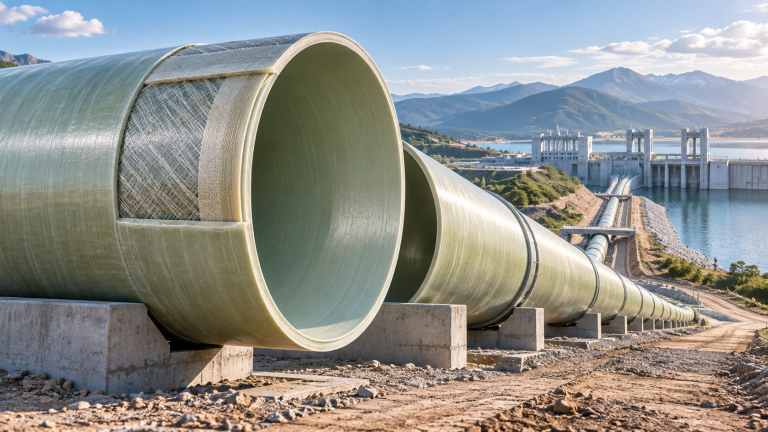
- Diameter Scale: HDPE systems are generally preferred in network distribution lines, service connections, and medium-to-large transmission lines (from DN 20 mm to DN 1600 mm). On the other hand, GRP pipes offer an unmatched production scale in thermal power plant cooling lines, large dam penstocks, and main transmission lines where massive mass flows are required (from DN 300 mm up to DN 4000 mm).
- Pressure Class: While HDPE pipes can reach up to PN 25 bar pressure classes via standard extrusion, much higher operating pressures (PN 32 bar and above) can be achieved in GRP pipes by modifying the fiberglass winding angles and density.
Life Cycle and Labor Cost Analyses
The economic feasibility of pipelines is calculated by considering the material cost (CAPEX) along with the operation and installation (OPEX) costs. The biggest advantage of GRP pipes is that they can be laid extremely fast and independently of weather conditions at the construction site, thanks to their socket and spigot joint structures. Especially in large diameters, the fact that no welding process is required significantly reduces labor time.
In HDPE pipes, butt fusion or electrofusion, which is the primary jointing method, makes the pipe monolithic at the molecular level. The absence of gaskets in the joints reduces the risk of leakage and maintenance costs to zero. However, as the diameter increases (especially above DN 1000 mm), the setup of HDPE welding machines, heating/cooling times, and the required energy consumption demand a more intensive site effort compared to GRP installation.
Project-Specific Engineering Services and After-Sales Services (ASS)
Massive infrastructure projects necessitate pipe supply together with complex engineering calculations. In a proper project; water hammer surge analyses, in-trench static load (Marston Theory) calculations, and concrete thrust block designs to dampen the axial thrust forces occurring at bends must be verified by the supplier company’s expert engineering staff. Site supervision, welder training, and witnessing hydrostatic field tests provided within the scope of After-Sales Services (ASS) constitute the legal and technical assurance of the project.
Eco-Friendly Technologies Reducing Carbon Footprint
The modern infrastructure vision dictates minimizing the carbon load left to nature while preventing water losses and leakages. Kuzey Boru produces polymer technologies that have a much lower Embodied Energy compared to high energy-intensive steel and concrete systems, based on Life Cycle Assessment (LCA) metrics in its production processes.
Kuzey Boru’s HDPE systems integrate into the circular economy with their 100% recyclable structure even after completing their service life. While energy efficiency is maximized on our production lines in compliance with ISO 14001 standards, Scope 1 and Scope 2 emissions are significantly reduced through telescopic loading optimizations (nesting) in global logistics operations.