GRP Pipes and Fittings: What Are the Long-Lasting and Durable Solutions for Challenging Conditions?
The service life of a pipeline is often determined by how much the field conditions demand beyond the capabilities of the material itself. The chemical composition of the soil, groundwater levels, cover loads, traffic impacts, the temperature and chemical characteristics of the conveyed fluid, pressure class, and the potential for hydraulic shock are all combined into a single design equation. Within this equation, material selection is the most expensive factor to correct after installation. For this reason, GRP (Glass Reinforced Polyester) pipes and fittings emerge as an alternative when engineering requirements exceed the limitations of conventional materials.
Challenging Infrastructure Conditions and Material Performance
The conditions that truly place stress on a pipeline in the field are rarely caused by a single factor; rather, they result from the accumulation of multiple simultaneous effects. A metallic pipeline buried in sulfate-rich soil is not only exposed to external corrosion, but also experiences reduced efficiency in its cathodic protection system, leading to a measurable decrease in wall thickness over time. When fluctuating groundwater levels, freeze-thaw cycles, and traffic-induced dynamic loads are added to the equation, the service life of conventional materials often falls significantly below the intended design target.
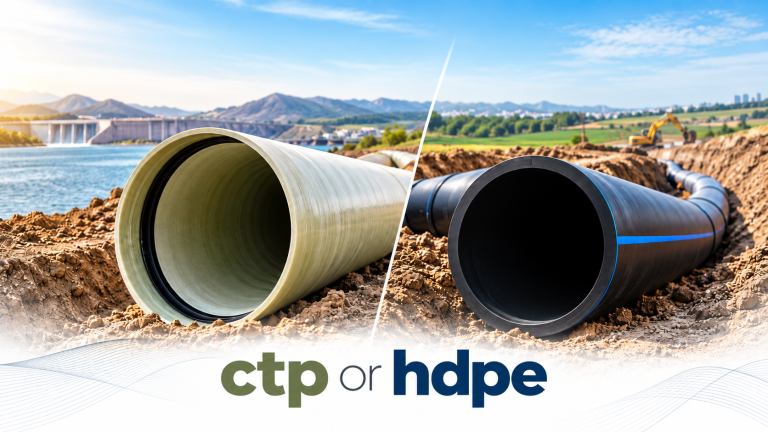
GRP’s response to these challenges is rooted in material science. A thermoset resin matrix binds continuous glass fiber reinforcements together, creating a composite structure that, unlike metals, is not susceptible to electrochemical corrosion. More importantly, this performance characteristic does not significantly deteriorate over the years. In cast iron or reinforced concrete pipelines, internal buildup gradually develops over time, increasing friction losses and consequently raising pumping energy consumption. In GRP pipeline systems, this tendency remains highly limited.
Mechanical Profile and Design Flexibility of GRP Pipes
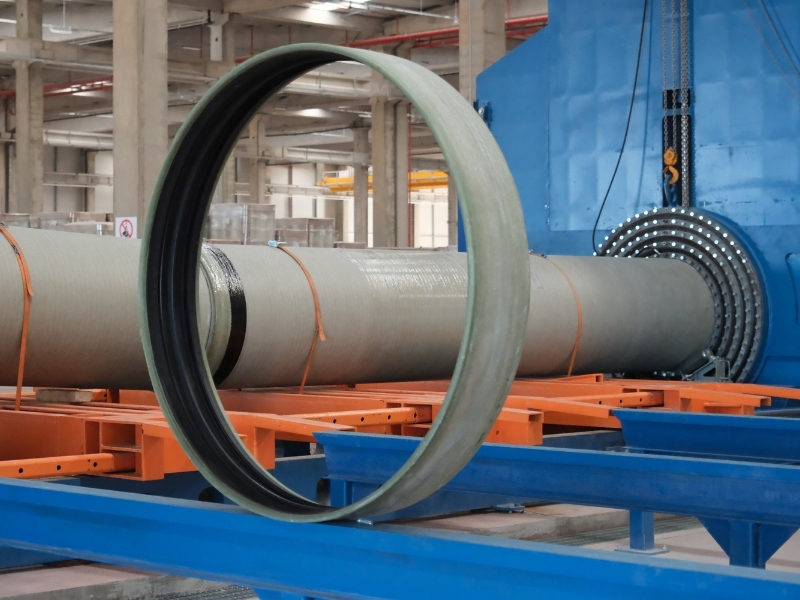
To understand the mechanical behavior of GRP pipes, they should not be considered isotropic materials. Strength values in the axial and circumferential directions are determined by the winding angle and fiber orientation. Manufacturers tailor the laminate design according to the combination of internal pressure and soil loads, making it possible to produce multiple pressure-stiffness combinations for the same pipe diameter. GRP pipes offer a wide range of diameter options suitable for different infrastructure projects. Pipe diameters are selected according to the application requirements and the characteristics of the fluid being conveyed. Kuzeyboru manufactures GRP pipes in various diameters ranging from DN300 mm to DN4000 mm. Glass fiber reinforced pipes are primarily classified according to nominal diameter (DN), pressure class (PN), and stiffness values.
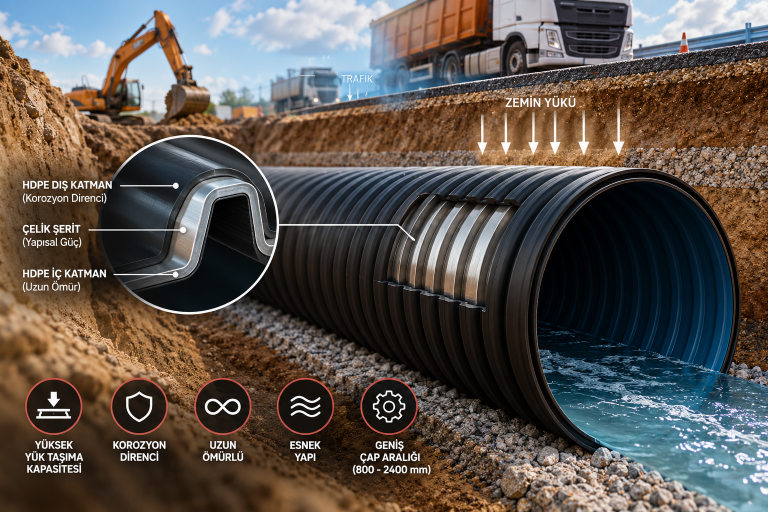
Ring stiffness is of particular importance in buried pipeline systems. In buried flexible pipes, a significant portion of the load-bearing capacity is provided by the surrounding backfill; the pipe and the soil together function as a single system. This is one of the most frequently discussed parameters of GRP in the field, because long-term performance depends not only on the strength of the material itself but also on the quality of installation.
In addition, GRP pipes are significantly lighter than cast iron or reinforced concrete alternatives of the same diameter. This directly affects lifting equipment capacity, maneuvering space around the trench, and daily installation productivity. Particularly on construction sites with limited accessibility, this reduced weight significantly decreases logistical challenges and handling requirements.
Fittings: Ensuring Structural Continuity Along the Pipeline
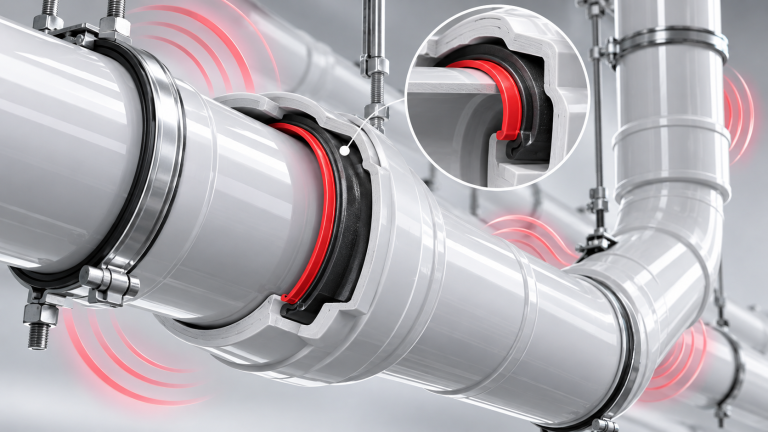
The true engineering test of a pipeline is often not found along straight pipe sections, but rather at the fittings where geometric transitions occur. GRP elbows, T and Y branches, reducers, couplings, flanged connections, and blind caps are designed to maintain the structural continuity of the pipeline at these critical points. The key requirement is that the pressure class and stiffness of the fitting must be at least equal to those of the main pipe. From an engineering perspective, every elbow is subjected to additional axial forces due to changes in flow direction. Particularly in buried pipelines, these forces must be resisted through reinforced concrete thrust blocks or restrained joint systems. In projects where such details are overlooked during the design stage, the first failure almost always occurs at a fitting location.
When standard catalog components cannot meet project requirements, custom-manufactured fittings become essential. Asymmetrical branch angles, double-reduction transitions, or specialized connection details for valve chambers can all be produced using project-specific laminate calculations. This flexibility enables GRP systems to be adapted to the hydraulic and geometric constraints commonly encountered in the field.
Production Capacity, Quality Control, and Standards
Kuzeyboru’s annual GRP production capacity exceeding 223,000 tons represents a significant engineering advantage in ensuring supply continuity for large-scale infrastructure projects. In transmission line projects that progress continuously over long distances, the alignment between the daily installation rate on-site and the factory’s daily production capacity is a critical factor. High production capacity increases batch sizes while reducing variations between production runs, meaning that the mechanical properties of samples taken at the beginning and end of a production cycle remain highly consistent. Manufacturing methods such as continuous filament winding and centrifugal casting support this consistency; however, each method has a distinct laminate architecture and therefore different mechanical characteristics. The appropriate production method is selected according to project specifications.
The manufacturing process is controlled through resin-to-glass ratio monitoring, winding angle measurements, curing profile verification, axial and hoop strength testing, hydrostatic pressure tests, and long-term hydrostatic design basis evaluations. When standards such as ISO 23856 and AWWA C950 are used as references throughout both production and inspection stages, a 50-year design life becomes more than a marketing statement—it becomes a measurable engineering prediction supported by extrapolated regression analyses. For engineers responsible for project execution, this documented performance serves as a reliable reference for decades after the pipeline has been commissioned.
In conclusion, when properly designed and manufactured, GRP pipes and fittings deliver measurable performance that surpasses conventional materials under demanding infrastructure conditions where corrosion, pressure, external loads, and temperature effects act simultaneously. Combined with Kuzeyboru’s high production capacity and standards-based manufacturing discipline, they provide a quiet, reliable, and long-lasting solution in the true test that begins once the pipeline is buried underground.